
Let me tell you on a beautiful historical city of France. The area is well known to me ,but always by passed this town until then went in on my road warrior trails,, Glad to find me pictures of the abbey in my cd rom vault to share in my blog for and me, I am talking about the city of Conques. Therefore, let me tell you on this is Conques and its abbey !!! Hope you enjoy the post as I.
The town of Conques is a former town located in the Aveyron department 12 ,in the former Midi-Pyrénées ,now in the Occitanie region of my belle France, It became the new town of Conques-en-Rouergue. The town is 43 km from Figeac, 113 km from Cahors, 134 km from Gaillac, 192 km from Toulouse, 620 km from Versailles, and 699 km from my current home, We came here on our way north from Toulouse on my road warrior trails, taking the A68 autoroute dir Albi, go around the town on the N88 road dir Rodez around this town took the D901 road dir Marcillac-Vallon continue bearing right into the D42 , a very curvy road right into the parvis of the abbey.
Since the 20C, Conques has been declared a major stopover on the Way of St. James (Via Podiensis) because it is mentioned in the last book of the Codex Calixtinus, virtually unknown until its Latin edition in 1882. It is also a village listed by the association “Les plus beaux villages de France” or the most beautiful villages of France. The supposed link with the pilgrimage to Compostela earned Conques the classification of the abbey church and the bridge over the Dourdou as UNESCO World Heritage Sites in 1998.
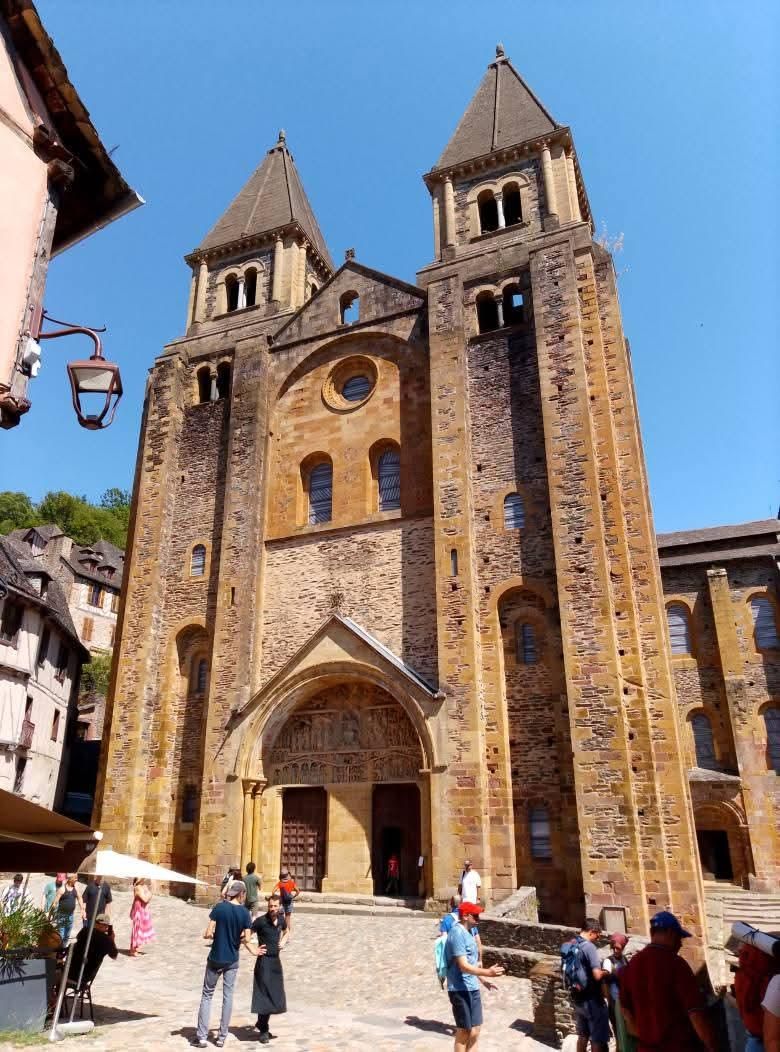
The Abbey Church of Sainte-Foy is considered a masterpiece of Romanesque art in southern France, remains especially famous for its tympanum and its treasure, which includes unique pieces of art from the Carolingian period, including the reliquary statue of Sainte Foy. The porch is flanked by two towers with powerful buttresses. These massive towers were raised and topped with stone pyramids in 1881. They have two twin openings in their upper part, surmounted by a quadrangular roof. The western portal of the Abbey Church of Sainte-Foy opens onto two doors separated by a large trumeau. A vast semicircular tympanum surmounts them, sheltered under a projecting pediment. Higher up, beneath a semicircular relieving arch, two windows of the same shape are surmounted by an oculus. Six polychrome stone marquetry rosettes flank these windows. The façade is crowned by a gable with gently sloping slopes. The tympanum of the Last Judgment is considered one of the fundamental works of Romanesque sculpture for its artistic qualities, its originality and its dimensions,
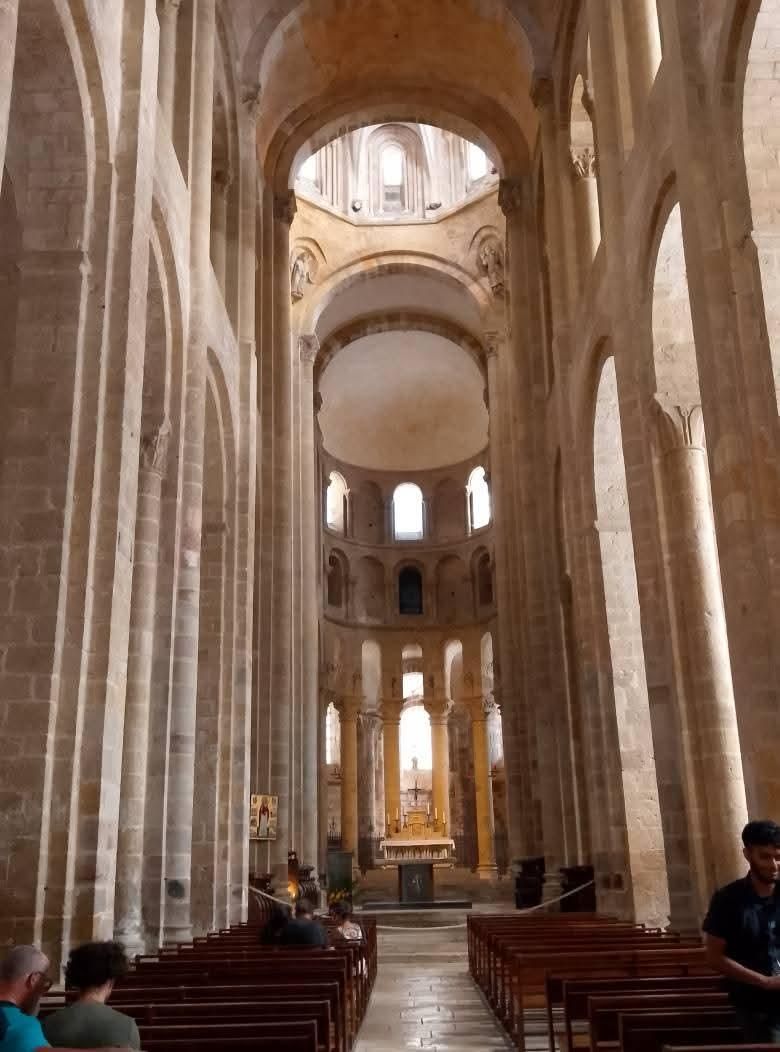
The church is built on a Latin cross plan with radiating chapels with three on the chevet, and Benedictine four chapels aligned on the transept. The interior of the abbey church is very sober, with the choir, the painted vault, and the galleries painted a light, almost white color. The choir is surrounded by an ambulatory allowing the faithful to parade around the relics of Foy d’Agen.(Sainte Foy), It is adorned with wrought iron grilles dating from the 12C.
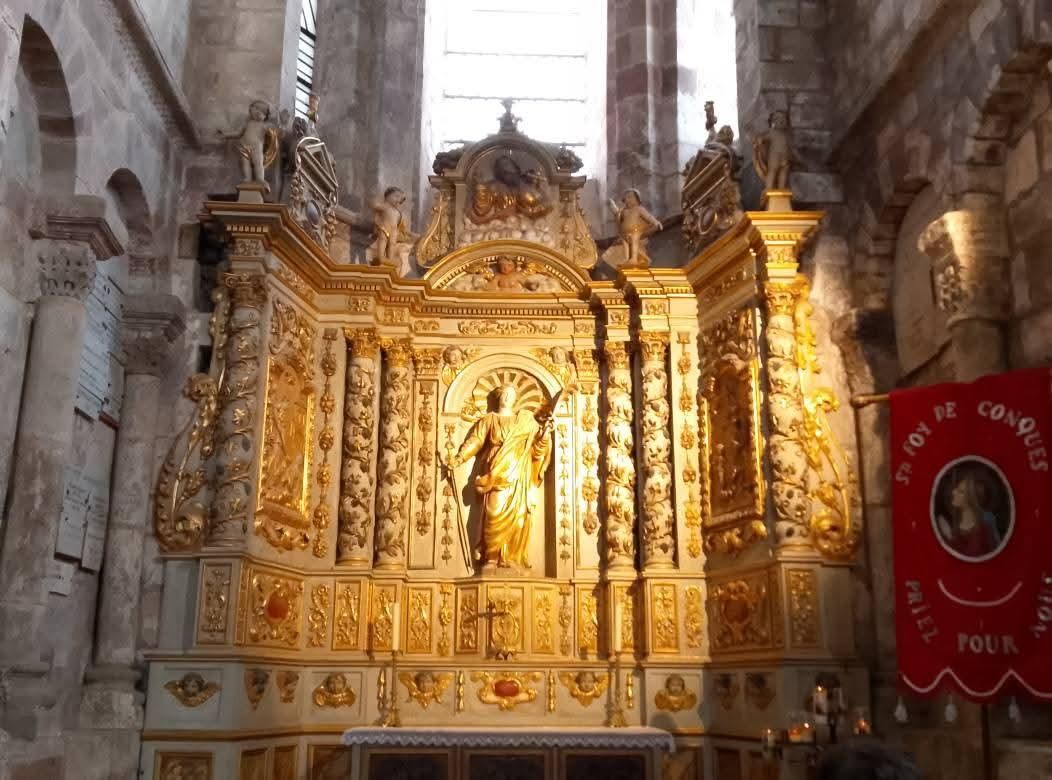
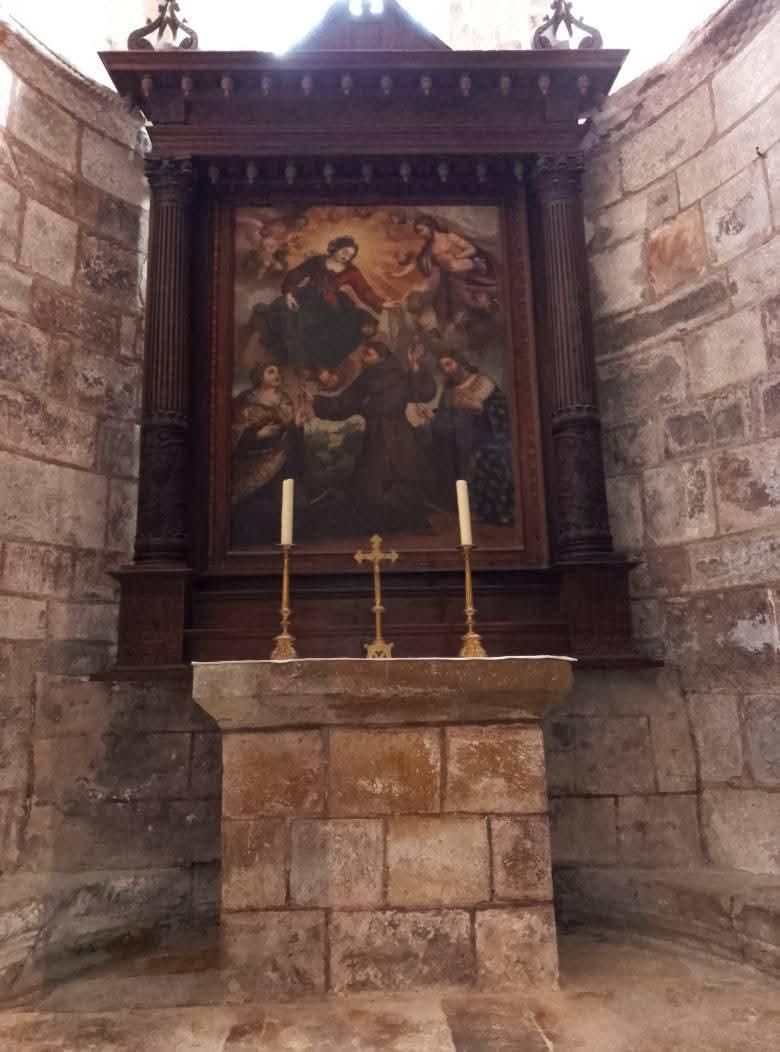
The restoration of a painting showing the Virgin giving the cord to Francis of Assisi, who himself gives it, on the left, to Elizabeth of Hungary, and on the right, to Louis IX, revealed the existence of revolutionary stigmata: the crown, the scepter, and the fleurs-de-lis on the robe have been scratched.
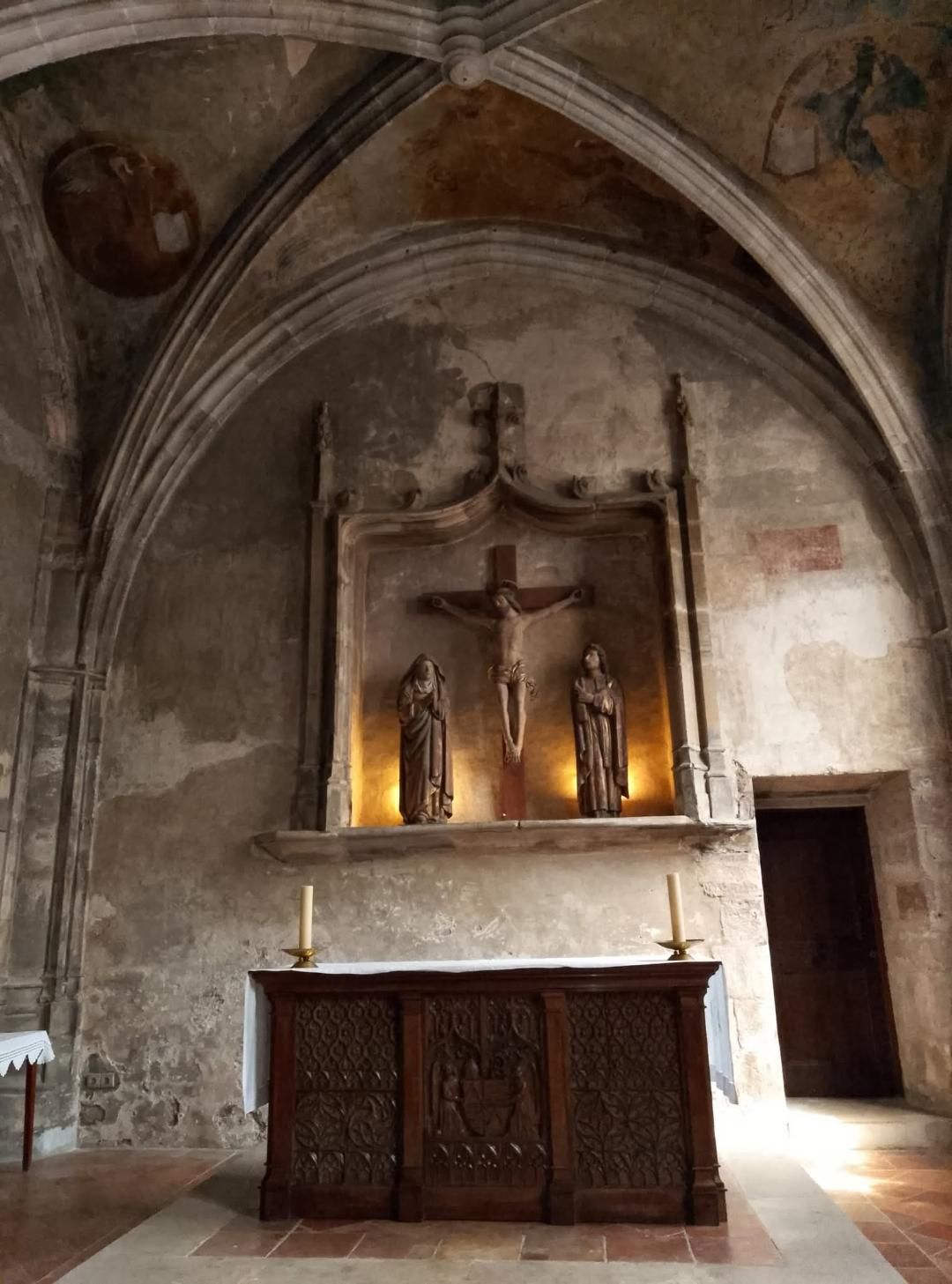
The sacristy is decorated with 15C frescoes depicting the martyrdom of the saint. At the end of the left transept, you can admire a high relief depicting the Annunciation. To the south of the abbey church, some vestiges of the cloister remain, including six twin bays of the western gallery. It served for a long time as a stone reserve for building the village houses. Displayed in the former monks’ refectory, the religious goldwork section is the most complete collection of French religious goldwork, spanning from the 9C to the 16C, with in particular reliquaries by local artists dating from the 11C. The centerpiece of the treasure is the reliquary statue of Sainte Foy.
Some other things to see , me think, are the Château d’Humières a 16C castle with sculpted consoles and a high staircase tower. There is a curious mullioned window that follows the curve of the corner of the wall. The Saint-Roch Chapel was built in the 15C on the site of the original Conques castle, whose presence is attested from the 11C. It is accessed via a small footpath from Rue Charlemagne. On the steep Rue Charlemagne, the Porte du Barry is a powerful Romanesque arcade of red sandstone. Still called Rue de la Caneyra in 1907, this route was used in the Middle Ages by pilgrims leaving Conques for Quercy and Aubin. The street still connects the abbey square to the “Roman” bridge of Conques. Old bridge called “Roman”;the Way of St. James crosses it thanks to this bridge, built in 1410, A contemporary, semi-buried building, the European Center for Medieval Art and Civilization was inaugurated in 1992 , a place for conferences and research seminars devoted to the Middle Ages, the center has gradually diversified its actions by leading a multidisciplinary cultural project: music, cinema, contemporary art, artistic education, crafts, etc.
A bit of condense history (mostly of the abbey) I like tell us the origins of Conques are recounted in texts dating, for the oldest, from the 9C. These are the charters of 801, 813, 817, granting donations and favors, and especially a diploma of April 8, 819 signed by Louis the Pious. The hermit Dadon settled around 790 in a deserted place and founded a hermitage there which evolved into a monastery in 800, The monastic community built a church dedicated to Saint-Sauveur ( known as Conques I). Emperor Louis the Pious, by the capitulary of 817, imposed the Benedictine rule on all monasteries and placed that of Conques under his protection in 819, giving it around ten churches. The miracles obtained by invoking the relics quickly intensified the pilgrimage to Conques, so much so that Abbot Stephen I had a larger basilica with three naves built in the middle of the 10C ( known as Conques II). The cult of the saint even spread throughout Europe where priories were founded in her name. The influx of pilgrims encouraged Abbot Odolric to build the current Romanesque abbey church ( known as Conques III). The abbey was then a destination for pilgrimages. In the 12C ; it became a major stopover on the Via Podiensis, the pilgrimage route from Puy-en-Velay to Santiago de Compostela. The Benedictine abbey was begun between 1041 and 1052. Its chevet was certainly completed before the death of Odolric in 1065. This abbey was built on the site of the old hermitage of Dadon, dating from the end of the 8C. A Benedictine abbey until 1537, it was then placed under the responsibility of secular canons. Since 1873, the abbey church has been entrusted to the brothers of the Premonstratensian order. It is currently a priory of the Abbey of Saint-Martin-de-Mondaye. It has also been listed as a UNESCO World Heritage Site as part of the Routes of Santiago de Compostela in France since 1998. Because of its vocation to welcome pilgrims and to worship the relics of Sainte Foy, it is called a pilgrimage church and even constitutes the prototype of other great pilgrimage churches. After the period of the great abbots who built Sainte-Foy, the monastic community began to decline at the beginning of the 13C. The saint fell out of fashion, and the abbey, hampered by its marginal location, lost its influence. In 1537, the abbey experienced a serious crisis with the Bishop of Rodez ordering its secularization. From then on, and until the French revolution, secular canons were in charge of the abbey church. During the Wars of Religion, the abbey was looted and damaged by fire (1568). The abbey experienced a resurgence in the 17C before suffering serious damage during the French revolution: the canons were dispersed, the abbey was left to an impoverished town, and the abandoned cloister was quarried by the villagers. Between 1836 and 1849, the Sainte-Foy Abbey, carried out the most urgent repairs. The abbey regained its status as an active religious and cultural center in 1873 when the Bishop of Rodez, Joseph Bourret, installed the Premonstratensian Fathers of Saint-Michel de Frigolet there.
The official Abbaye Sainte Foy of Conques : https://abbaye-conques.org/
The Conques tourist office on the abbey : https://www.tourisme-conques.fr/en/en-conques/st-foy-abbey-church
The Aveyron dept 12 tourist office on the abbey : https://www.tourisme-aveyron.com/fr/diffusio/patrimoine-culturel-visites/abbatiale-sainte-foy-de-conques-conques-en-rouergue_TFO335026016433
The official Chanoines réguliers de Prémontré on the abbey : https://abbaye-conques.org/labbaye-sainte-foy-de-conques
The French agency on the ways of Santiago on the abbey : https://www.chemins-compostelle.com/composante-du-bien/abbatiale-sainte-foy/
The official most beautiful villages of France on Conques : https://www.les-plus-beaux-villages-de-france.org/fr/nos-villages/conques/
This is beyond words really, again, a must to see come here , the Sainte Foy Abbey of Conques is a must, and really needs more time, we will be back, eventually, One more wonderful monument of my belle France, Again, hope you enjoy this post on this is Conques and its abbey !!! as I.
And remember, happy travels, good health, and many cheers to all !!!

 Paris1972-Versailles2003