
The wonderful town ,we have come here often, more when living in Versailles; but still nice memories of Houlgate. I found me a picture in my cd rom vault that prompt me to do this post for you and me , Therefore, let me tell you on this is Houlgate !!! Hope you enjoy the post as I.
The town of Houlgate is located in the Calvados department 14 ,in the Normandie region of my belle France, Last count it had a population of 1,657 inhabitants,. A seaside resort on the Côte Fleurie, created on the moors of Beuzeval, located in the Pays d’Auge, halfway between Cabourg to the west and Villers-sur-Mer to the east, The town is renowned for its seaside architecture typical of the Belle Époque. It is located 30 km from Caen, 14 km from Deauville, 22 km from Pont-l’Évêque , 201 km from Versailles, and 341 km from my current town, We came here first from Versailles connecting with the A13 autoroute de Normandie dir Rouen to exit 29 connecting with the D675 road, and by Annebault connect with the D45 road, and past village of Heuland connect with the D27 road or route de Lisieux , and by the Haras des Cépierres bear right into the D24 road to Houlgate follow sigsn to centre ville or plage du Temple, The town is served by two exits off the A13 autoroute, passing through Auberville or Dives-sur-Mer, or directly by train and the Deauville-Dives-Cabourg line.
There is a large sandy beach in Houlgate divided into two sectors. That of the city centre offers many activities in the summer season with an ideal location opposite the casino and the bathhouse. Children are not forgotten with a beach club. Plage du Temple beach is the most central beach of the resort. Located along the Rue des Bains or D513 road, there are many activities in the summer (children’s club, beach volleyball, water sports, …). Nearby, there are several restaurants and bars as well as the bathing establishment of Houlgate. A cinema and a casino are also available. Note that this beach is supervised in the summer season and there is an area set aside for windsurfers. Access to this beach is via the Rue des Bains at the lifeguard station and Houlgate casino. Several car parks are available.
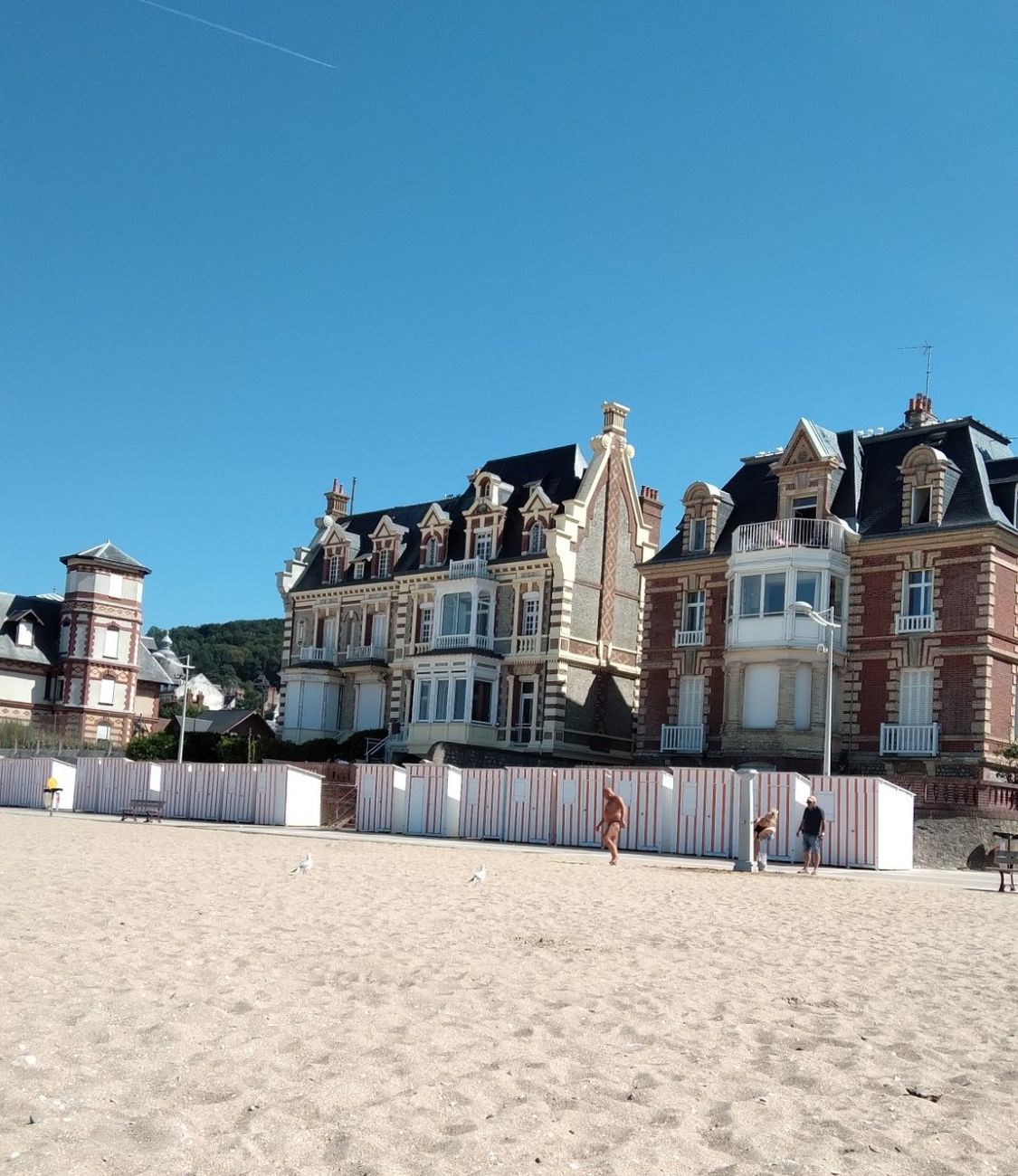
Other things to see with more time are the Belle Époque villas and the Roland Garros Promenade with many structures to catch the eye. Beyond the magnificent Belle Époque villas, two remarkable buildings deserve attention. The first, recognizable by its rotunda which dates from 1904, is none other than the former Grand Hôtel. The second comes to us from the distant past, when the earth was populated by ferocious reptiles several meters high. These are the Black Cows cliffs, Take a 2 km beach, embraced from west to east by a green setting. Add to that a delicately salty sea air, gentle rays caressing the face, playful laughter carried far away by occasional gusts of wind, and magnificent seaside villas. You are in front of one of the most beautiful beaches in Normandy painted by nature. The Saint-Aubin Church in Beuzeval , Saint-Aubin Church, rue Victor Lecesne, built in the neo-Gothic style, The William Column, a commemorative column originally placed at the top of the Butte de Caumont. It was inaugurated on August 18, 1861, on the very spot from which William the Conqueror gave the signal in 1066 for the departure of the fleet for the conquest of England. The former Grand Hotel, built in several stages, The Beuzeval Manor, located 3 km from the coast and built in the 19C, it was later acquired by the owner of BHV, Henri Viguier. The manor is built on the site of an older medieval castle. Château Foucher-de-Careil, or Château de Caumont: neo-Louis XIII style castle, built in 1863 on the very site of the camp of William the Conqueror’s army in 1066 before the invasion of England.
A bit of history I like tell us that the first lord of Beuzeval to leave a mark on history was Pierre de Sinville. On August 6, 1066, Duke William and his entourage traveled along the shore path to join his troops at Dives-sur-Mer, but the high seas and bad weather prevented him from passing at the “Mauvais Pas”. Going up the “Dix Douets” stream, they found accommodation at the Beuzeval manor. Jean d’Aché , a companion of William who became the conqueror, was given possession of the fief of Beuzeval in recognition of the services rendered during the conquest of England. The d’Aché family became the holders of the fief of Beuzeval for several centuries. Eudes d’Aché, son of Jean, accompanied Robert Curthose, son of William the Conqueror, to the Holy Land in 1096. After five and a half centuries, the fiefs of Beuzeval and Gonneville left the d’Aché family to become the possession of the Le Brun family, lords of Sallenelles. In 1620, King Louis XIII, accompanied by the Prince of Condé, coming from Honfleur by the shore, passed through the “Mauvais Pas” to stop at the coaching inn of the Hostellerie de l’Épée Royale (now the Hostellerie Guillaume-le-Conquérant) in Dives-sur-Mer. The lordship of Beuzeval then passed to the de Secqueville family. The last lord of Beuzeval before the French revolution was Mr. Boistard de Prémagny.
It all began on the left bank of the Drochon between 1845 and 1850; The fashion for sea bathing arrived in Beuzeval. A few tourists from Caen and then from Paris began to come to Beuzeval for their holidays. As the number of tourists increased, a wooden guesthouse was built. In 1863, the landscape painter Paul Huet painted a canvas entitled View of the cliffs of Houlgate, which is now preserved at the Museum of Fine Arts in Bordeaux. The Hôtel Imbert was built in 1877, to which its tower was added in 1907. The seaside village was now called Beuzeval-les-Bains and attracted the Protestant population. In 1859, the Grand Hôtel was built. In 1860, the Notre-Dame de Houlgate chapel was built. The village took the name Houlgate, the name of the hill of the maritime village. In 1898, as the village of Houlgate grew larger than its rival, Beuzeval-les-Bains, the name of the town was changed to Beuzeval-Houlgate. The name changed again in 1905 to simply Houlgate. Houlgate was a place of study and creation for painters of the Impressionist movement. This “Cénacle,” as they called themselves, was held at the Moulin Denise. It consisted of Paul Huet, Constant Troyon, and Léon Riesener. Edgar Degas, Berthe Morisot, and Gustave Caillebotte came as guests. After the defeat in 1815 at the Battle of Waterloo and the fall of the First Empire, the region was occupied by Prussian troops.
It was in the middle of the summer season that war was declared on August 2, 1914. The requisition of the Grand Hotel, the casino, the evangelical house and a few other villas emptied Houlgate of its clientele. All these requisitioned buildings were transformed into a hospital center for the 3rd Army Corps under the name of temporary hospitals 23 and 24. The railway line allowed the arrival of medical trains directly at Houlgate station. To boost the morale of the beleaguered, the casino organized shows that featured performances by Mistinguett and Yvonne Printemps. The seaside resort business resumed in 1917, but the heart was no longer in it, and Houlgate would never regain its Belle Époque luxury, its wealthy bourgeois clientele being ruined by the war. In 1942, the plateau was occupied by the nazis, with the installation of an artillery post with 155 mm cannons of French origin placed in concrete shelters connected to a large underground complex with food reserves and shelters, as well as a Würzburg radar. From April 26, 1944, until the Liberation, the site was heavily bombed and destroyed, leading to the disappearance of all the conifers planted at the beginning of the 19C. Since then, vegetation has grown back: plane trees, horse chestnuts, and ash trees. Montgomery’s strategy left the Côte Fleurie, the Pays d’Auge, and Houlgate 10 km from the Battle of Normandy. The town was not liberated until two months after the Normandy landings, and it wasn’t until August 17, 1944, that the liberation of the Côte Fleurie was launched with Operation Paddle. The Piron Brigade, a Belgian-Luxembourg unit, closely followed the coast. On August 19, it reached Cabourg, the engineers stabilized the bridge over the Dives, and on the 21st, it liberated Houlgate. On October 10, 1944, the first group of French soldiers from the 3rd Engineer Battalion arrived in Houlgate. Its soldiers settled in the town to clear mines from the coast. Fifteen of them lost their lives there, despite the fact that it was nazis prisoners who cleared the most dangerous areas, claiming that they were the only ones who knew where the mines were located. A commemorative plaque near the beach commemorates the sacrifice of the French mine clearers.
The town of Houlgate on its heritage : https://www.ville-houlgate.fr/ma-ville/cultes/
The Houlgate tourist office on its heritage : https://www.normandie-cabourg-paysdauge-tourisme.fr/en/to-do/
My fav site plages tv on the plage du Temple: https://en.plages.tv/detail/temple-beach-houlgate-14510
The local Normandie-Cabourg-Pays de l’Auge tourist office on Houlgate : https://www.normandie-cabourg-paysdauge-tourisme.fr/en/a-voir/houlgate/
The Normandy region tourist office on the beaches : https://en.normandie-tourisme.fr/the-most-beautiful-beaches/
There you go folks, a wonderful town by the sea in gorgeous Normandie, Houlgate is worth more time which will do, eventually Again,hope you enjoy this post on this is Houlgate !!! as I,
And remember, happy travels , good Health, and many cheers to all !!!

 Paris1972-Versailles2003