
I could not believe found me older pictures in my cd rom vault of a wonderful City that needs to be seen more ,even by me. Of course, it is now in my blog for the memories of always for you and me, We have criss cross this beautiful area of my belle France for many years, and Caussade is worth the detour indeed. Therefore, here is my rendition of this is Caussade !!! Hope you enjoy the post as I.
The town of Caussade is located in the department 82 of Tarn-et-Garonne in the Occitanie region of my belle France. The town is rural with 6,858 inhabitants in 2022 (INE). It is in the Caussade urban area and is part of the Montauban county area. Caussade is a former town in the Quercy Blanc or Bas-Quercy, located in the hills of Quercy, is nicknamed “the city of the hat”, due to the great hat-making tradition. In particular, the straw hat, the famous boater hat, made here which experienced a commercial peak at the end of the 19C beginning of the 20C. The town is 26 km from Montauban, 38 km from Cahors, 78 km from Toulouse, 112 km from Agen, 600 km from Versailles, and 726 km from my current home, The town of Caussade has a train station on its territory, gare de Caussade, served daily by Intercités connecting it to Toulouse-Matabiau or Paris-Austerlitz stations, You can, also, come here by car on the A62 Bordeaux -Toulouse highway, the local D820 road and D117 road as well as from Paris on the A20 highway (which is the old N20 taken since then) We came from our current home on the N165 to Nantes, then the A83 to past Niort get on the A10 dir Bordeaux go around Bordeaux on the rocade N230 cross the Garonne river and continue on the A630 rocade to connect with the A62 dir Toulouse at exit/sortie 10 get on the A20 dir Montauban to exit/sortie 59 go into rond point and get on the D117 road to rond point of Bd Leoncé Granité bear right into place Notre Dame parking by the Church Notre Dame of Caussade.
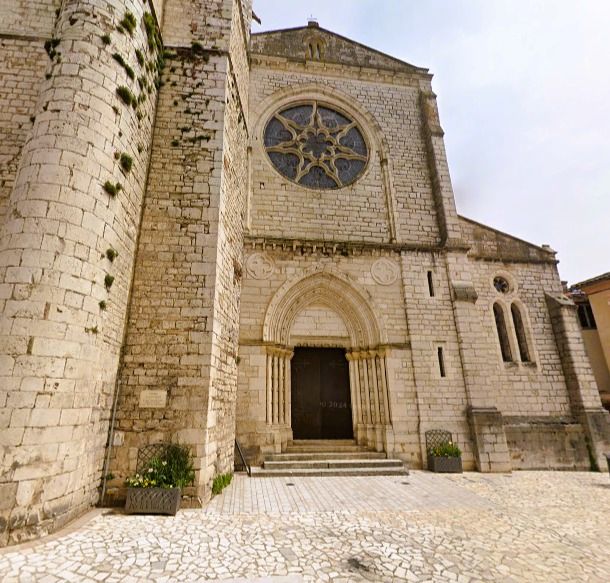
In the 12C, and probably since the 10C, a first Church Notre Dame was a priory of the Abbey of Moissac. This first church was destroyed during the Hundred Years’ War (1337-1454), and rebuilt and enlarged starting in the 15C. The top of the brick bell tower dates from this period. It is built on a massive, older white stone base, The church was again partially destroyed during the Wars of Religion. The nave was rebuilt, larger, as was the rest of the church, rebuilt in a neo-Gothic style in the 19C. The Church Notre Dame de l’Assomption with its single nave and canted chevet, is characteristic of the Southern Gothic style. The polygonal bell tower, in the Toulouse style, also recalls the entry into Aquitaine of molasse and clay bricks. Most of the stained glass were designed in 1881. A local association helps in restored the church such as the chapels’ stained-glass windows , namely 18 rooms, including the two sacristies and the baptismal font.
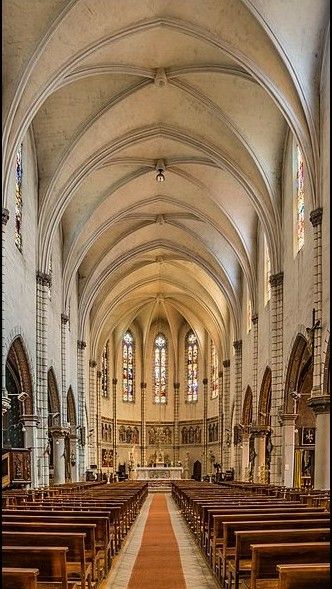
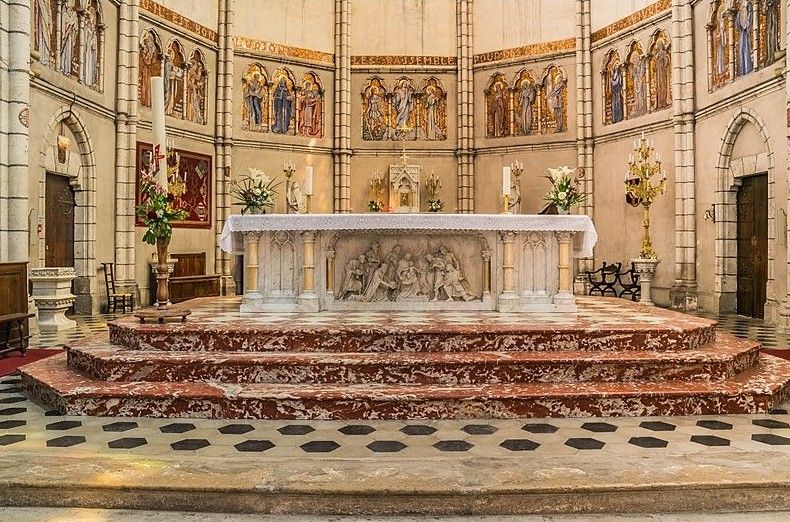
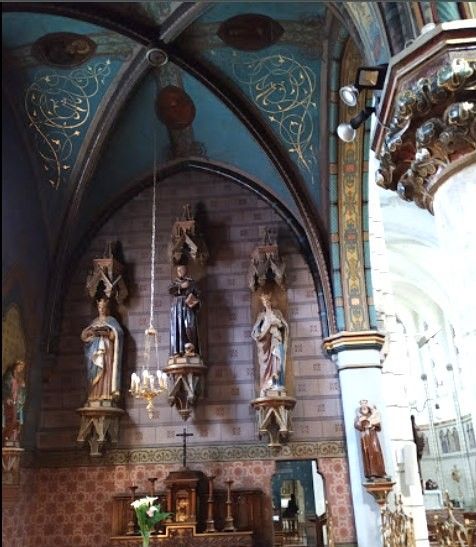
The chapels’ stained-glass windows are dedicated to the saint who bears their name. They were donated by families whose names appear at the bottom of each window. Texts at the entrance to each chapel explain its history. The stained-glass windows in the upper nave are dedicated on the right to the Saints of the Old Testament and on the left to the shrines where the Virgin appeared. In the choir, they are dedicated to the Virgin Mary. Those in the rose window, completely restored a few years ago by the town, represent the seven sacraments. The stained-glass window enclosing the rose window, depicts the seven sacraments. In the center, a multi-lobed circle is decorated with the Dove of the Holy Spirit carrying the ampulla of Holy Chrism.
Other things to see here are the tour Arles tower ; the maison Tavern house , The Protestant temple located at 23 rue Clément-Marot, The parish is a member of the United Protestant Church of France. During the Renaissance, from 1509, Caussade belonged to the domain of the humanist woman of letters Marguerite de Valois-Angoulême, elder sister of King Francis I, to her Calvinist daughter Jeanne d’Albret, then to King Henry IV, head of the Huguenot during the Wars of Religion. In 1562, Caussade was a Protestant stronghold, in the orbit of Montauban. During the Huguenot Rebellions, the city was besieged by the armies of Cardinal Richelieu, and Louis XIII ordered the fortifications to be razed.
A bit of history I like tell us that the first mention of a viscount as lord of Caussade is indirect because it appears in a donation of an alleu of Monteils to the cathedral of Cahors in 968 by a certain Amalvin and his wife Avane subject to the rights of the viscount. The first lord of Caussade known by a charter of 1060 is Raymond. In a deed of gift of 1101, another Raymond is lord of Caussade and calls himself viscount of Quercy. The county of Quercy was in the dependence of the counts of Toulouse since 919 with Raymond II of Toulouse, undivided with his brother Ermengaud of Rouergue, Upon the death of Alphonse of Poitiers and his wife, Jeanne of Toulouse, in 1271, the King of France, Philip III the Bold, retained the territories that the Treaty of Paris of 1259 had provided for returning to the King of England: Quercy and Agenais. By the Treaty of Amiens of 1279, the King of France accepted the conditions imposed by the Treaty of Paris. He returned Agenais and renounced Saintonge, but Quercy was subject to an investigation. Finally, Quercy remained with the King of France, Philip the Fair, in 1286 in exchange for an annuity. The King of France occupied the Duchy of Guyenne. Helie VII, Count of Périgord from 1295 to 1311, was also Viscount of Lomagne and Auvillars. He had received these viscounties from his first wife, Philippa of Lomagne, in 1286. He signed a deed of exchange with Philip the Fair at Saint-Germain-en-Laye in November 1301, by which he ceded these viscounties to the king in exchange for substantial estates in the western part of the County of Périgord. The English negotiators sought the advice of Pope Boniface VIII. The Pope issued an arbitral award on June 30, 1298. On June 19, 1299, the French and English negotiators signed the Treaty of Montreuil-sur-Mer, accepting the Pope’s arbitral award. The Duchy of Guyenne was returned to the King of England, who no longer owed liege homage to the King of France. By the Treaty of Brétigny, signed on May 8, 1360, Quercy was ceded to the King of England by the King of France, John II, who had been taken prisoner at the Battle of Poitiers. The barony passed into the hands of the Counts of Armagnac following the marriage of Jeanne de Périgord with John II, Count of Armagnac, on 23 November 1359. The barony of Caussade did not return to the Counts of Périgord because it was still the property of Bernard VII of Armagnac when the Parliament of Paris decided to seize the property of Archambaud VI of Périgord in 1398 and 1399. The barony was then united with the County of Rodez (domain of the Counts of Armagnac since 1313). The Black Prince was named Prince of Aquitaine by his father on July 19, 1362. Several towns in Quercy recognized the sovereignty of the King of France. Caussade, in June 1369, but the town was occupied by the English in 1388. On May 13, 1460, the Parliament of Paris confiscated the property of Jean V d’Armagnac. Jean, Lord of Montauban, Marshal of Brittany and Admiral of France, raised claims to the barony in the name of his grandmother, Béatrix d’Armagnac. But the property was returned to the Count of Armagnac by Louis XI in 1464. Charles of Armagnac obtained the lifting of the seizure of the property of his House by the States held in Tours in 1484, after the death of Louis XI. Following the dismemberment of the County of Rodez in 1486, Caussade became the fortified capital of a barony. In 1509, on the occasion of the marriage of Charles IV of Alençon with Marguerite d’Orléans (alias d’Angoulême), elder sister of François I, the latter transferred to them a large part of the estates of the House of Armagnac. Caussade must have been part of it because the Duke of Alençon introduced new customs to the inhabitants of Caussade in June 1515. The Duke of Alençon died after the Battle of Pavia in 1525. Marguerite d’Angoulême inherited his titles as Count of Armagnac and Rodez, Duke of Alençon. She remarried on January 24, 1527, to Henry II, King of Navarre, Count of Périgord, Foix and Bigorre, Viscount of Limoges and Béarn, at the Château de Saint-Germain-en-Laye. Her daughter, Jeanne d’Albret, received all the property given as a dowry to her mother by her brother, King Francis. She married Antoine de Bourbon, Duke of Vendôme, first prince of the blood. The ownership of these properties was confirmed on May 13, 1554 by King Henry II. They were passed on to his son Henry IV who reunited them with the Crown domain after his accession to the throne of France.
The town of Caussade on its heritage : https://www.mairie-caussade.fr/transitions/patrimoine/
The local Quercy-Caussadais tourist office on Caussade : https://www.tourisme-quercy-caussadais.fr/the-destination/quercy-caussadais-at-a-glance/caussade/?lang=en
The Tarn et Garonne dept 82 tourist office on Caussade : https://www.tourisme-tarnetgaronne.fr/en/offers/caussade-hats-city-caussade-en-2357415/
The Occitanie region tourist office on Caussade : https://www.visit-occitanie.com/en/activities/visits/traditional-villages-and-towns/caussade-hat-experience/
There you go folks, a quant old town that ,again, needs to be seen more, It has a rich history, and wonderful architecture. Glad is included in my blog for the memories of always, Again, hope you enjoy this post on this is Caussade !!! as I.
And remember, happy travels, good health, and many cheers to all !!!

 Paris1972-Versailles2003