
I have made several trips to this town mostly on business but eventually got around to be with the family for a bit, However, found these pictures in my cd rom vault that should be in my blog for you and me, This is nice chic Neuilly-sur-Seine in the Hauts de Seine dept 92 of the Île de France region of my belle France , This was one of my typical runs to/from Paris almost every month, I like to tell you a bit more on the former Château of Neuilly sur Seine !!! Hope you enjoy the post as I.
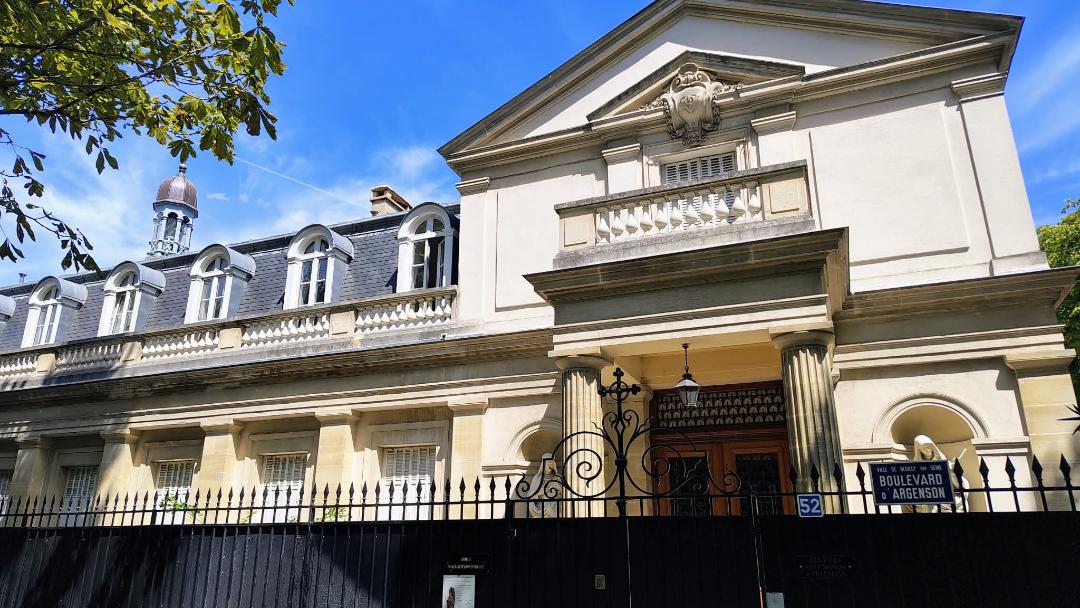
Owned by the Orléans family since 1819, the Château de Neuilly was burned and looted during the 1848 revolution. Confiscated by Napoleon III in 1852 along with the property of the House of Orléans, the estate was divided up into lots starting in 1854. Only the north wing, known as the pavillon of Madame-Adélaïde ( younger sister of Louis-Philippe d’Orléans,king of the French) remains, built in the 19C, This wing was acquired in 1907 by the sisters of Saint Thomas de Villeneuve, and a chapel and a building attached to the municipal hospital relying on the ruins of the castle ; located at 52 Boulevard d’Argenson.
The estate encompassed a vast 170-hectare park called “Parc de Neuilly,” which included the entire part of present-day Neuilly sur Seine between Avenue du Roule and the city of Levallois-Perret (see posts). This complex had been divided into two very unequal parts on which two châteaux had been built: The Château de Villiers, in the village of Villiers-la-Garenne, and the Château de Neuilly, was originally a building probably built in the second quarter of the 17C, which belonged in 1668 to Louis Béchameil de Nointel, Superintendent of Finances to the Duke of Orléans and Maître d’Hôtel to Louis XIV. The Château de Neuilly was acquired in 1702 ,remaining with the same owner until July 11, 1740, when it was sold to the Marshal-Duchess of Biron, born Marie-Antoinette de Bautru de Nogent, wife of Charles Armand de Gontaut-Biron, who, by a will of August 16, 1740, transferred the bare ownership to the Count of Argenson Secretary of State for War under Louis XV, and the usufruct to M. de Villars, The latter having died in 1741, the Count of Argenson received the entire property upon the death of the Duchess of Biron on August 4, 1741. Seduced by the privileged location of the castle overlooking the Seine, he had a new castle built in 1751. It was a construction decorated with an Ionic order and raised on several terraces overlooking the Seine. At the Château de Neuilly, the Count of Argenson received the philosophers Diderot, Voltaire and Rousseau. In 1757, at the request of Madame de Pompadour, his rival, he was disgraced and exiled to his land at Les Ormes. He did not return to Paris until 1764, where he died some time later. He bequeathed the château to his friend Louis XV, who refused it. On July 10, 1766, his heir, the Marquis Marc-René de Voyer d’Argenson, Marquis de Voyer, sold the Neuilly estate and again to the beginning of 1792 to Madame de Montesson , former morganatic wife of the Duke of Orléans, Louis-Philippe “the Fat”. On 8 May 1794), Madame de Montesson sold the estate whose new owners rented it as a second home to Talleyrand. Talleyrand gave magnificent parties there, before the property was sold to Murat on 4 March 1804. Murat, who had also acquired the Château de Villiers, united the two estates by acquiring the land on the Plaine de Villiers and the three main roads that lay between the fences of the two properties. He carried out major works and extensions there between 1804 and 1807, notably adding the left wing to the main château, as well as the dining room and part of the right wing, and extending the façade onto the garden; he enlarged and replanted the park. At the Château de Neuilly, Murat gave sumptuous celebrations, such as on the occasion of the coronation of Napoleon I as King of Italy in 1805. Murat, who became King of Naples in 1808, all his assets were united in the extraordinary domain of the Crown. Princess Pauline Borghèse, the Emperor’s sister, received the property as an endowment on October 28, 1808. In 1814, the estate returned to the Crown. In 1818, the Châteaux of Neuilly and Villiers were acquired by the Duke of Orléans, the future Louis-Philippe I, in exchange for the so-called “Chartres” stables, located on Rue Saint-Thomas-du-Louvre, which belonged to him and had been occupied by the Crown stables since 1801.
Louis-Philippe had the Château de Neuilly transformed with in 1820, the right wing of the château was enlarged to accommodate the apartments of the Duke of Orléans and those of Madame Adélaïde. In 1821, new kitchens were built ,the cellars under the dining room, the chapel, the service quarters, and the joining of the small château to the large château were completed in 1822. The following year, the façade on the main courtyard and the two entrance pavilions were redone. In 1824, it was the turn of the main gate and the buildings that accompanied it, In 1825-1826, the entrance and outbuildings on Avenue Sainte-Foy, the greenhouse, and the covered riding school were renovated. In 1828, the courtyard of the rebates with its outbuildings and the temple of Diana in the park. In 1829, the wing of the apartments of the Duke of Orléans and the Duke of Nemours, the common building and its outbuildings. In 1830-1831, the new stables, the marble temple, the grottoes, the guardhouses, the houses on Avenue Sainte-Foy. The Orléans family was particularly fond of the Château de Neuilly, where they took up their summer quarters. During the 1848 revolution, the château was burned down and pillaged on 25 February 1848. Confiscated by Napoleon III in 1852 with the property of the House of Orléans, the park was divided into 700 lots , which, after the creation of seven boulevards 30 metres wide and nine streets limited to 15 metres wide, were the subject of successive auctions from 1854 onwards. All that remained of the castle was one of the wings built by Murat, called the “wing of Madame Adélaïde”. It was occupied from 1863 to 1874 by the Notre-Dame-des-Arts boarding school, then from 1874 to 1907 by a workhouse for poor young girls. The estate was bought in 1907 by the Congregation of the Sisters of Saint-Thomas de Villeneuve following the expropriation of its house on the rue de Sèvres in Paris. The sisters moved there on September 23, 1908, and had a chapel built, the Notre-Dame-de-Bonne-Délivrance Chapel. This chapel was consecrated on June 22, 1910 and houses the statue of Our Lady of Good Deliverance, called “the Black Virgin of Paris.”
The City of Neuilly sur Seine on its heritage: https://www.neuillysurseine.fr/tunnel/decouvrir-neuilly
The Hauts de Seine dept 92 tourist office on Neuilly sur Seine :https://destination.hauts-de-seine.fr/promenade-urbaine-neuilly-sur-seine.html
There you go folks, an oasis of tranquility and class just bordering Paris, the off the beaten path, Neuilly sur Seine. Worth the detour me thinks , and wonderful to walk past architectural and historical awesome buildings such as this one, Again, hope you enjoy this post on the former Château of Neuilly sur Seine !!! as I.
And remember, happy travels, good health, and many cheers to all !!!

 Paris1972-Versailles2003