
I have made one round in my road warrior trails to this part of the Paris area, and was glad, plenty here to see, I found these older pictures in my cd rom vault ,and decided to give a post of their own for the memories of always on Clichy, This is Clichy in the Hauts de Seine dept 92 of the Île de France region of my belle France , Therefore, let me tell you about this is Clichy !!! Hope you enjoy the post as I.
The City of Clichy is located in the Hauts-de-Seine department no 92 ,in the Île-de-France region of my belle France. The terms Clichy-la-Garenne and Clichy-sur-Seine are often used to refer to the City, It is located 2 km from Levallois-Perret, 3 km from Saint-Ouen-sur-Seine, 2 km from Asnières-sur-Seine, 3 km from the 17éme arrondissement of Paris , and 21 km from Versailles. The City is well connected with seven departmental roads . The D1 crosses Clichy and consists of the Quai de Clichy, the Quai Charles-de-Gaulle, and the Quai Éric-Tabarly. The RD 911 or Boulevard Jean-Jaurès leads towards Paris, and the RD 19 or Rue Martre towards the towns of Asnières and Gennevilliers. The RD 17 crosses Clichy , running from the Clichy-Levallois train station to the Place de la République-François Mitterrand, followed by the D 17B to Saint-Ouen. The RD 912 or Boulevard Victor-Hugo, between the Porte de Clichy and Saint-Denis, was the Route de la Révolte during the French revolution. The City is served by the ring road or Boulevard Périphérique of Paris, but without an access ramp to the outer ring, the town borders Paris via the Porte de Clichy and the Porte Pouchet. I have come here by car from Versailles along the Bd de la Reine, left to Avenue des Etats Unis, left to Rue du Général Pershing or D182 road continue same road now Bd de Jardy to connect at exit/sortie 5 with the A13 autoroute de Normandie dir Paris go over the Seine rive by Saint Cloud continue thru avenue de la Porte d’Auteuil onto the BP beltway of Paris continue part is underground road continue then bear right onto the Porte de Clichy or D911 road onto Rue du 8 mai 1945 continue same road becomes the D19 road the Rue Martre, then bear left onto Rue du Landy continue to Bd Jéan Jaurés and the city hall below,
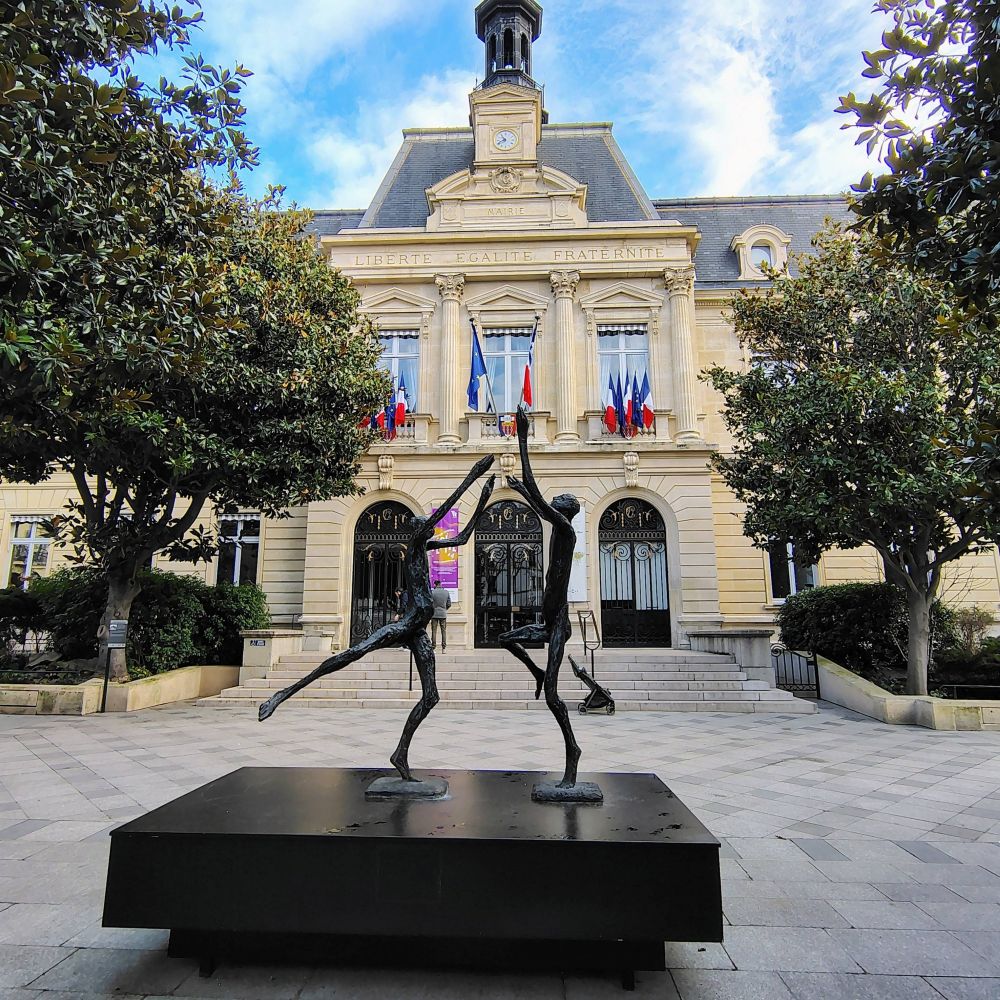
The hôtel de Ville or City/town hall, inaugurated in 1878, to replace the old town hall renovated in 1836. It was enlarged with two symmetrical wings in 1907. The pediment of the central bay was removed in 1970. The decoration of the wedding hall was entrusted to the painter Oscar Mathieu. The sculptor Adolphe Leleu created the exterior decoration based on Depoix’s designs. The sculptor Alphonse Germain was responsible for two stone fireplaces. The ceiling paintings and the panels in the wedding hall and waiting room are the work of the painter Pescheux.
A bit of history tell us that in the 6C, the territory extended as far as the gates of the Louvre, reaching the borders of the Rouvray forest, Boulogne-sur-Seine, the city of Saint-Denis, and Montmartre. Also in the 6C, a charter of Chilperic I (King of the Franks) clearly mentions a palace called Clippiaco. The first traces of Clichy date back to 625, in the chronicles of the royal palace of Clippiacum (Clichy). Clotaire II, father of Dagobert I, had in fact established his principal residence and court there from 614. Clichy was for a time a residence of the Merovingian kings and the domain of Dagobert I who married Gomatrude there in 626; at that time, it was called Clippiacum. Its territory later became a royal hunting ground. Saint Sigisbert (Sigebert III), son of King Dagobert I, was born in 630 at the palace of Clichy. Following an extraordinary assembly of laymen and clergymen in 633, Sigebert III was named king of Austrasia (East Francia), Aquitaine, and Provence. The good reputation of Gaël reached the ears of Saint Ouen, and through the intermediary of Eligius, Dagobert’s advisor, peace was negotiated in Clichy in 636 between Dagobert and Gaël, king of Domnonée, in northern Brittany. Brittany was then pacified. A few years after skillfully negotiating peace between Neustria (Western France) and Austrasia (Eastern France) in Cologne, the diplomat Saint Ouen retired to the royal villa of Clichy, where he died in 684. The palace was likely located on the hill where the Church of Vieux-Saint-Ouen still stands. In a charter signed in 741 in Clichy, in the public palace, Charles Martel renewed the donation to the Abbey of Saint-Denis of the entire village of Clichy, with its lands, buildings, houses, farmers, slaves, vineyards, meadows, and waterways, owned by persons of either sex, In 885, the Normans destroyed the royal palace and the surrounding villages. In 1193, Philip Augustus detached Clichy from the royal domain to make it a feudal lordship, in exchange for the castle of Pierrefonds, which was granted to Gaucher de Châtillon, an ally of the royal family. Through successive marriages, the lordship passed, via the “ladies of Clichy,” from noble family to noble family. During the Hundred Years’ War,
Joan of Arc, during the siege of Paris in 1429, camped at Monceau before attacking the Saint-Honoré gate. Joan of Arc assembled her army on the plain of Clichy to raise the armies to the sound of “Mont-Joye-Saint-Denis” (the rallying cry of the feudal armies). This episode precedes the unsuccessful conquest of Paris by Charles VII in 1429. There is a very close connection between Saint Vincent de Paul, parish priest of Clichy between 1612 and 1625, Saint Louise de Marillac, Antoine Portail, and the parish of Clichy. At the age of 31, he became the parish priest of Saint-Sauveur-Saint-Médard in Clichy, a town later called Clichy-La-Garenne, where he began his parish ministry. This church still exists in the 21C. In 1613, Saint Vincent de Paul entered the illustrious Gondi family as a tutor. In 1617, he founded, with the wealthy ladies of the city, the “Ladies of Charity” to help the poor. In 1623, he created the “Company of the Daughters of Charity”. They then took the name “Company of the Daughters of Charity of Saint Vincent de Paul.” It was also in Clichy that “Monsieur Vincent” met Antoine Portail, his dearest and oldest companion in the Congregation of the Mission. He died in 1660, the same year as two other residents of Clichy: Louise de Marillac and Vincent de Paul. The Roule district was separated from Clichy in 1690. It was soon established as an independent parish (1697) and, in 1722, became an integral part of Paris.
In 1784, Clichy lost a third of its territory. Louis XVI granted the tax farmers permission to build a wall encompassing the Clichy lands located beyond the present-day Place de Clichy. The wall was built along the boundaries of the present-day Boulevard de Clichy, Boulevard des Batignolles, Boulevard de Courcelles, and Boulevard Monceau. From 1790 to 1795, Clichy was a canton within the district of Franciade (Saint-Denis). During the defense of Paris against the Russians in 1814, General Moncey established his headquarters at the Clichy gate. In 1815, Clichy, having been evacuated, was subjected to pillaging by the Prussians and the British, who camped there and ransacked the houses. The surrender of Paris, and the refusal to fight of the generals who accompanied it, led Napoleon to abdicate at Fontainebleau on April 6. In 1860, Clichy regained part of its final territory when Paris annexed the territories of the former villages that were inside the Thiers fortifications. The northwestern part of the former villages of Batignolles-Monceau, located outside the defensive line, was then reintegrated into Clichy. In 1866, Napoleon III promulgated a law creating the City of Levallois-Perret from the former “village of Levallois,” effective January 1, 1867. The City of Clichy lost nearly half its territory to obtain its current boundaries, along the railway line which would also constitute an important means of communication with Paris, shared by both cities, which then shared the current Clichy-Levallois train station. In 1882, a commemoration was held at the Chance-Milly Cemetery (Clichy’s South Cemetery) of the capture of the Montretout redoubt during the Battle of Buzenval on January 19, 1871, during the Franco-Prussian War. In May 1891, the affair of the Clichy massacre, which took place on May 1, 1891, in Clichy, when anarchists were victims of police violence, was one of the main causes of the “Era of Attacks” (1892-1894). Along with the Fourmies massacre, which occurred on the same day, it was one of the events of this period when social tension reached its peak.
The City of Clichy on its heritage : https://www.ville-clichy.fr/47-histoire-patrimoine-clichy.htm
The Clichy tourist office on its heritage : https://www.clichy-tourisme.fr/decouvrir/patrimoine/
The Hauts de Seine dept 92 tourist office on Clichy : https://destination.hauts-de-seine.fr/promenade-architecturale-clichy-la-garenne-92.html
There you go folks, an oasis of tranquility and class just bordering Paris, the off the beaten path, Clichy is worth the detour me thinks, Again, hope you enjoy this post on this is Clichy !!! as I.
And remember, happy travels, good health, and many cheers to all !!!

 Paris1972-Versailles2003