
I have made one round in my road warrior trails to this part of the Paris area, and was glad, plenty here to see, I found these older pictures in my cd rom vault ,and decided to give a post of their own for the memories of always on Clichy, This is Clichy in the Hauts de Seine dept 92 of the Île de France region of my belle France , Therefore, let me tell you about curiosities of Clichy !!! Hope you enjoy the post as I.
The City of Clichy aka Clichy-la-Garenne and Clichy-sur-Seine are often used to refer to the City, It is located 2 km from Levallois-Perret, 3 km from Saint-Ouen-sur-Seine, 2 km from Asnières-sur-Seine, 3 km from the 17éme arrondissement of Paris , and 21 km from Versailles.
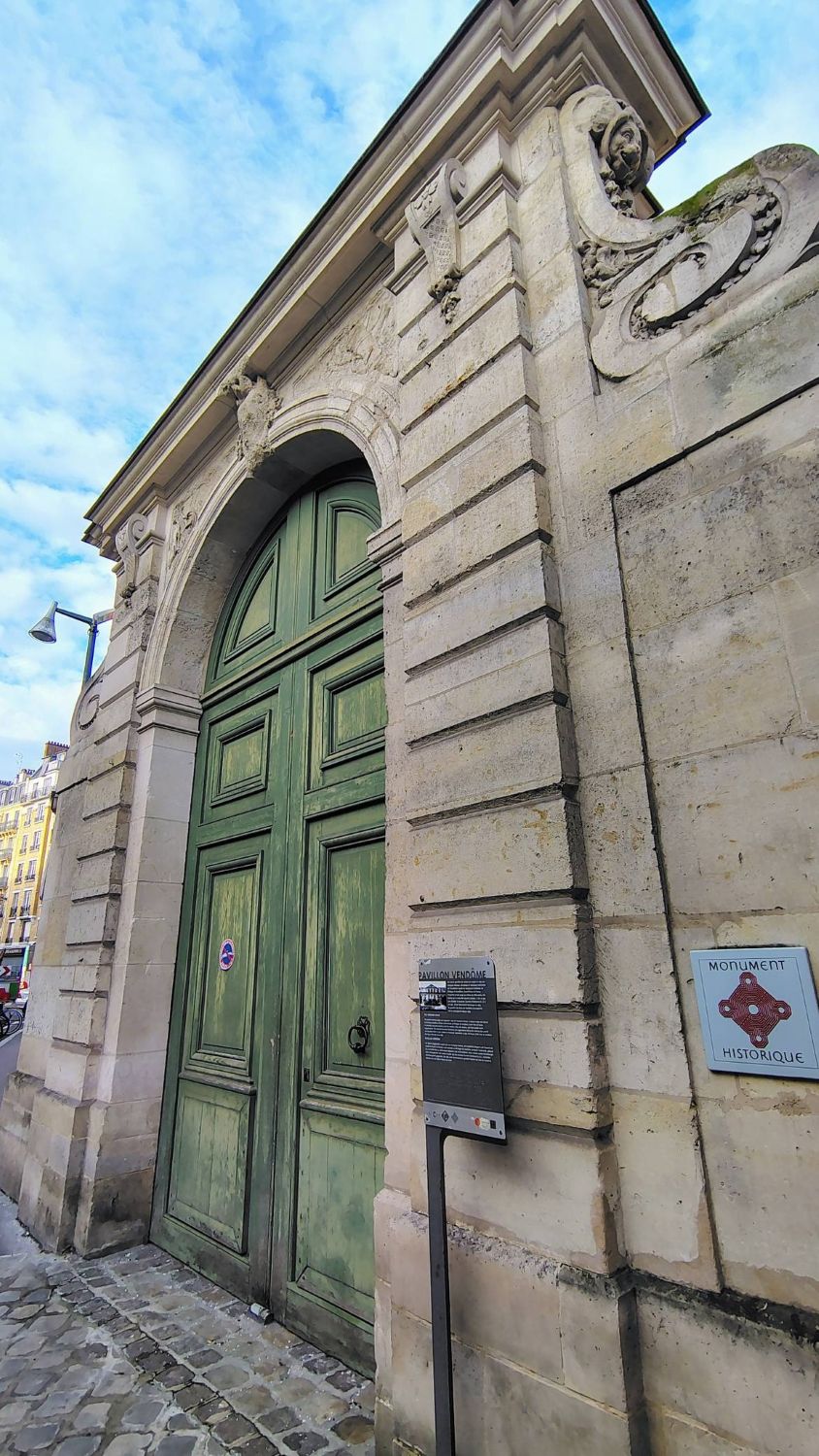
The Pavillon Vendôme, built at the end of the 17C as a hunting lodge, was renovated for the actress Françoise Moreau, mistress of Philippe de Vendôme. The building was acquired by the city in 1989. In 2016, the city established a contemporary art center and the city’s tourist office there. Its garden is open to the residents of Clichy.
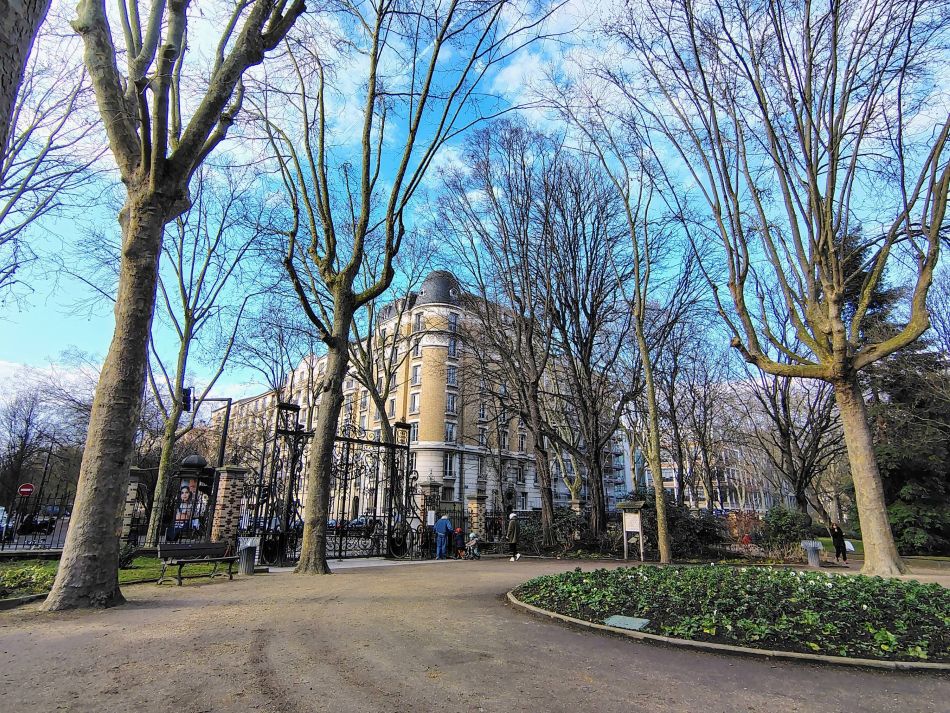
The Parc Roger-Salengro is a 2.4-hectare green space managed by the City, located in the République district. between Boulevard du Général-Leclerc, Rue du Général-Roguet, and Rue de Villeneuve ; its construction was in 1897 It includes rare, century-old trees, including a bald cypress from Louisiana, a Bhutanese pine, an Osage orange, and a handkerchief tree. The park, which was called Parc Denain for over 40 years, originated from the subdivision of the property of Madame Léo Delibes, daughter of Elisabeth Désirée Mesnage-Denain, whose stage name was Mademoiselle Denain, a member of the Comédie-Française. The sculptures that we can still admire today are titled Terre endormie (Sleeping Earth) by Noémie Debienne, Nymphéa (Water Lily) by Julien Caussé, and La leçon (The Lesson) by Frédéric Tourte. In 1937, the park was renamed Roger Salengro, in homage to the French politician.
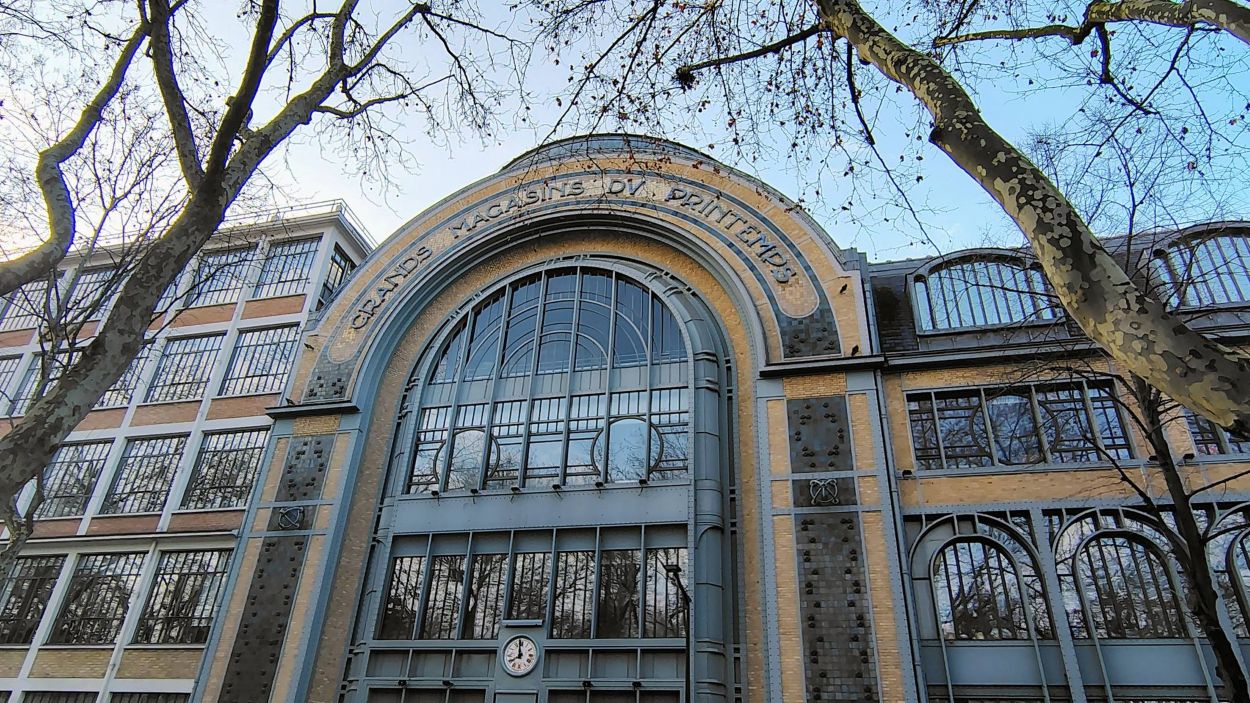
Founded in 1905, the Printemps department store company grew rapidly; in 1910, the new Printemps store on Boulevard Haussmann was completed. In 1908, an annex was built in Clichy. A building designed for adaptation, it has served successively as a warehouse, a garment workshop, and then offices. It is bordered on the left by the monumental entrance and, on the right, by the passageway leading to Rue d’Alsace. The building opens onto a glazed courtyard at the rear. The left bay consists of a single-span arch, housing a hall, and three entirely metal floors. The facade’s design plays on the interplay of metal structures and brick. This brickwork is embellished with ceramic tiles spelling out the establishment’s name, and with yellow and blue flamed stoneware tiles. For the left third of the building, constructed in 1923 , a right angle and concrete replaced the metal arc. A terrace topped with sawtooth roofs replaced the attic. The dome of the Printemps Haussmann department store in Paris created in 1923 , was removed from its 3,185 glass panels in 1939 and stored for safekeeping in the Clichy warehouses. After the risk of bombing, the pieces were forgotten. It was only in 1973 that the stained-glass windows were rediscovered and reinstalled.
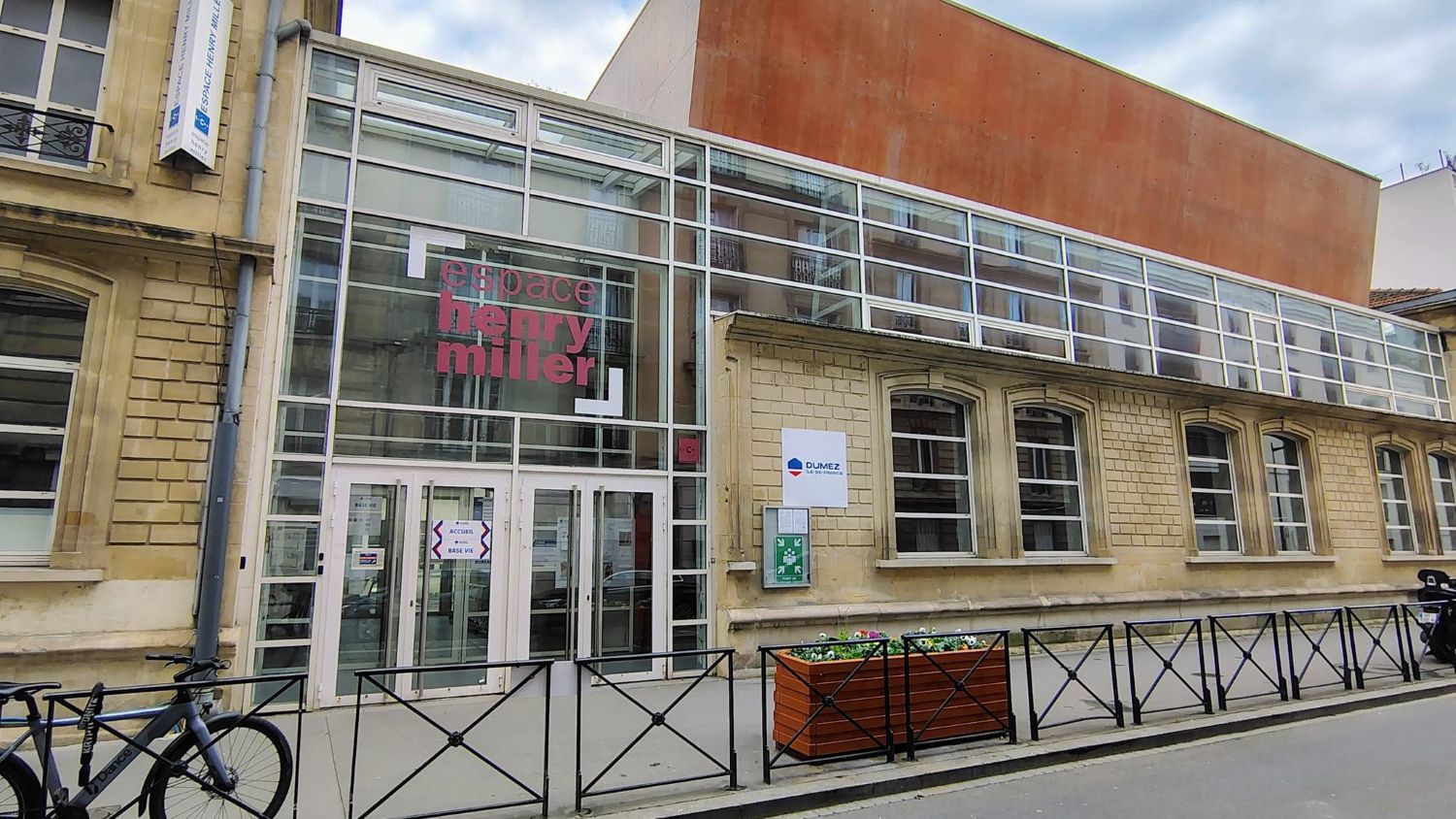
Espace Henry Miller ,its a cultural center with a Salle Polyvalente , Salle de spectacle, Salle de danse, Deux studios d’enregistrement et de répétitions, ouverts aux particuliers, et Quatre salles (réunions, cours) à 3, rue Docteur Calmette An anecdote worth mentioning here is that the Jours tranquilles à Clichy or the Quiet Days in Clichy is an autobiographical novel by american Henry Miller written in 1940 and published in 1956 in France and then in 1965 in the United States.Plunging us into a Paris of the interwar period where one does not always have enough to eat but where joy can be picked effortlessly for those who know how to recognize it, on the boulevards or on the terrace of the Wepler, in the midst of ordinary people and prostitutes, Miller describes another face of the American in Paris of the Roaring Twenties, less known and less mythologized than that of Gertrude Stein, Ernest Hemingway and his comrades of the Lost Generation.
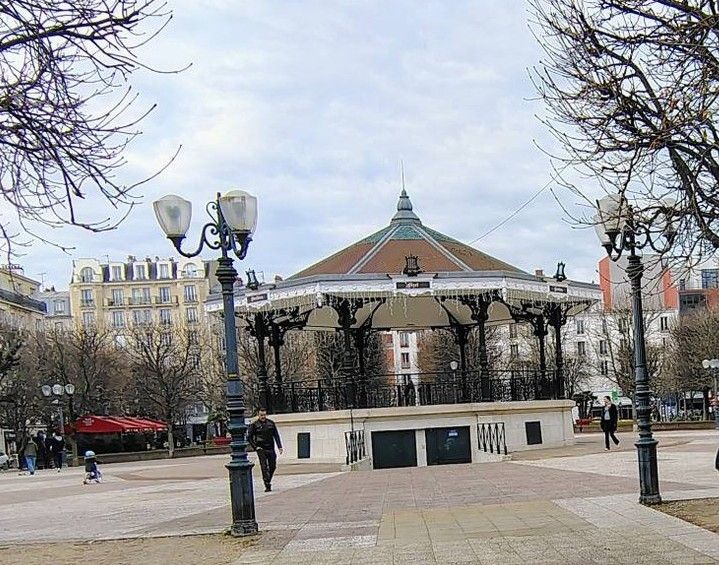
The kiosque à music or the bandstand was erected to adorn the former Place des Fêtes, today Place des Martyrs de l’occupation allemande 1940-1944 ,created in 1883 and reserved for the various festivities organized by the city. Four gardens, enclosed by wire mesh for the flowerbeds, were laid out. Fifty-six double-flowered horse chestnut trees were planted. The city erected a bandstand in its center dated April 18, 1895. The bandstand’s unique feature is its octagonal shape. Each side, enhanced by a three-stringed lyre, is decorated with the name of a 19C French composer. The eight plaques were restored in 1996. Last renovated in 2012,
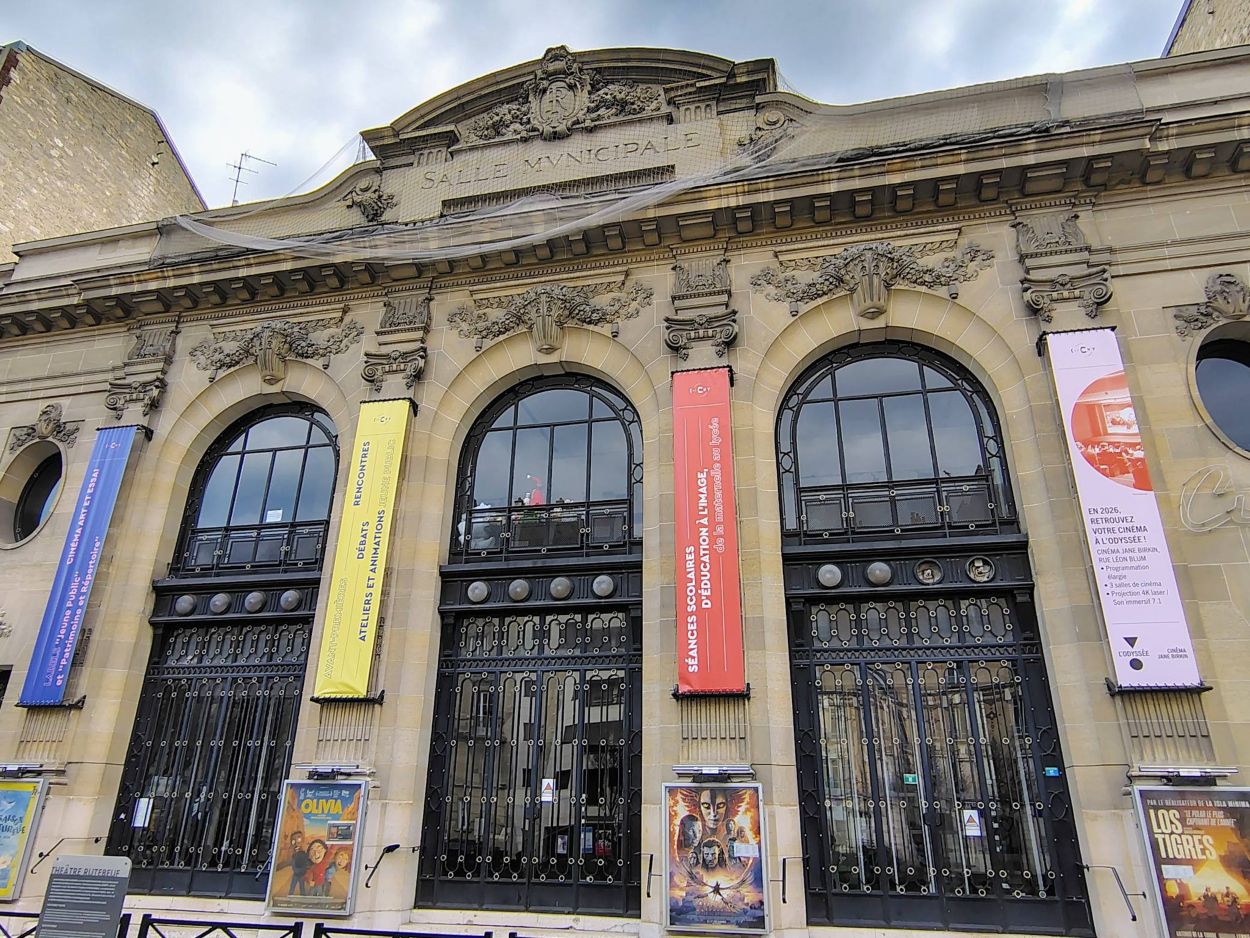
A venue for live performances and art-house films in the city of Clichy, the Théâtre Rutebeuf has become an essential multicultural institution, At 16-18 Allées Léon Gambetta, the city decided in 1909 to build a community hall and meeting room, With the outbreak of the Great War or WWI, construction had to wait for better times. The municipal hall was inaugurated with a dance performance by the Clichy schools in 1925. The entrance on the Gambetta avenues opens onto an elegant cut-stone building, with a neoclassical façade adorned with three large arcades decorated with garlands, bouquets, and cornucopias. On Rue Henri Barbusse, the façade is more understated, made of brick and featuring large windows that lend the building a sense of rigor and efficiency. The actors’ dressing rooms were located on the ground floor, while the main hall faced the Allées Gambetta. In 1967, to meet the technological advancements of the era, the hall was modernized, renovated, and soundproofed. Inaugurated with the first performance of Léo Delibes’ ballet Coppélia, the hall was renamed Théâtre Rutebeuf in 1968, in homage to the 13C poet who used to stroll in the Rouvray forest, of which the Bois de Boulogne is the last vestige, in the territory of Clippiacum ,today Clichy. The statue of the troubadour located here, a bronze by Rivet originally from the City/Town Hall lobby, won an award at the first Clichy-la-Garenne Spring Exhibition. Following the closure of the town’s cinemas, the entire complex was restored in 1980 to become multi-purpose and adapt its equipment for film screenings. At the beginning of the 20C, the site served as a ballroom, and it wasn’t converted into a theatre until 1990, when the city’s last cinema closed. Today, the venue hosts a variety of performances.
The City of Clichy on its heritage : https://www.ville-clichy.fr/47-histoire-patrimoine-clichy.htm
The Clichy tourist office on its heritage : https://www.clichy-tourisme.fr/decouvrir/patrimoine/
The Hauts de Seine dept 92 tourist office on Clichy : https://destination.hauts-de-seine.fr/promenade-architecturale-clichy-la-garenne-92.html
There you go folks, an oasis of tranquility and class just bordering Paris, the off the beaten path, Clichy is worth the detour me thinks, Again, hope you enjoy this post on curiosities of Clichy !!! as I.
And remember, happy travels, good health, and many cheers to all !!!

 Paris1972-Versailles2003
I love discovering places just outside Paris that have so much history and character! Clichy sounds full of hidden gems and especially the Pavillon Vendôme and that octagonal bandstand. It’s amazing how much heritage is packed into one area.
LikeLiked by 2 people
Yes indeed working on it so much to see in one country! thanks for stopping by Cheers
LikeLiked by 1 person