
And wow, again found me pictures in my cd rom vaults that should be in my blog for you and me. Great to dig into my vault of pictures a never ending source it seems. My idea is to keep a log in my blog of all the places I, and my family have gone, like a living testament for generations to come. In the meantime, a great source of info for future travelers/visitors and locals alike. This is my homage to Périgueux in the Dordogne dept 24 of the Nouvelle-Aquitaine region in my belle France. Therefore, here is my take on the Cathédrale Saint Front of Périgueux !!! Hope you enjoy the post as I
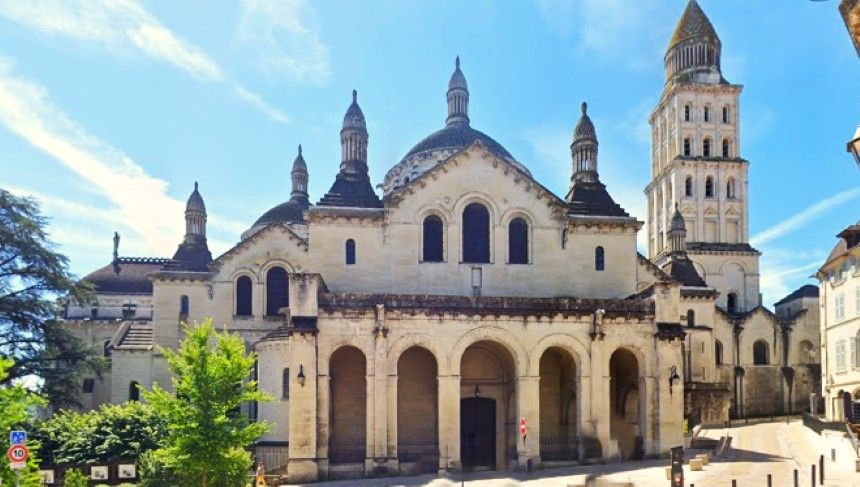
The Cathédrale Saint-Front, place de la Clautre is built in the city center of Périgueux, on the tomb of Saint Front , the legendary evangelizer of Périgord, who gave his name to the central district of the city in the Middle Ages. Originally a simple church at the beginning of the 5C, it underwent several destructions and reconstructions, to become, from 1669, the cathedral of the diocese of Périgueux, also erected as a minor basilica in 1897, it was classified as a World Heritage Site in 1998 as part of the Routes of Saint-Santiago de Compostela (Jacques-de-Compostelle), via Lemovicensis in France. The cathedral has been state property since the law of December 9, 1905.
On the north side of the Saint Front Cathedral is the 25 meters long porch with a five-bay terrace. The porch has remained intact since the construction of the first church; it was reinforced by a wall following the fire of 1120. Inside the latter, a gallery with numerous machicolations was built. The door leading to this gallery, called the “Porte du Gras” or “Porte du Greffe” because it had to be climbed several steps, dates from 1581, It was rebuilt in modern times. The so-called Porte de Thouin gate, to the south, with a completely undecorated tympanum and large fanciful consoles, allows passage from the cathedral cloister to the Thouin Garden. Measuring 8 meters high and 5 meters wide, it was previously the third entrance to the Basilica of Saint-Front. From the Place de la Clautre, above the broken arch, a second semicircular arch is visible which overhangs the old portal. The plan of the cathedral is in the shape of a Greek cross and its five domes with pinnacles announce a singularly direct kinship with the religious buildings of Byzantine architecture. The capitals crowning the pillars of the cathedral are typical of the Corinthian order and are decorated with acanthus leaves.
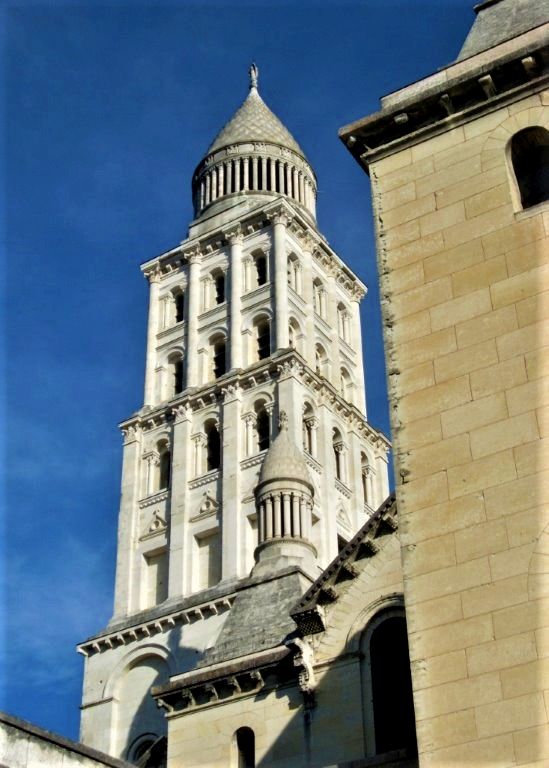
The bell tower of Saint-Front Cathedral rises to 62 meters. Built at an unknown date, historians know that it was rebuilt after the fire of 1120. It has a rectangular base that successively becomes square on each floor. Inside the bell tower, on the first floor, there is a gallery with the only access to light being a window decorated with Corinthian columns. The second floor, measuring 10.45 meters in height, is composed of pilasters of different types, an architrave, a frieze, sculptures of lambs, a cornice resting on a picture rail, as well as other details. The third floor, measuring 9.55 meters in height and similar to the second, is also surrounded by a gallery. The size of the windows, for its part, reduces with each floor. Each floor follows a precise geometric plan and is different from the other floors. The bell tower is topped by a conical dome measuring 8 meters in height and 7 meters in diameter and resembling a pine cone. The bell tower is surmounted by an angel.
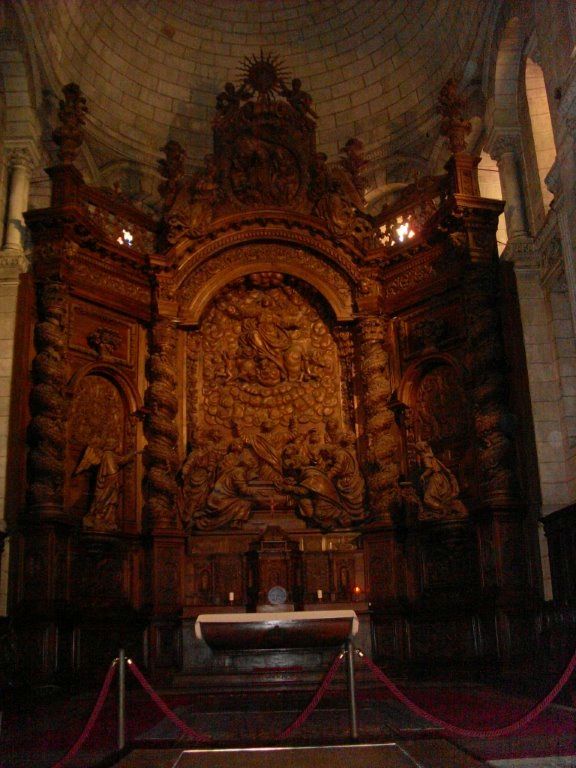
The apse is hidden by a large 17C altarpiece made for the chapel of the Jesuit college in Périgueux. The altarpiece was reassembled in 1811 in the north apse of Saint-Front Cathedral. The high altar is placed in the center of the cathedral so that the priest faces the faithful during services. This altarpiece evokes the story of the Assumption of Mary in its central part. In the lower part, the apostles surround the tomb of Mary, which they found empty. An apostle, perhaps Saint Thomas, with raised arms, looks at the Assumption of the Virgin called by her Son, who is represented above and holds a crown. The Annunciation was represented there with, on either side, on the left, the archangel Gabriel, and on the right, Mary. Abbot Audierne wrote in his Monumental, Statistical, Picturesque and Historical Guide to the Dordogne that Mary has the face of Anne of Austria, which may recall the vow of Louis XIII who dedicated his kingdom to the Virgin Mary after the birth of Louis XIV, in 1638. The costumes are those of the time of Louis XIII.
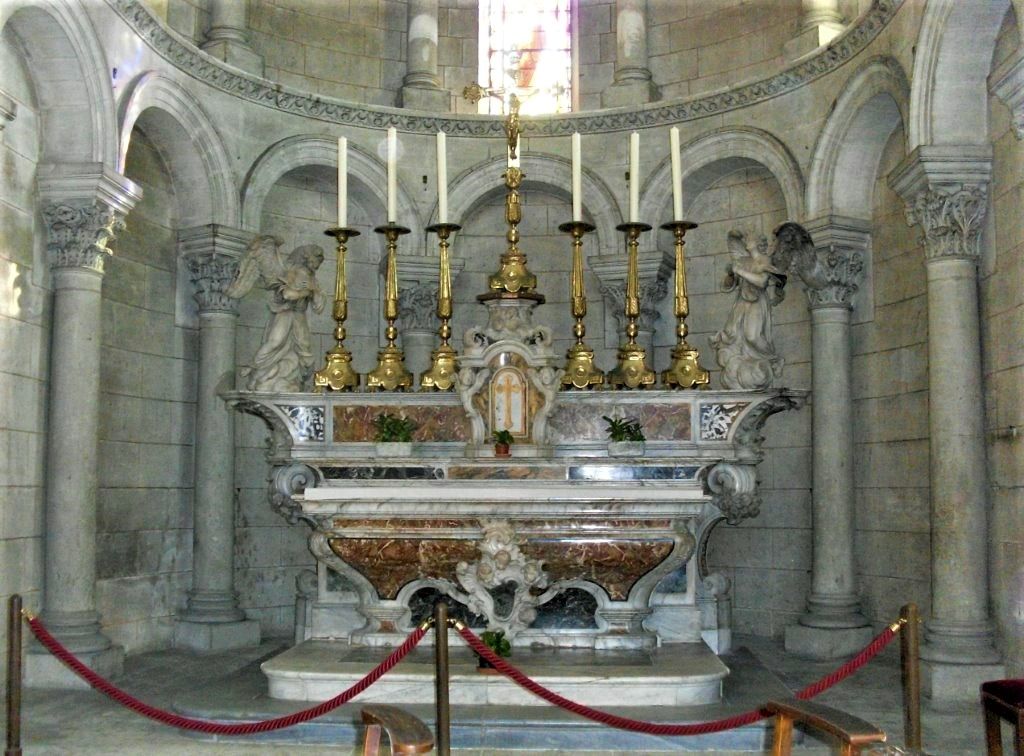
In the chapel located in the south arm of the transept was placed an altar from the Charterhouse of Vauclaire. By agreement of January 20, 1761, it had been commissioned from the Italian sculptor Contestabile by the Charterhouse of Vauclaire. It was completed in 1762 in Toulouse by the sculptor. The high altar was installed in the Charterhouse in November 1762. In the 19C, it was then transported to the Cathedral,
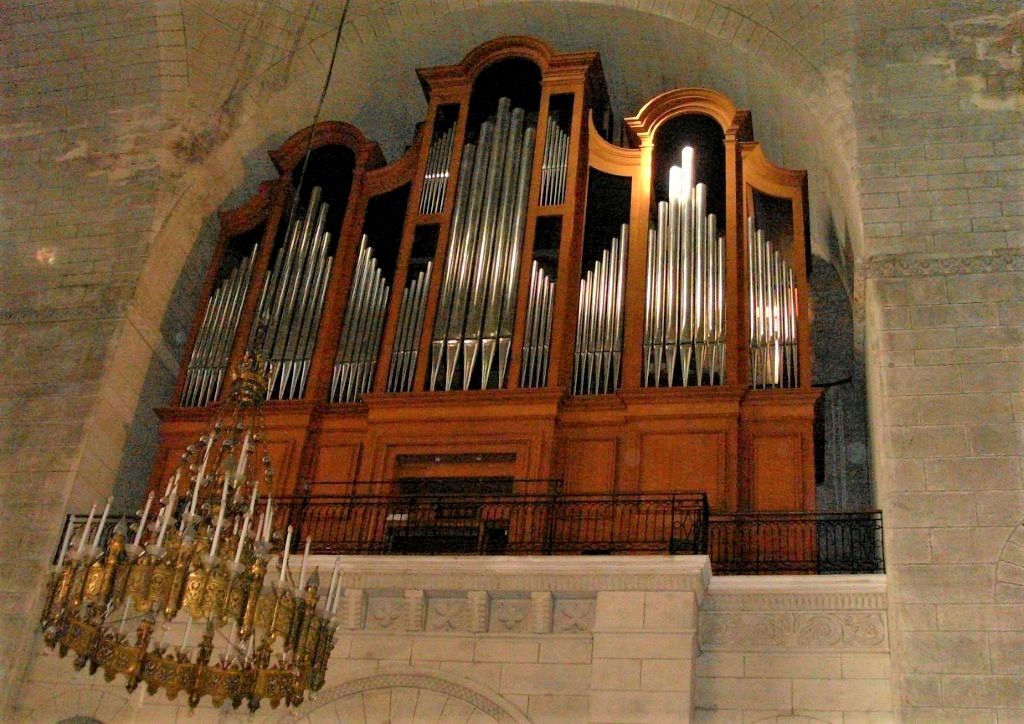
The great organ is located under the western dome, the access point to the old church. The first Great Organ of Saint-Front was made from 1731 to 1733. A neo-Gothic choir organ was built in 1901 and installed in 1903. In the 11-12C, the choir frequented by both churches was at this location. On each side, there are two chapels intended to house relics. The northern one, dating from the 7C, lost a bay and its floor added in the 12C during works, and is currently the chapel honoring Saint James. The southern one, for its part, dated from the 9C. No old stained glass windows remain from the cathedral. The grisailles placed in the north arm of the transept were made from copies made on ancient fragments The stone altar there is decorated in bas-relief. The pulpit represents the evangelists around the basin from the 18C. The five chandeliers suspended under each dome, representing the heavenly Jerusalem, illuminated the religious wedding of Napoleon III and Eugenie de Montijo at Notre-Dame Cathedral in Paris on January 29, 1853. One of the two ancient churches located to the south (9C) has two paintings, representing Saint Bernard and Saint Benedict, dating from the end of the 15C, and also a copy of The Last Supper by Leonardo da Vinci. In the south dome, the niche contains a 16C mural. Most of the paintings disappeared between the 16C and 19C, the same goes for the frescoes, damaged by time.
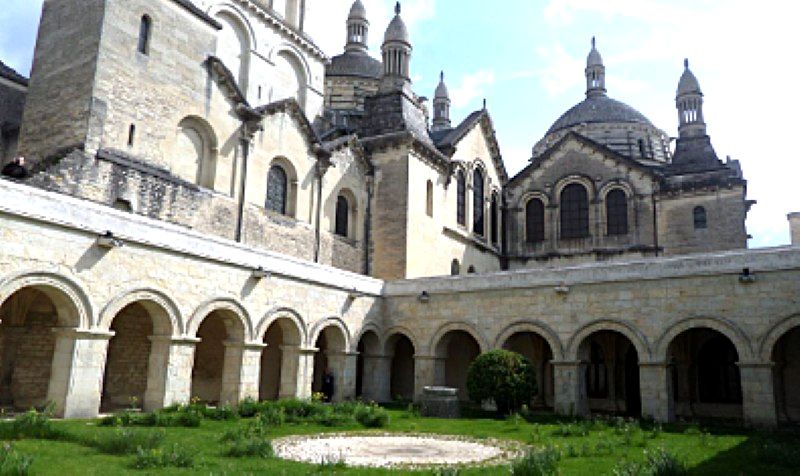
Located next of the cathedral, the monastery is vast: its southern façade measures nearly 50 meters. During the construction of the Abbey of Saint-Front in 1047, the monks added the cloister, which was improved during the construction of the domed church in 1173. The vaults and arcades were transformed in the Gothic style in the 14-15C. The cloister has four galleries, a place for reading and teaching when Saint-Front was an abbey. The northern one, an allegory of darkness and Hell, faces the southern one, oriented towards Jerusalem and representing life and resurrection. The eastern gallery is where the sunrise appears, and the western one symbolizes renunciation of the world. In the past, monks did not enter the garden, as it was considered an image of Paradise.
A bit of history I like of the cathedral tell us that dating back to its earliest days in the 4C and 5C, the cathedral was first a church, then an abbey before taking the title of cathedral in the 16C, following the sack by the Huguenots of the episcopal seat, the church of Saint-Étienne-de-la-Cité. restored during the second half of the 19c, the Saint-Front Cathedral has a plan in the shape of a Greek cross and five domes on pendentives. The cathedral , initially an abbey church, took the name of the man who was, according to legend, the first bishop of Périgueux: Saint Front. The construction of a first church on the side of a hill is reputed to be due to Bishop Chronope between 500 and 536. The Norman invasions which took place in the Périgord in the 9C destroyed the church in the year 845, leaving only the oldest part, discovered by the faithful in the 16C. Walls of this first church were perhaps reused in the walls of the nave of the church built by Bishop Frotaire of Périgueux from 976 to 991, builder of the magnum monasterium, the abbey church of Saint-Front.by 984. This monastery was perhaps federated by the Benedictine order, on the site of the first church. It was consecrated on March 21, 1047. The choir was vaulted and behind the altar housed the tomb of Saint Front sculpted in 1077 by Guinanond, a monk of the Abbey of La Chaise-Dieu. This tomb was decorated with numerous precious stones and sculptures, including a painted angel with a halo made from glass elements, now preserved in the Périgord Museum. The place where the body of Saint Front rested was discovered by a canon at the time of Bishop Frotaire. It was also at this time that the writing of the life of Saint Front began. The construction of the domed church was completed between 1160 and 1170. The domed church was extended to the east in 1347 by a chapel dedicated to Saint Anthony in the Gothic style which was restored in 1585. In 1575, the Huguenots plundered the future cathedral, destroying much of the furniture and stealing the relics of Saint Front, which were taken away and thrown into the Dordogne river. The destruction caused by the Huguenots, when they took the city between 1575 and 1577, led to the abandonment of the Basilica of Saint Front for six years.
The City of Périgueux on its history : https://perigueux.fr/bienvenue-a-perigueux/histoire-de-la-ville.html
The Périgueux tourist office on the Cathedral : https://www.destination-perigueux.fr/en/la-destination-perigueux/les-incontournables/cathedrale-de-saint-front/
The Friends of the Cathedral Saint Font of Périgueux : https://www.amiscathedralesaintfront.fr/
The Dordogne Perigord tourist office on Périgueux : https://www.dordogne-perigord-tourisme.fr/sinspirer/une-destination-aux-multiples-facettes/villes-villages-caractere/villes-art-et-histoire/perigueux/
There you go folks, another dandy spot in the beautiful countryside of the Dordogne and Périgueux is a prime star. Again, glad to share these pictures with you all and great for me to have the memory forever. Again, hope you enjoy this post on the Cathédrale Saint Front of Périgueux !!! as I.
And remember, happy travels, good health, and many cheers to all !!!

 Paris1972-Versailles2003