
In my road warrior ways of my belle France, I have come to meet many small towns that really makes France, the best, In one of my favorite regions, let me bring out more visible the city of Saintes. The city of Saintes is located in the Charente-Maritime department 17 of the Nouvelle-Aquitaine region of my belleFrance. Therefore, this is my take on the Cathédrale Saint Pierre of Saintes !!! Hope you enjoy it as I.
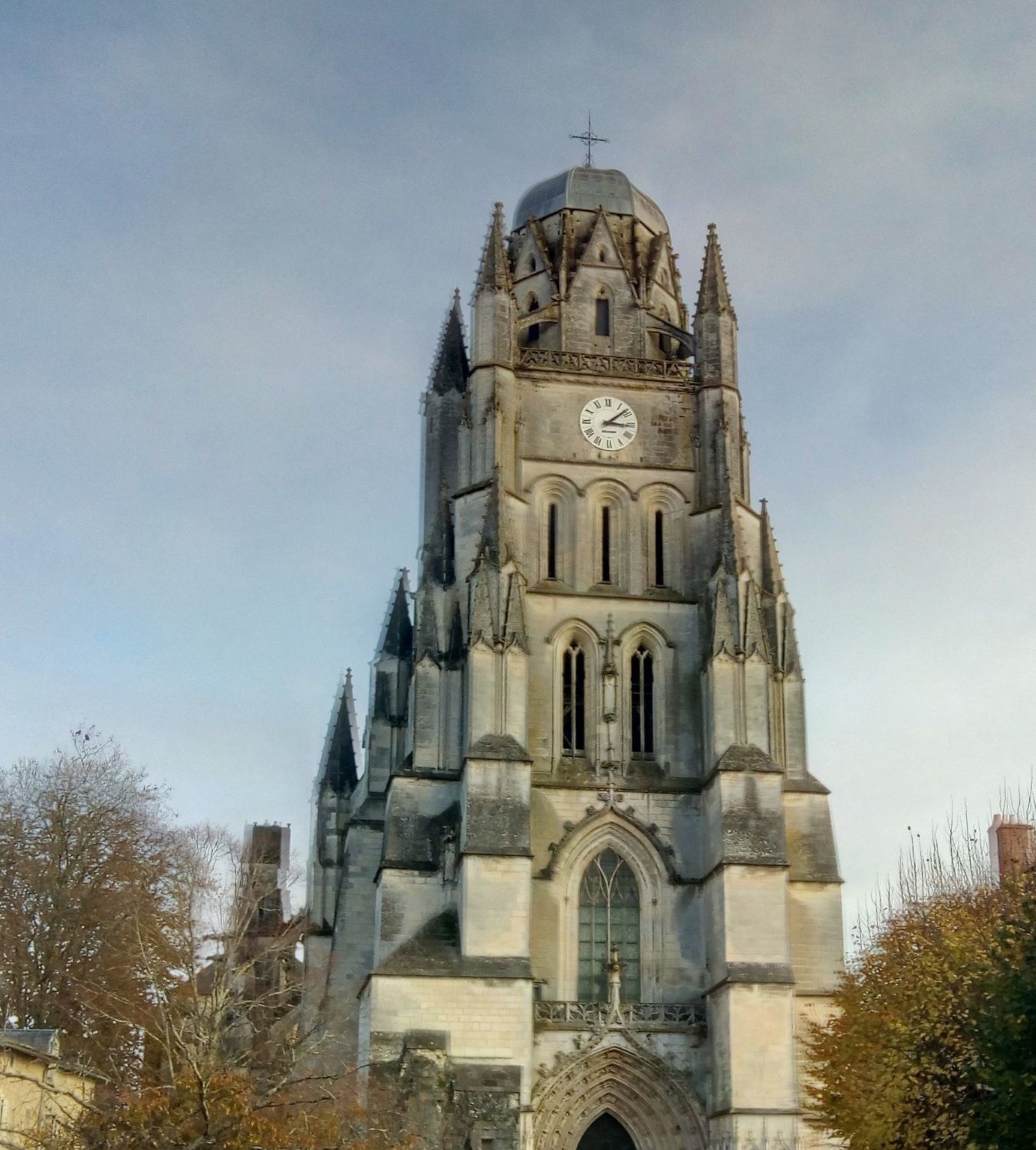
The Cathédrale Saint-Pierre de Saintes or the Saint-Peters’ Cathedral of Saintes is one of the main religious buildings of Saintes, located at Place du Synode, One of the most remarkable elements of the cathedral is its bell tower-porch, which dominates the urban landscape of the former capital of Saintonge. Dominating the roofs of the city by almost 58 meters, it is covered with a copper dome giving it an atypical silhouette. A spiral staircase dating from the 15C leads to the summit platform. The bell tower houses four bells,
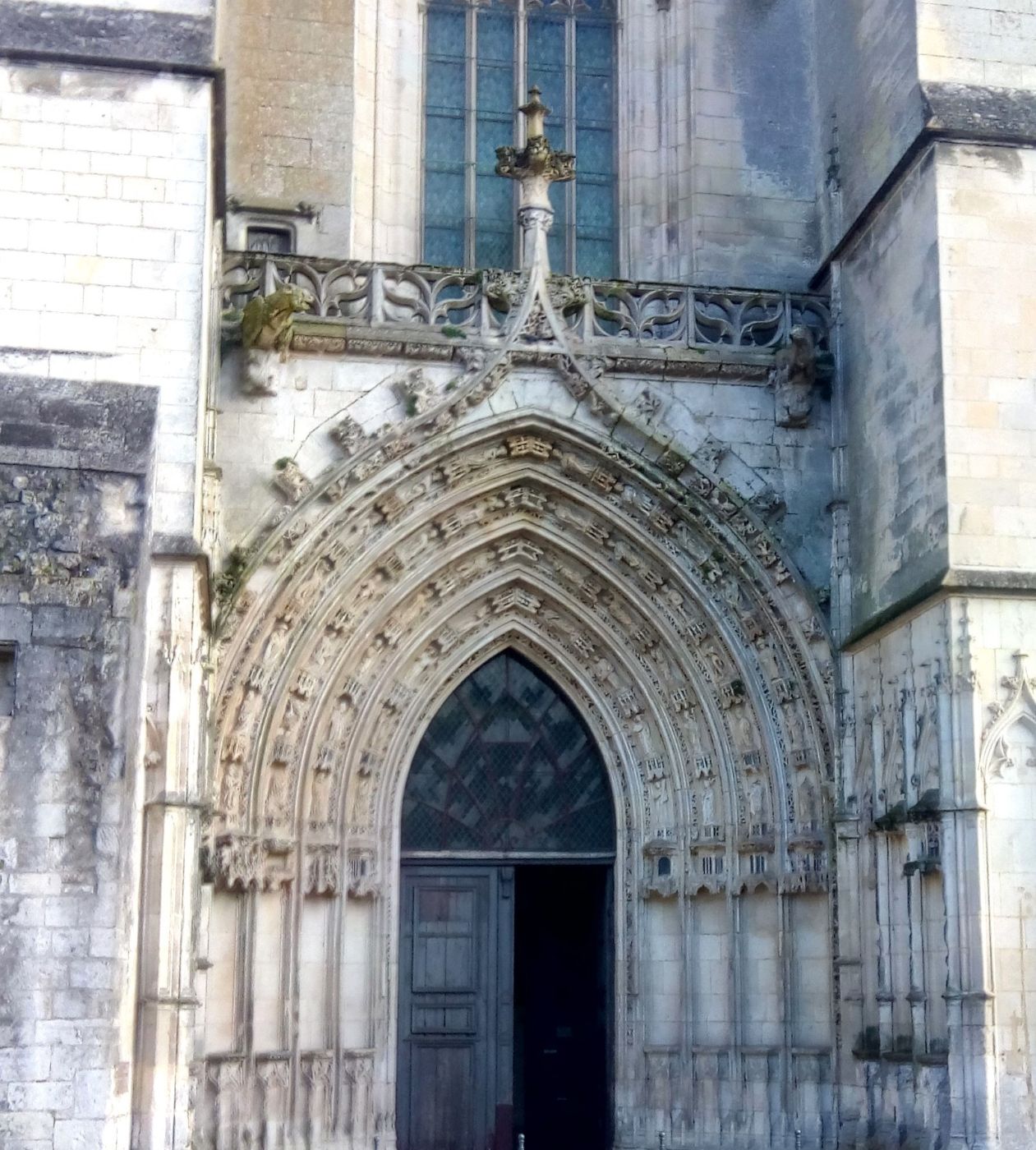
The western portal is formed by a pointed arch with four voussoirs on which are displayed representations of angels, apostles and figures from the Old Testament. These sculptures are divided into four angels on each side, then five personalities (bishops, builders, etc.), then six personalities (knights, bishops, etc.) and finally seven apostles.
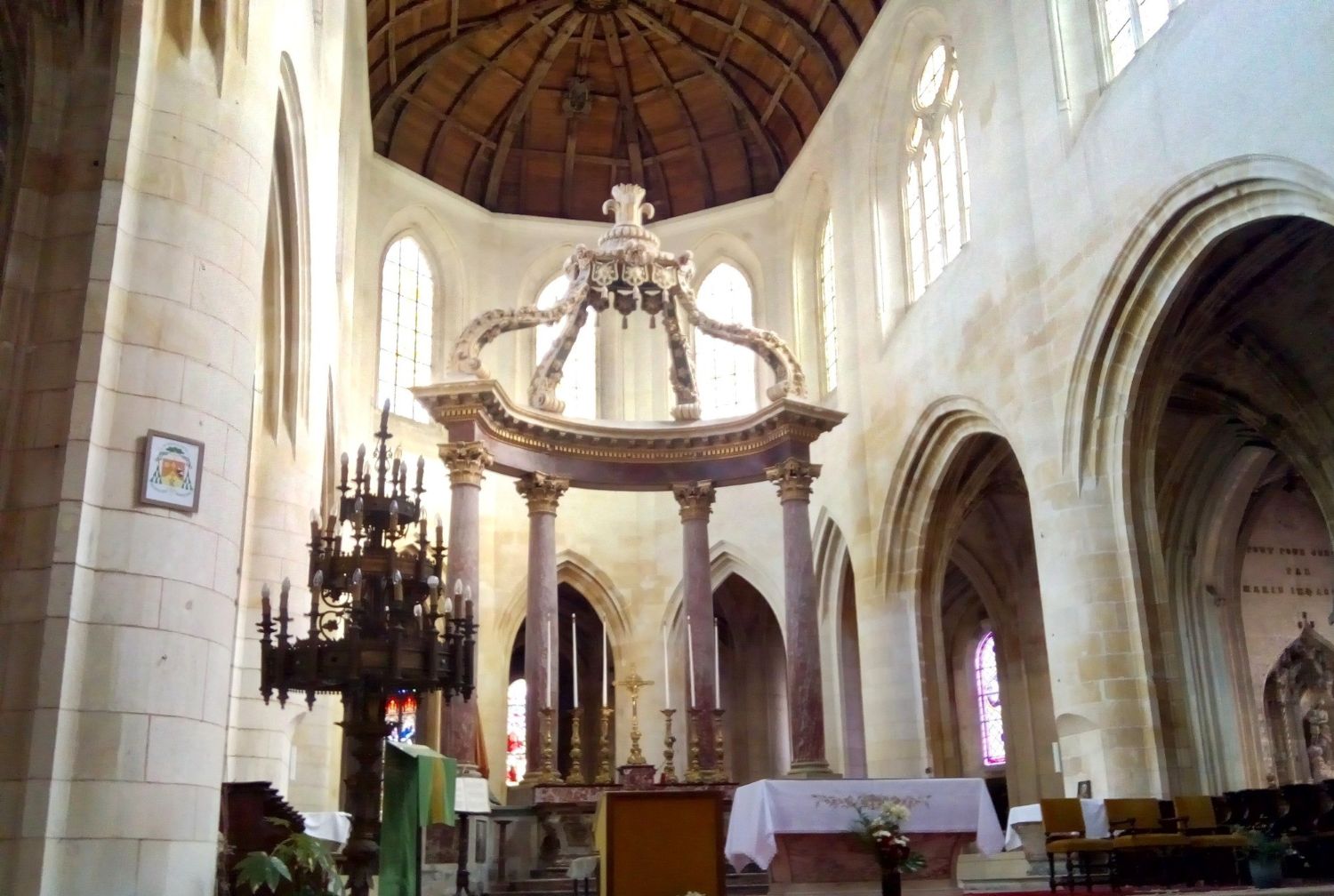
The nave is lined with aisles, themselves flanked by side chapels covered with a sixparts vault. Large bays with flamboyant tracery recall the 15C cathedral. The cathedral choir is covered with a paneled vault in the shape of an inverted ship’s hull. Bordered by an ambulatory, it retains only four of the original fifteen radiating chapels, the others having been demolished by the Huguenots.
The southern transept provides access to the canonical cloister, one of the few of its type to be preserved in France. Only the southern and western galleries remain today, which house a few canons’ tombstones. An annex building also provides access to the cathedral’s treasure, one of the most important in the Poitou-Charentes region. Among the pieces on display are an 18C chased silver chalice , an 18C painting depicting the conversion of Saint Eustella, a silver crucifix with rocaille decoration dated 1776, and 18C porcelain cruets.

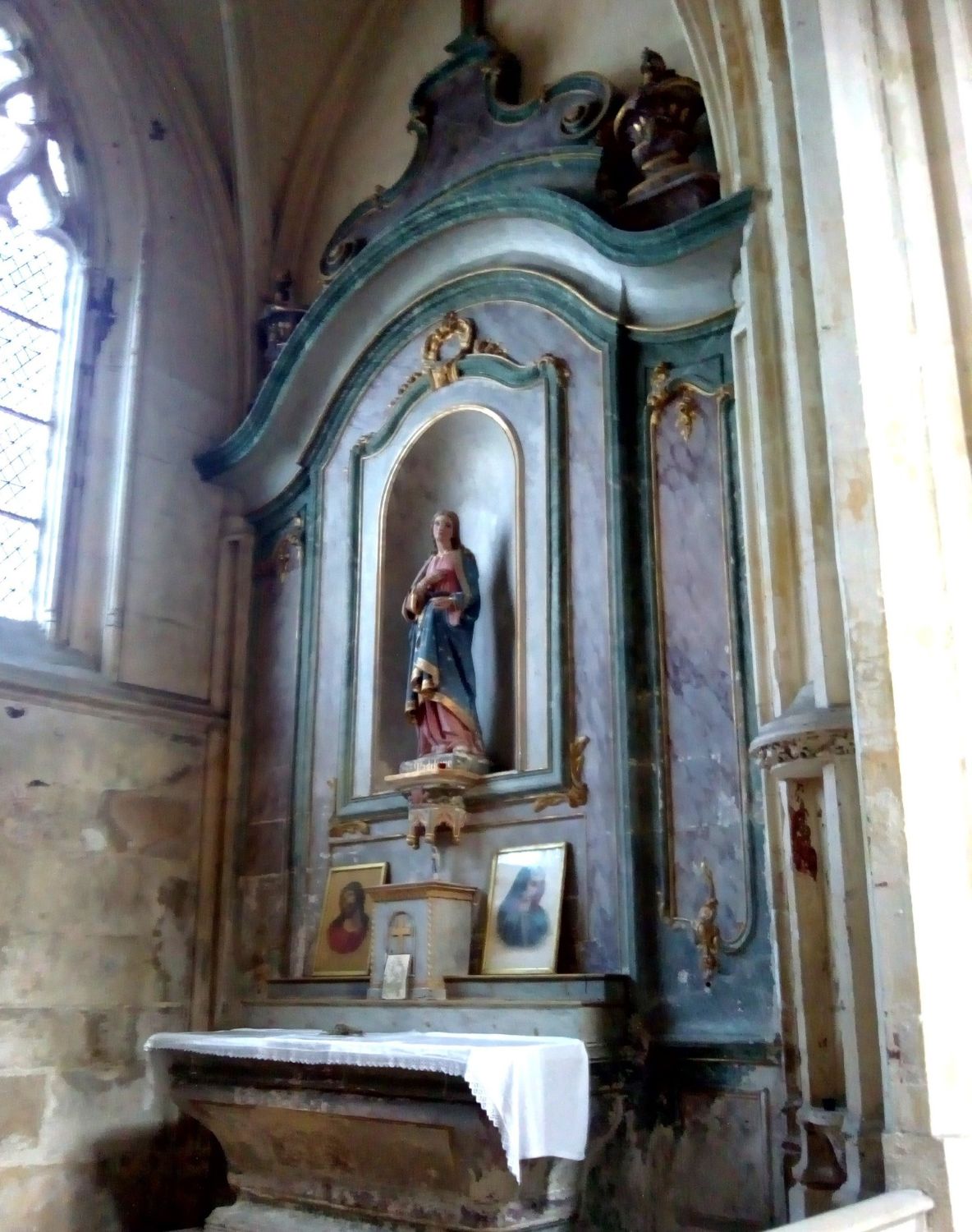
Briefly on the chapels, The Chapel of the Baptismal Font, formerly the Chapel of Saint Sebastian, adorned with a chandelier and a ciborium, which also has a painting of the baptism of Christ by John the Baptist, painted by Miss Delusse in the 19C, a drawing teacher. The Chapel of Saint Mary Magdalene,(see pic) it has a painting by Antoine Reissener, The Birth of the Virgin from the 19C. The Chapel of the Souls in Purgatory, in addition to its altar, houses a monument to the dead of the Great War or WWI and two listed paintings: a Monk in Prayer from the 18C and The Virgin Mary Interceding for the Souls in Purgatory from the 19C, by Louis Sotta, a drawing teacher in Saintes between 1835 and 1855. The Chapel of Saint-Michel, which houses a 16C dedication to Charles Guitard, The Chapel of Saint Thérèse of the Child Jesus, formerly called the Chapel of the Ambulatory, Chapel of the Trinity, Chapel of Refuge. It includes the coat of arms of the Du Refuge family, the protective family: silver with two faces of gules and two coppers or colors facing azure. The Chapel of the Holy Spirit and of Our Lady of Lourdes. The axial chapel, Chapel of the choirboys of the Psalette, known as the Tourette, incorporates late Gothic elements and motifs prefiguring the Renaissance. Built between 1515 and 1520, it contains the tombs of two deans of the chapter. The Marie-Eustelle Harpain Chapel, for Marie-Eustelle Harpain. It only includes a solid wall within the ambulatory. The old corresponding chapel was destroyed during the Wars of Religion. The Chapel of Our Lady of Victories, also called the Chapel of the Blessed Sacrament, or the South Chapel of the Choir, which contains a series of 17C shell niches, a star vault, and a 19C altar sculpted by the Arnold Brothers, sculptors from Saintes. The altar, the washbasin, the tabernacle, the credence table and the 19C altarpiece are listed, as is the stained-glass window of the patriarchs. The Chapel of Saint Joseph, also called the Chapel of the South Transept, formerly the Chapel of Saint John and Saint James, is the chapel corresponding to the apse of the south transept. It includes an 18C painted stone altarpiece, a painting of the Birth of the Virgin painted by Riesener (gift from the Minister of the Interior in 1850), two credence tables in wrought iron and gilded sheet metal. In the wall, there remains the tomb of Cardinal d’Archiac. The chapel of Saint Eutrope, formerly the chapel of Saint Andrew and Saint James, a plaque to Jean de Vivonne, Marquis of Pisany is affixed there. It has a painting depicting Saint Eustelle at the feet of Saint Eutrope, first bishop and evangelizer of Saintes, signed Solla – 1818, The Chapel of Confessions or Saint Peter Chapel, formerly the chapel of Our Lady of Pity, which has two paintings of Saint Peter, as Saint Peter with the rooster, and the repentance of Saint Peter. The Chapel of Blessed Pierre-Louis de la Rochefoucauld-Bayers, last bishop of Saintes, beatified on October 17, 1926. Formerly the chapel of Saint Catherine and Saint Barbara.
Installed on a gallery overlooking the nave, the great organ was placed in the cathedral in 1626. It is characterized by a rococo decoration including a statue of King David playing the harp. The two arms of the transept are covered with domes on pendentives. While the north transept was largely rebuilt in the 14C, then in the 16C, the south transept dates mainly from the 12C. It is the only vestige of the Romanesque cathedral erected by Pierre de Confolens. A 13C enfeu is established in the south wall. While the apse of the south transept has been preserved, housing an 18C altarpiece, that of the north transept was demolished during the sacking of the cathedral by the reformed armies. The north transept has had various uses throughout history. It is currently dedicated to the Sacred Heart.
A bit of history tell us that the current cathedral is the successor to an early Christian sanctuary erected under the episcopate of Bishop Palladius in the 6C. In the 11C, the latter was ravaged by fire. A few years later, Bishop Pierre de Confolens had plans drawn up for a new cathedral, of which only the southern transept remains, with a dome on pendentives and walls lined with semicircular arches on the outside. In the 13C, a canonical cloister and the canons’ lodgings were added to the cathedral. At the dawn of the 15C, however, the Romanesque cathedral was in a deep state of disrepair. The Romanesque sanctuary was succeeded by a flamboyant Gothic building, still under construction during the visit of King Louis XI in 1472. The new cathedral then rose on three levels, a triforium marking the boundary between the arcades and the high windows. The trace of a high-roofed roof is still visible today at the rear of the tower. Almost reaching the clock, its peak reached 39 meters in height. In 1568, Huguenot troops led by François de Coligny d’Andelot sacked the cathedral, hammering the portal and breaking in two the statue of Charlemagne located to the right of it. Similarly, part of the radiating chapels of the choir were destroyed or mutilated, and the furnishings were looted. The nave was rebuilt as early as 1585. The cathedral suffered little during the revolutionary period. This was not the case for the prelate who had led it since 1781. In 1791, Bishop Pierre-Louis de la Rochefoucauld was arrested for refusing to take the constitutional oath. Imprisoned in the Carmes prison with more than a hundred other clergymen, he was one of the victims of the September Massacres on September 2, 1792. In 1802, the diocese of Saintes was abolished and annexed to that of La Rochelle. By a pontifical brief from Pope Pius IX on January 22, 1852, the diocese was renamed the Diocese of La Rochelle and Saintes and the title of cathedral was returned to it. In 1871, it also obtained the title of minor basilica. on January 22, 1852, which established the Diocese of La Rochelle and Saintes. It has since had the title of co-cathedral.
Pope Urban II celebrated Easter Mass in the old cathedral in 1096. Philip V (Felipe born in Versailles) , Duke of Anjou and King of Spain, attended Christmas Mass in 1700. Benefactors and visitors to the old cathedral included: Emperor Charlemagne; King Henry II of England; King Louis VII of France; King Louis IX of France (Saint Louis); and King Philip III of France. Benefactors and visitors to the current cathedral included: King Louis XI of France; King Louis XIII of France; King Louis XIV of France; King Philip V (Felipe) of Spain; Emperor Napoleon I; and Emperor Napoleon III.
Thecity of Saintes on its religious heritage so the Cathedral : https://www.ville-saintes.fr/decouvrir-sortir/les-incontournables/edifices-religieux/
The Catholic Parishes of Saintes on the Cathedral: https://catholiques17.fr/saintes/paroisse-rive-gauche/nos-clochers-rg/cathedrale-saint-pierre/
The Saintes tourist office on the cathedral: https://en.saintes-tourisme.fr/saint-pierre-cathedral/
There you go folks, a dandy town of my belle France that needs more time. It is on my list to come back! Saintes has a lot of great architecture and history to spent at least two days. Again, hope you enjoy the post on the Cathédrale Saint Pierre of Saintes !!! as I
And remember, happy travels, good health, and many cheers to all !!!

 Paris1972-Versailles2003