
Once again looking back into my cd rom vault found me these wonderful pictures that should be in my blog for you and me, This is on historical Verdun,officially appointed as Verdun-sur-Meuse from 1801 to 1970, and back to Verdun ;located in the Meuse department no, 55, in the Grand Est region of my belle France , This is a wonderful city in to visit anytime with plenty of wonderful architecturally and historically amazing sights, We will be back, eventually. Therefore, here is my take on the Cathédrale Notre Dame of Verdun !!! Hope you enjoy the post as I.
The Cathédrale Notre-Dame was elevated to the dignity of minor basilica by Pope Pius XII in 1947. Dedicated to the Virgin Mary, the cathedral was built starting in 990 according to the Rhenish Romanesque plan. It is therefore the oldest in Lorraine and one of the oldest in Europe. Blending Romanesque and Ottonian architecture, it has stood the test of time and today incorporates numerous architectural styles: Romanesque, Gothic, Baroque, and Rococo. The cathedral has two bell towers. The Lion Portal was built in the 12C at the foot of the tower, which no longer exists. It was walled up after the fire of 1755 and only rediscovered in 1916 thanks to German artillery bombardment. The tympanum depicts Christ in glory surrounded by the four Evangelists represented as the tetramorph: the lion for Mark, the bull for Luke, the angel for Matthew, and the eagle for John. Above the portal is a large, flat-bottomed, semicircular niche, followed by a small gallery whose cornice, impost, and colonnettes are decorated with plant motifs. The Saint John portal was built in the 12C at the foot of the now-vanished southeast tower. It takes its name from the fact that it provided access to the Saint John baptistery. It was walled up in the 13C due to the construction of the Sacrament room. The tympanum fresco depicted the Presentation of Jesus at the Temple, and the archivolts were decorated with heads, billets, and plant motifs. Today, only a few traces of this polychrome decoration remain.
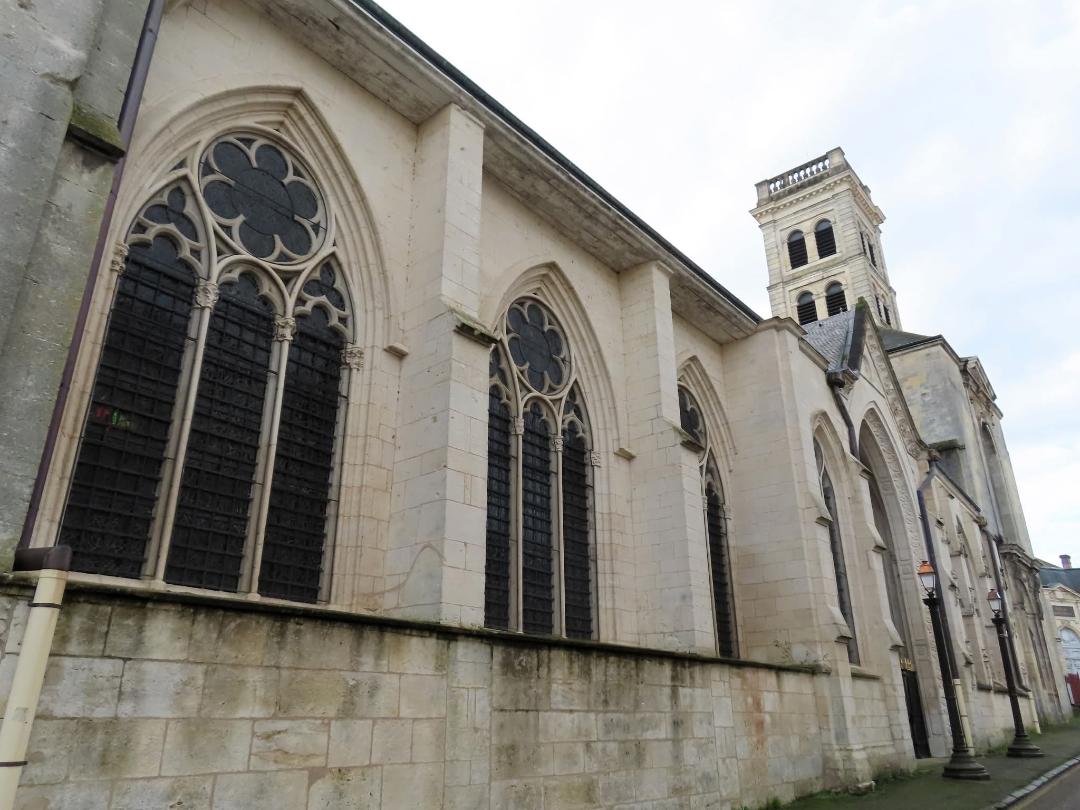
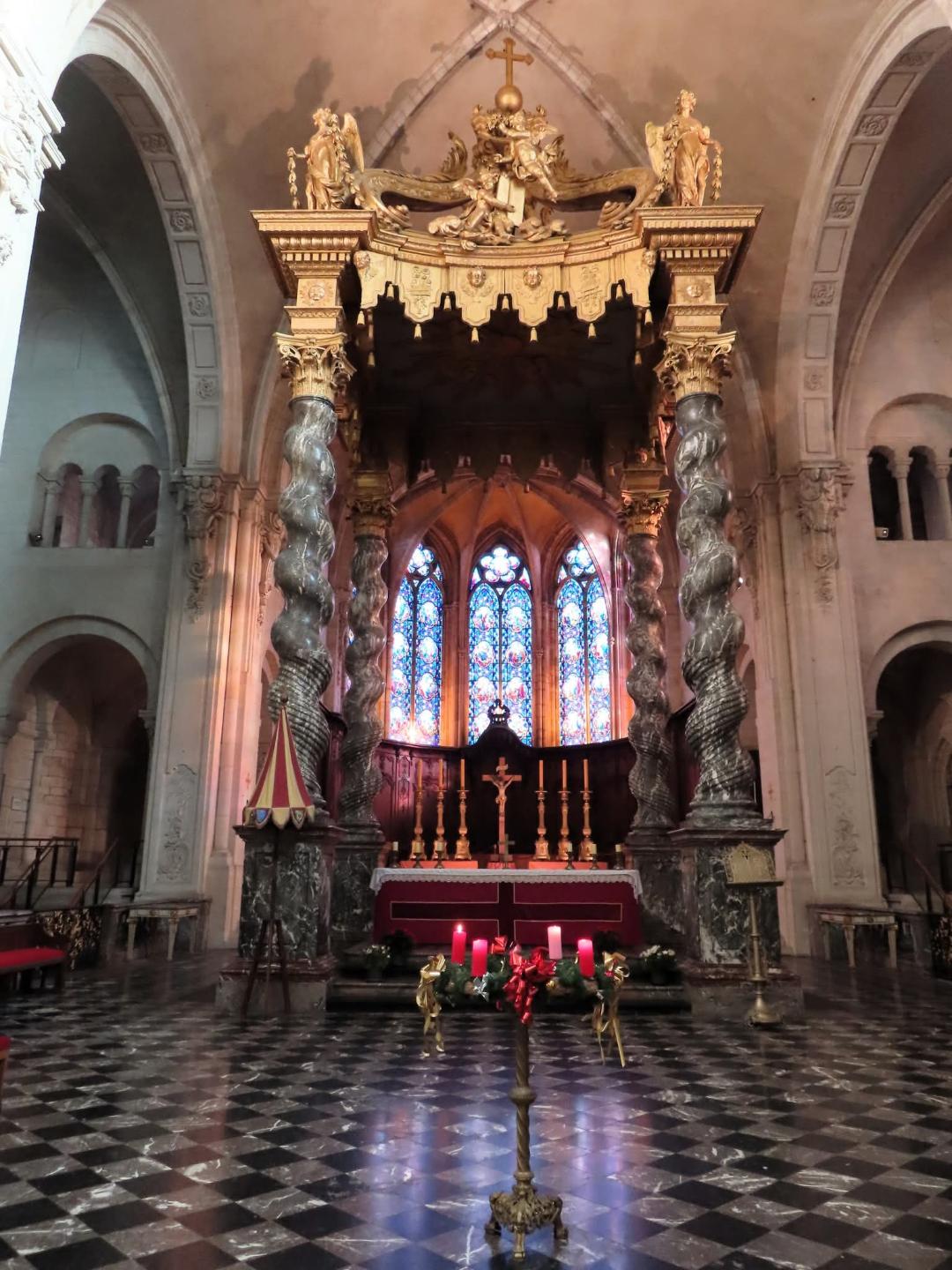
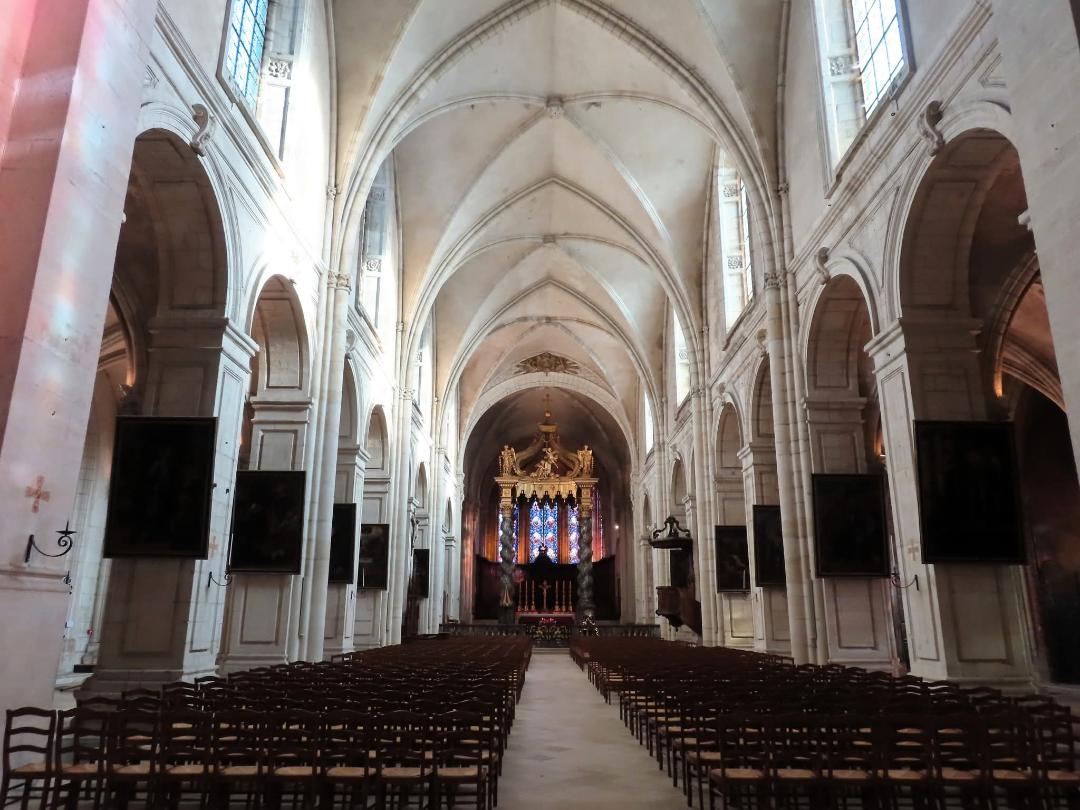
The cathedral is 94 meters long. It is 12 meters wide at the nave and 37 meters wide at the transepts. The vault is 19 meters high. The eight-bay nave with side aisles has nine Gothic side chapels. The western choir, or “old choir,” has a flat apse, while the eastern choir, or “new choir,” has a seven-sided apse built in the 12C and then heightened in the 14C. The baldachin installed at the crossing of the transept and the eastern choir is a smaller replica of the one in St. Peter’s Basilica in Rome. Sculpted in 1760, it is made of marble, stucco, gilded wood, and ironwork. The choir balustrade is inspired by that of the Luxembourg Gardens in Paris. The ensemble is intended to draw the viewer’s attention to a symbol of Baroque art and to make them forget the cathedral’s medieval image.
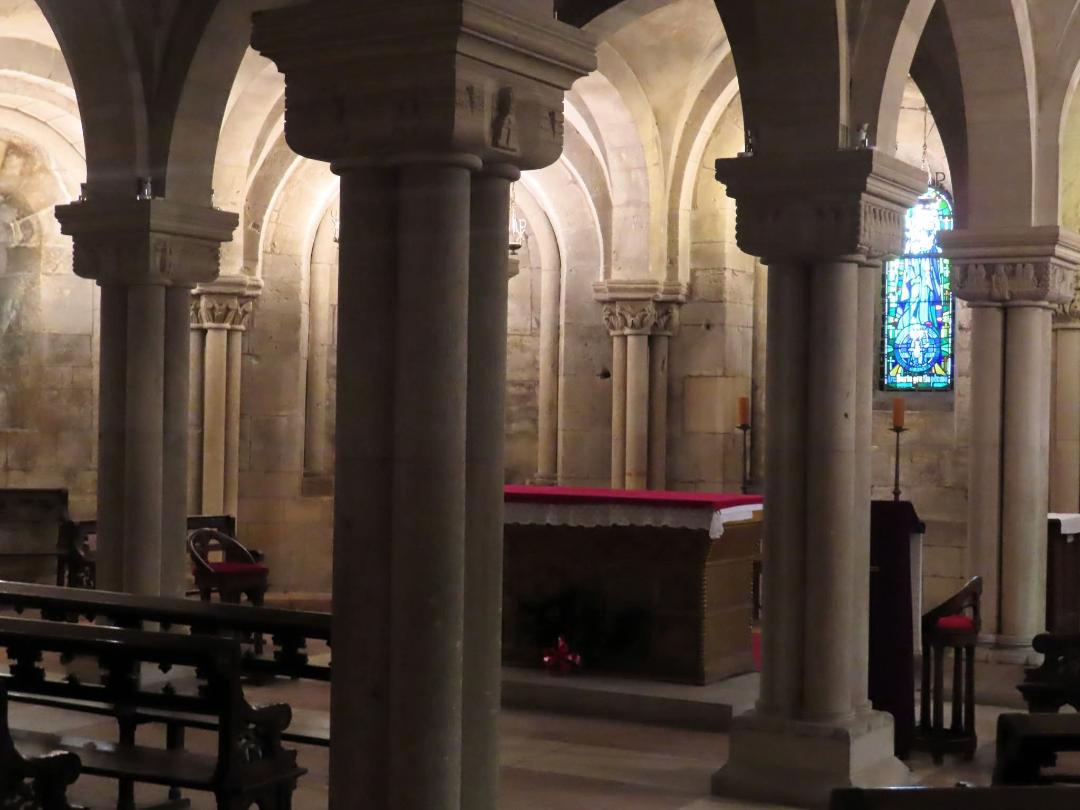
The crypt was built in the 12C. It consists of a central hall crypt and two lateral annex crypts serving as access points. It was filled in after the fire of 1755 and rediscovered after the Great War or WWI thanks to German bombing. It was restored in 1935, and the capitals of the 13 pillars of the crypt were created. The sculptures depict scenes from the religious life of the town and the Battle of Verdun in 1916. The statue of the Virgin Mary was sculpted in 1932. The vaults, walls, and transverse arches of the south wing of the crypt are painted with 15C frescoes. These latter depict religious subjects such as the Annunciation, the Presentation of Jesus in the Temple, the Nativity, the Visitation of the Virgin Mary, and the Last Judgment. The Resurrection is recounted in eight small paintings on a transverse arch.
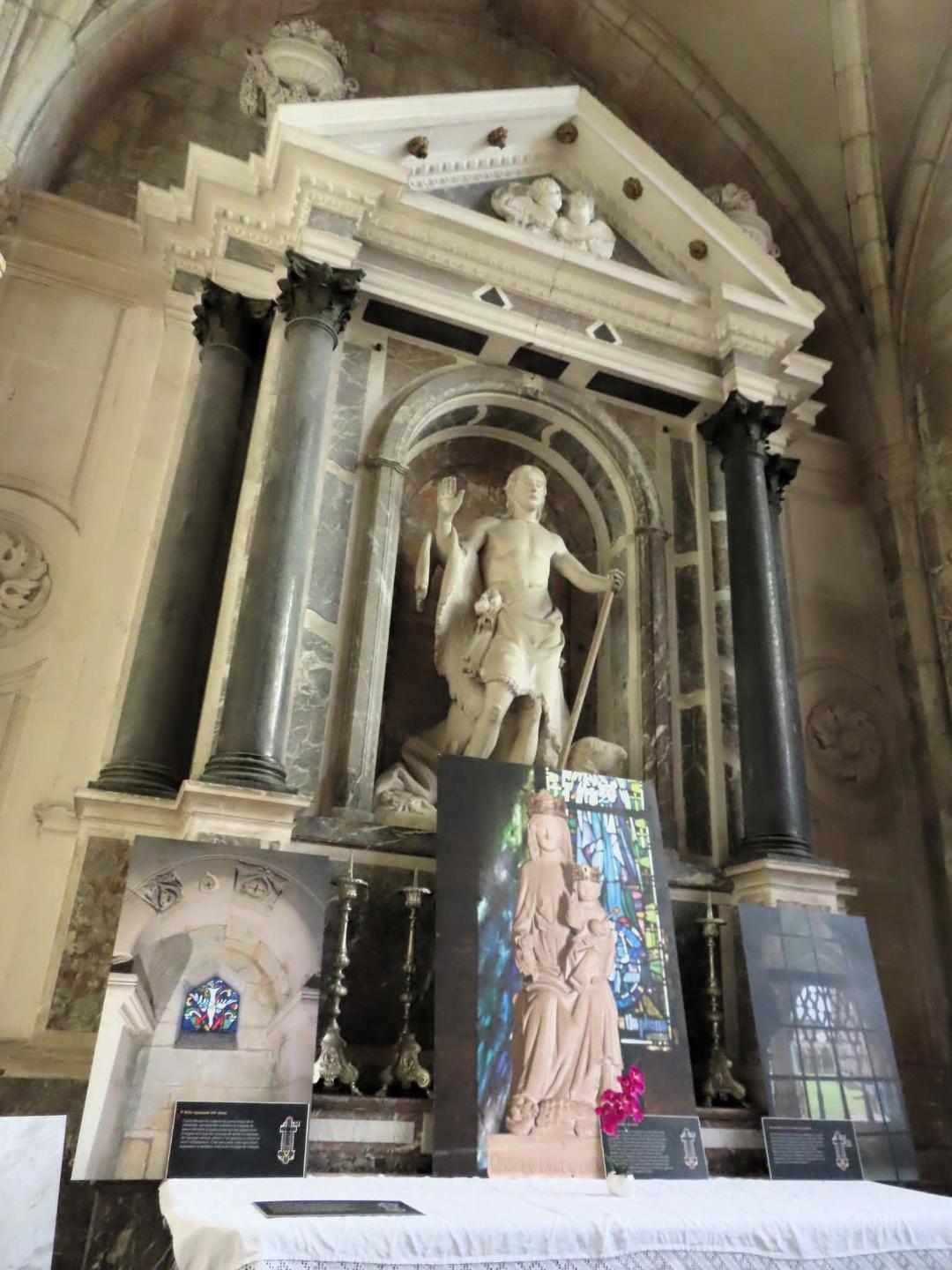
The Chapel of the Rosary was built between 1505 and 1515 in the Flamboyant Gothic style. It was one of the last to be erected and is adorned with several sculptures. The Baroque altar is surmounted by a Pietà dating from around 1774. The chapel is enclosed by a 19C. See pic the Chapelle Saint Jean Baptiste
The pulpit dates from 1760, replacing the one destroyed in the fire of 1755. Carved from oak, the motifs on the stair railing illustrate the parable of the sower, the Sermon on the Mount, and Isaiah’s prophecy concerning the ascension of nations to heaven. The stalls in the eastern choir also date from 1760. They include the bishop’s throne in the center of the apse, with the canons’ seats on either side. The numerous decorations refer to the Holy Scriptures. The stalls were removed for safekeeping during the Great War or WWI and subsequently restored.
The gallery organ was built starting in 1762, following the great fire of 1755. It features a Louis XV style case with a large organ in six towers measuring 12 meters wide by 10 meters high, and a positive organ in four towers measuring 3.5 meters wide by 3 meters high. It was installed in 1766 in the south transept.
The Notre-Dame Cathedral houses no fewer than nineteen bells in its two towers, cast between 1756 and 1955. Sixteen of these bells, covering exactly two octaves, can be rung in full peal and thus constitute the second most extensive peal in France. The Flamboyant Gothic cloister has a total length of 87 meters. Its three galleries provide access to the chapter’s outbuildings. The clerestory of the eastern gallery dates from the 14C, while the rest of the cloister was built between 1509 and 1517.
The Cathédrale Notre Dame houses the reliquary of Saint Saintin. He evangelized the city of Verdun in the 4C. During the French revolution of 1789, the relics were hidden in the tomb of Aymar-Chrétien-François de Nicolaÿ. In 1804, Antoine Eustache d’Osmond, Bishop of Nancy-Toul, who administered the Diocese of Verdun, had these relics placed in a reliquary. The Reliquary of the Holy Veil contains a relic taken from the Veil of the Virgin, a treasure of Chartres Cathedral. The relic was given to Verdun on October 20, 1933, by Raoul Harscouët, Bishop of Chartres. The reliquary is a bronze sculpture, gilded with mercury nitrate, created in 1933. It represents Notre Dame of Verdun, holding in her hand a glass tube containing the relic, and enthroned on the cathedral as it was before the fire of 1755.
A bit of history I like tell us that the Notre Dame Cathedral was built in the 10C, the oldest Cathedral in Lorraine and the biggest Roman style building on the East of France. From the 16C it has several renovations like adding lateral chapels and a cloister. Damage in WWI it was rebuilt from 1920-1935, and while at it found roman parts in the crypt from the 12C. It is located at Place Monseigneur Ginisty. At the beginning of the 4C, Verdun was evangelized by Saint Saintin de Meaux who had the first church dedicated to Saint Peter and Saint Paul built on Mont Saint-Vanne.The church was replaced in the 10C by the Abbey of Saint-Vanne in Verdun. In the 5C, after the barbarian invasions, Saint Pulchrone moved the cathedral to the safety of the Roman castrum, on its current site. The cathedral was dedicated to the Virgin Mary. From 990 to 1024, he had a new cathedral constructed according to the Rhenish Romanesque plan: a nave, two transepts, two opposing flat apses, each flanked by two bell towers. The pillars are square and the roof is timber-framed. On November 11, 1147, Pope Eugene III, who had been in exile in France since March 9, 1147, consecrated the cathedral in the presence of 18 cardinals. A stained-glass window located in the western transept, depicts this event. From the 15C to the 16C, several chapels were built and the cloister was rebuilt in the Flamboyant Gothic style. On April 2, 1755, the cathedral was severely damaged by lightning, leading to its reconstruction in the Baroque and Rococo styles. A baldachin similar to that of St. Peter’s Basilica in Rome was installed at the crossing of the transept and the eastern choir. Furthermore, the crypts, the Lion Portal, and the Venetian galleries were filled in. During the Great War or WWI, and more specifically the Battle of Verdun in 1916, the cathedral was damaged by bombing. The cathedral, however, remained an observation post overlooking the Meuse valley, as well as a garrison for French soldiers from 1919 to 1935. The destroyed sections were rebuilt, and the elements concealed in the 18C were brought to light. On November 10, 1935, the high altar and the crypt were consecrated. On July 2, 1946, the statue of Notre Dame was crowned by Angelo Roncalli, the future Pope John XXIII. Pope Pius XII elevated the cathedral to the dignity of a minor basilica by an apostolic brief dated September 8, 1947, the 900th anniversary of the cathedral’s dedication.
The Verdun tourist office on the Cathedral: https://en.tourisme-verdun.com/decouverte/post/verdun-s-cathedral?template=tpl-cms
The city of Verdun on the cathedral: https://www.verdun.fr/tourisme-loisirs/patrimoine/cathedrale-de-verdun/
The Meuse dept 55 tourist office on the cathedral : https://www.lameuse.fr/je-visite/activites-et-visites/visiter/p/cathedrale-notre-dame-verdun
The Grand Est region tourist office on the Cathedral : https://visitgrandest.com/cathedrale-notre-dame-de-verdun
There you go folks, a nice walk to be able to see some wonderful architectural stunning building in historical Verdun. Enjoy the walk, the best way to see a place, no different here. The text comes from the tourist sites above and mostly from wikipedia, Again, hope you enjoy the post on the Cathédrale Notre Dame of Verdun !!! as I.
And remember, happy travels, good health, andn many cheers to all !!!

 Paris1972-Versailles2003