
In my road warrior ways of my belle France, I have come to meet many small towns that really makes France, the best, In one of my favorite regions, passing by and lucky to have found me these pictures in my cd rom vault that should be in my blog for you and me, Let me bring out more visible the city of Saintes, that needs to be seen more, me think. Therefore, this is my take on the Basilique Saint Eutrope of Saintes !!!Hope you enjoy it as I.
The city of Saintes is located in the Charente-Maritime department 17 of the Nouvelle-Aquitaine region of my belle France. The city stretches on either side of a loop of the Charente river , 75 km from La Rochelle,117 km from Bordeaux, 469 km from Versailles, and 382 km from my current home. The A10 autoroute/highway crosses the town in its western part, along a north-south axis. Accessible via the 35 interchange, I came here from Versailles along the A10 autoroute to exit/sortie 35 taking the D137 to city center Saintes on the D24 road follow Basilique
The Basilica Saint Eutrope was Christianized in the course of the 3C, Among the oldest testimonies of sacred architecture in Saintes, the basilica occupies a preponderant place. Built in 1081,at the instigation of the Duke of Aquitaine and Count of Poitou William VIII of Aquitaine, it was then a stopover for pilgrims on their way to Santiago de Compostela in Spain. Its bell tower topped by a flaming spire dates from the 15C and is due to the donations of King Louis XI. Its crypt or lower church is one of the largest Romanesque crypts in Europe. On May 11, 1886, an apostolic brief from Pope Leo XIII elevated the church to a minor basilica. Consecrated by Pope Urban II in 1096, it honors Saint Eutropius, martyr, first bishop, and evangelizer of the region. His tomb, placed in the crypt, has since been visited by numerous pilgrims on their way to Santiago de Compostela. Since 1999, the basilica has been classified as a World Heritage Site under the Routes of Santiago de Compostela in France.
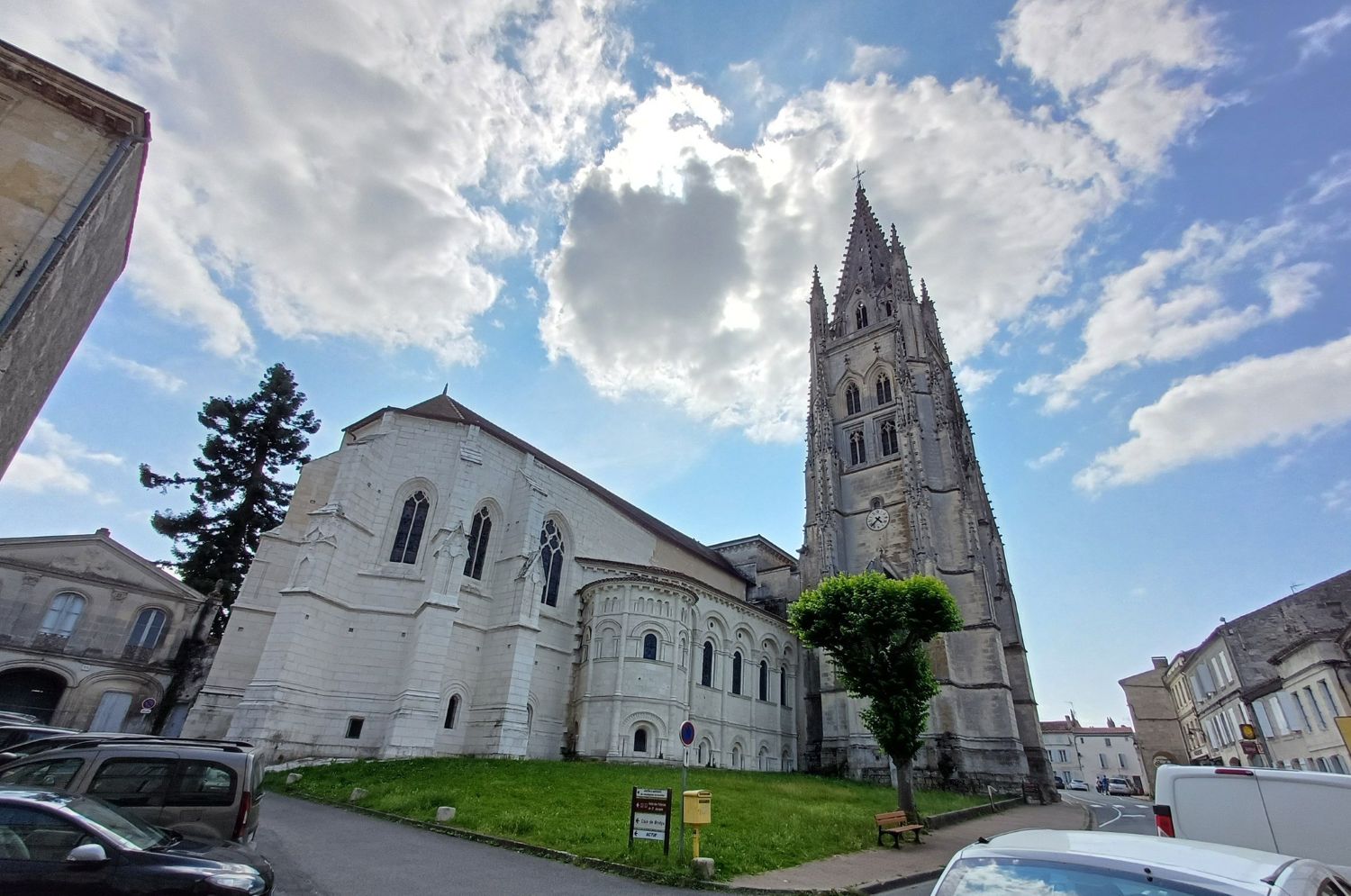
A masterpiece of Saintonge Romanesque art, the Saint-Eutrope Basilica ,also incorporates elements of other styles, such as the spire 15C, a pure product of Flamboyant Gothic, built thanks to a donation from King Louis XI. The spire rises to almost 80 meters built in 1478. The north side and its curious apse, This entire part of the old church ,which is the only one to survive after its destruction in 1803, dates back to the late 11C. The refinement of its decoration makes one regret the loss of the old nave.
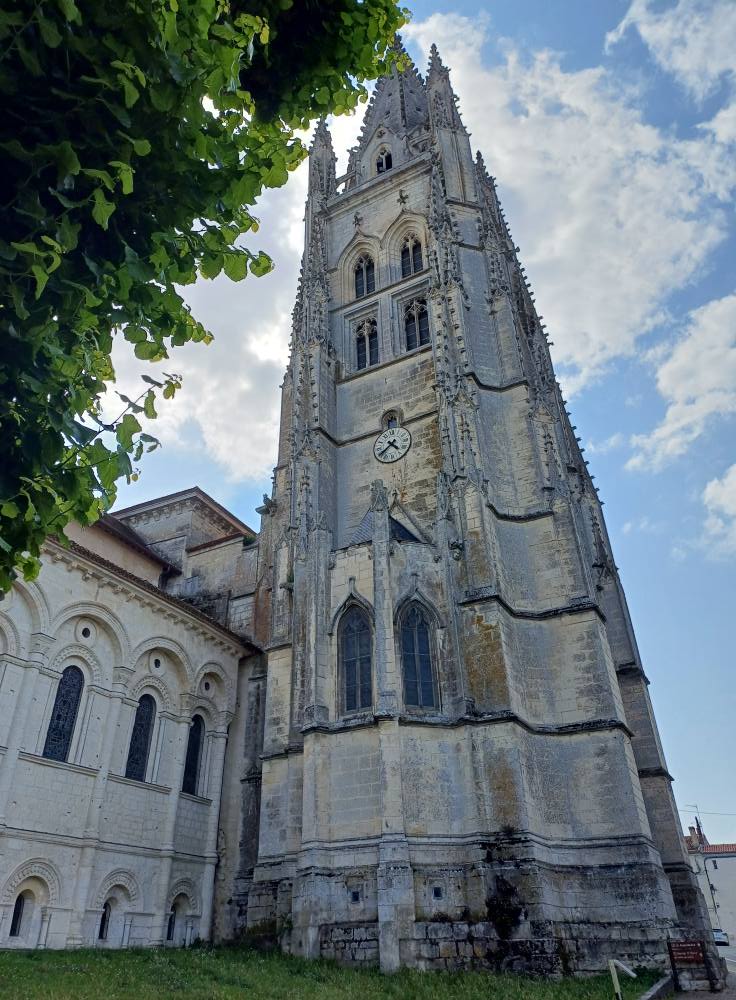
The choir, also Gothic, dates from the 16C, and the current facade, a very sober Romanesque pastiche, dates from the 19C. The basilica retains numerous extremely careful Romanesque capitals and a series of stained-glass windows. Saint Eutrope or Saint Eutropius. The life of this saint is not very well known and sometimes turns into a legend. Born in Persia, he heard about Christ at Herod’s court. He became a disciple, then an apostle of the Santons. Mistreated in Saintes, he fled to Rome. But Pope Clement crowned him bishop and sent him back to Saintonge. Working with virtue and charity, conversions multiplied. Estelle, the legate’s daughter, requested baptism. Then, renouncing the world, she built her hermitage near the bishop’s. The enraged legate ordered Eutropius’s death. This was done with an axe. Estelle had his body buried and would soon be martyred in her turn. The relics of the two saints are venerated in the church’s crypt.
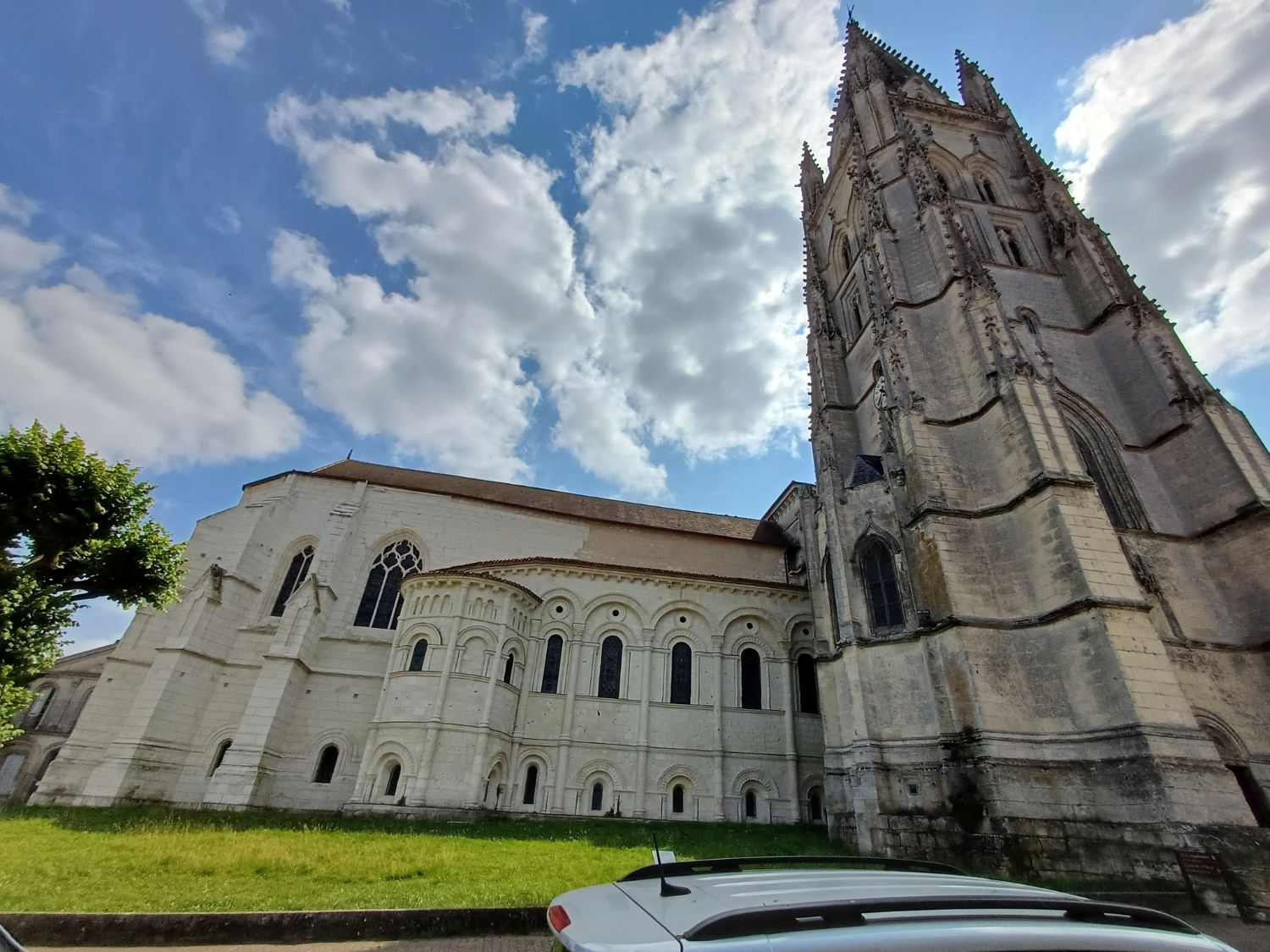
The city of Saintes seems to have had its first churches during late Antiquity. Tradition dates the foundation of the first cathedral back to the 5C, although no archaeological evidence has come to corroborate these claims. In the 6C, a funeral basilica was built around the tomb of Bishop Vivien, outside the city wall. Reaching episcopal dignity in 573, Palladius promotes the cult of Saint Eutrope, evangelizer of the city of Santons. He had a first basilica erected in his honor in the valley of the Arenes. No trace of these early Christian sanctuaries remains today, most of them having either been destroyed or replaced later. In fact, most of the city’s churches have been taken over in the Middle Ages. In 1789, the last prior of Saint-Eutrope, Henri-François d’Aubourg, died. The priory’s cartularies and charters were seized by the revolutionary authorities a few months later and condemned to be burned in public during the Terror in application of the law “on titles of feudalism and superstition” of July 17, 1793. On August 10, the parchments containing the history of the priory fueled a pyre established on the Place des Cordeliers, with the exception of a few documents protected by a man named Lacoste, a member of the municipal administration.
The official Basilique Saint Eutrope: https://saint-eutrope.com/
The city of Saintes on its religious heritage so the Basilica : https://www.ville-saintes.fr/decouvrir-sortir/les-incontournables/edifices-religieux/
The Saintes tourist office on the Basilica of St Eutrope : https://en.saintes-tourisme.fr/saint-eutrope-basilica/
The official French agency for the way of Santiago de Compostela on the Basilica : https://www.chemins-compostelle.com/composante-du-bien/eglise-saint-eutrope/
There you go folks, a dandy town of my belle France that needs more time. We will be back, eventually, Saintes has a lot of great architecture and history to spent at least two days. Again, hope you enjoy the post on the Basilique Saint Eutrope of Saintes !!! as I
And remember, happy travels, good health, and many cheers to all !!!

 Paris1972-Versailles2003