
I just found older but new pictures in my cd rom vault and they should be in my blog for you and me, It was a road warrior trip going by Orléans and not able to see all but just a nice monument indeed, We shall be back, eventually, Let me tell you here on the Collegiate Church Saint Liphard of Meung sur Loire, part II !!! Hope you enjoy it as I.
The town of Meung-sur-Loire is located in the Loiret department no, 45 in the Centre-Val de Loire region of my belle France, It is 19 km from Orléans, 8 km from Beaugency, 124 km from Le Mans, 145 km from Versailles, and 404 km from my current home, The town is crossed by three main axes: the A10 autoroute/highway and three departmental roads ,the RD 2152, RD 2 and RD 3. The A10 aka Autoroute d’Aquitaine, links Paris to Bordeaux (at the level of its ring road) via Orléans, Tours, Poitiers and Niort. The Meung-sur-Loire interchange, which constitutes exit/sortie no, 15, is located on the territory of the town.
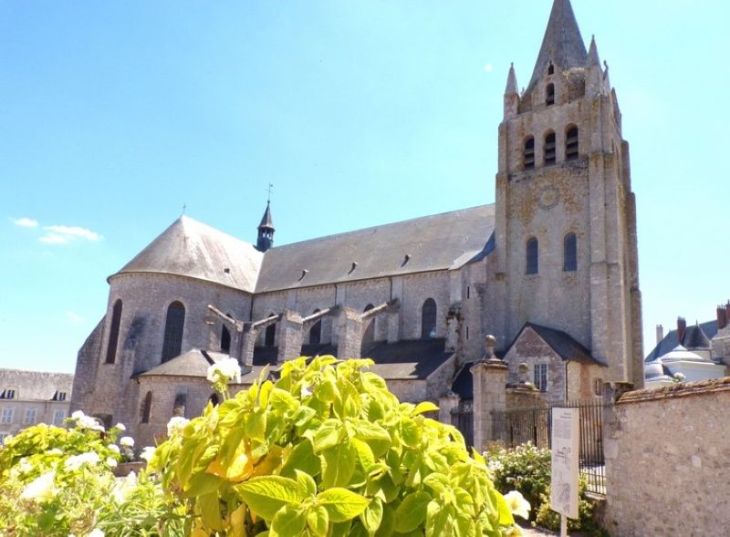
The Collegiate Church Saint-Liphard is from the 11C to the 13C, built on the tomb of the saint, is a church with Romanesque parts. The bell tower is backed by a fortified tower, called Manassès de Garlande. The church plan is in “clover” with three semi-circular apses which is not usual in the region. It contains an organ rebuilt in 1971. The church was again restored around 1570, and in the 19C and again in 1985.

On the death of Liphard in 565, an oratory was built on his tomb, under the aegis of Marc, bishop of Orleans. Then, the city becomes lordship of the bishops of Orleans. At the end of the 9C, the monastery was partly destroyed by the Norman invasions. An abbey church in Romanesque style replaces the previous one in the 10C. Its plan is in a Latin cross, East-West oriented, however the transept finished in hemicycle and the apse of the choir gives it a form of clover. Unique in the region, this Tréflé plan is generally found in churches in northern France, and Rhine countries. In 1068, the monastery is secularized, it no longer follows the monastic rule. The church becomes collegial. The porch tower is built. In 1103, Lionel de Meung, lord felon of the bishop, took refuge in the church with his troops. The bishop appeals to the future Louis VI le Gros. The rebels not wanting to go,burned the church. There is only the bottom of the bell tower from the church.
The church was rebuilt and consecrated on October 14, 1104. The fillings are numerous: the sculpted modillions and the portal … Around 1160, Bishop Manassès de Garlande built a fortified house (today the ruined tower) attached to the Tour Clocher. It serves as a chapter room, court and prison. The bishop makes justice there and has it enforced.
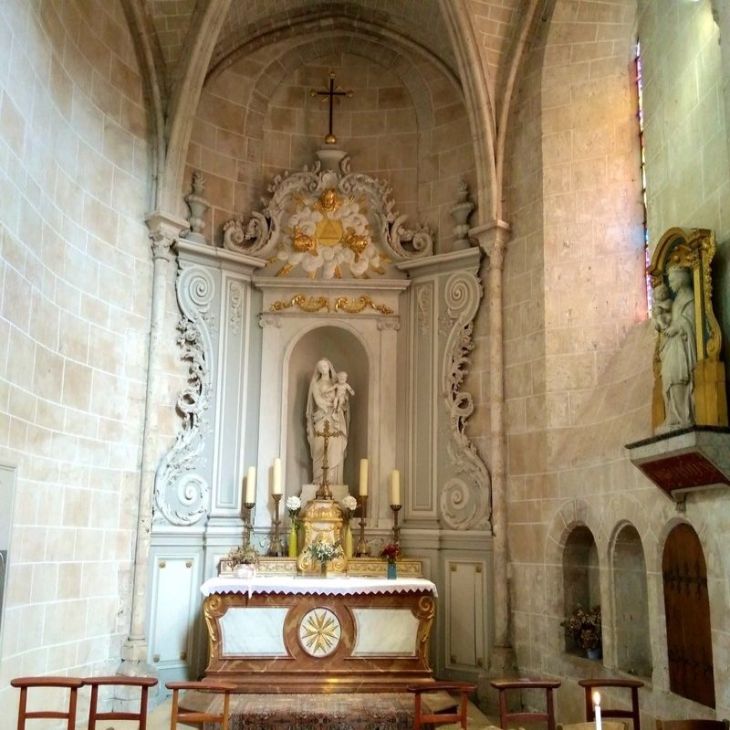
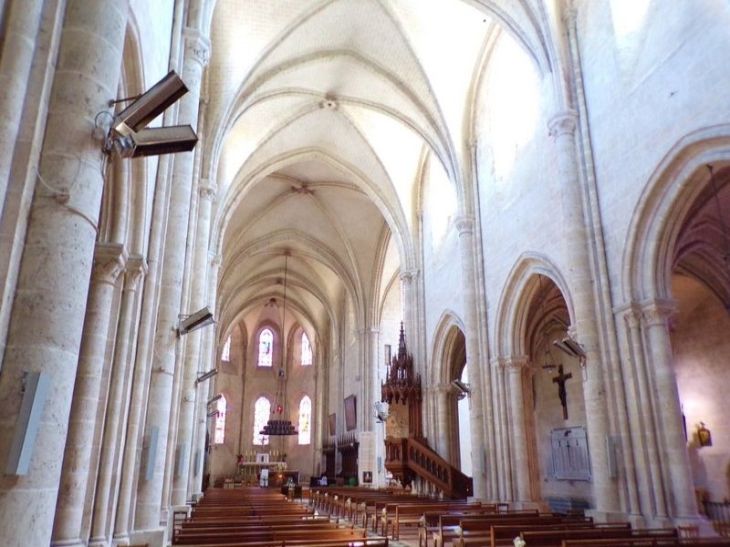
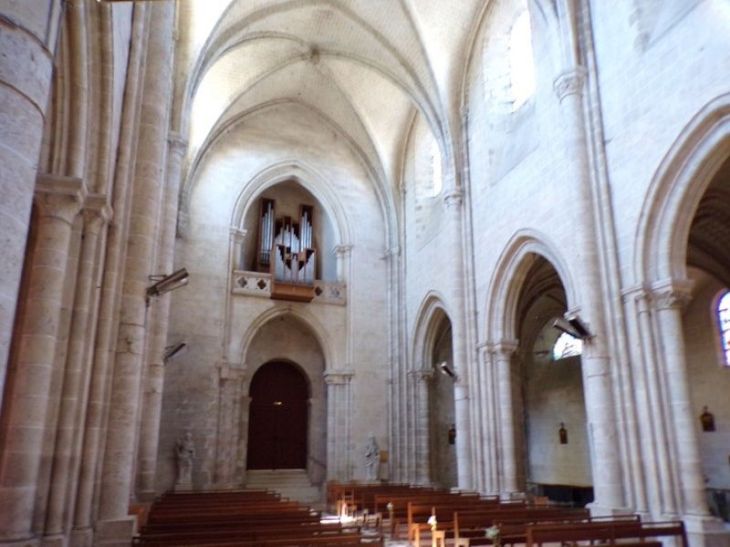
In the 12C, the Romanesque church was transformed into a Gothic church: enlargement of the choir, elevation of the nave and the vaults, enlargement of the aisles. In the 14C, chapels were added. The collegiate church measures 56 meters long, including 18 meters of choir. The large nave is 12 meters wide, and the 32 meters transept for 16 meters high. In 2004, for the 900th anniversary of the dedication, the west portal is reopened, the porch tower is restored and a chandelier made by Goudji was installed above the major altar. The info above comes translated mostly from the City webpage on the church,
Other things to see here with more time are the Château de Meung-sur-Loire , Former residence of the bishops of Orleans, it was delivered by Joan of Arc from the hands of the English in 1429, before becoming a prison. Today, the passion and dynamism of the owner make this castle a lively and culturally exciting place. Demonstrations of fencing with musketeers, and of course do not miss the arrival of Joan of Arc, the icon of Orléans! The castle is located at 16, Place du Martroi, Also, the Porte d’Amont, the only rest of the fortifications that surrounded the city. It dates from 1629. It includes a clock, one of the dials of which has 61 minutes, The famous novel Les Trois Mousquetaires (1844) by Alexandre Dumas begins in Meung-sur-Loire; and the end of the novel Le Club Dumas (1993) by Arturo Pérez-Reverte takes place in the castle of the town.
A bit of history tell us that a Gallo-Roman village was called Magdunum and was located in a very swampy region, Tradition tell us that it was Saint Liphard around 520 which had the places cleansed, channeling the rivers that became the Mauves. He built a chapel there, which then became a monastery. In 1103, King Louis VI seized the fortress. A year later, the relics of Saint Liphard are placed in the church. The fortified abbey home that adjoins the church was put in construction during the 12C. Jeanne d’Arc came to meditate in the church in 1429. The Battle of Meung-sur-Loire took place on June 15, 1429, it was one of the battles that followed the siege from Orleans.
Between January 29 and February 8, 1939, more than 2,800 Spanish refugees fleeing the collapse of the Spanish Republic in front of Franco’s troops, arrived in the Loiret. In front of the insufficiency of the host structures of Orleans, 46 rural reception centers are open, including one in Meung-sur-Loire. Refugees, mainly women and children (men are disarmed and held in the south of France), are subject to strict rules, vaccinated, mail is limited, and food, if it is not very varied and cooked French, however, is assured. Part of the refugees return to Spain, encouraged by the French government which facilitates the conditions of return, and those preferring to stay are grouped at the camp de la verrerie des Aydes in Fleury-les-Aubrais.
The town of Meung sur Loire on its history/heritage : https://meung-sur-loire.com/ma-ville/histoire-et-patrimoine/
The local Terres du Val de Loire tourist office on Meung sur Loire : https://www.tourisme-terresduvaldeloire.fr/meung-sur-loire/
The Loiret dept 45 tourist office on Meung sur Loire : https://www.tourismeloiret.com/fr/decouvrir/les-incontournables-made-loiret/meung-sur-loire/voir-faire
There you go folks, this was a pleasant visit and should return eventually, A quant nice historical town with great architecture , Again, hope you enjoy the post on the Collegiate Church Saint Liphard of Meung sur Loire, part II !!! as I
And remember, happy travels, good health, and many cheers for all !!!

 Paris1972-Versailles2003