
I like to take you back to beautiful historical and gourmand Saumur ! As we love to walk once in town , we delight ourselves with the wonderful architecture of these streets. Then, as an amateur historian i like to indulge on their beginnings by talking with the local people, visiting the tourist office and the folks at the various monuments in town. A rich tradition of France we enjoy it much. Oh yes Saumur is in the dept 49 of Maine et Loire in the region of Pays de la Loire, a different Loire. I like to update this older post with new text and links for you and me, Therefore, here is my new take on the streets of Saumur !!! Hope you enjoy it as I.
First a bit of history and details on the wonderful central pretty Place de la Bilange. A large vacant lot that has hosted the weekly Saturday market since the 12C. The name appears between 1150 and 1200, in a charter where Marie de Maillé gives a house located “in bislenchia salmuriensi” The word becomes “Bislengia” in 1218 The French form “la Billenge” is attested in 1268. Without a doubt, the name comes from the word Bilanx, which becomes Bilancia in popular Latin and which designates a large balance characterized by a plague carrying two trays. Balance as in weights for merchants taxes. From 1794 to 1808 it was called the Place du Salut Public, when the guillotine is installed at the location of the pillory. From 1808 to 1818: Napoleon Ier gives it his name since he came to spend an hour in the Blancler Hotel. Since 1818 it returns back to the primitive name, which, according to the law of the least effort…, the local Saumurois often abbreviate in place Bilange.
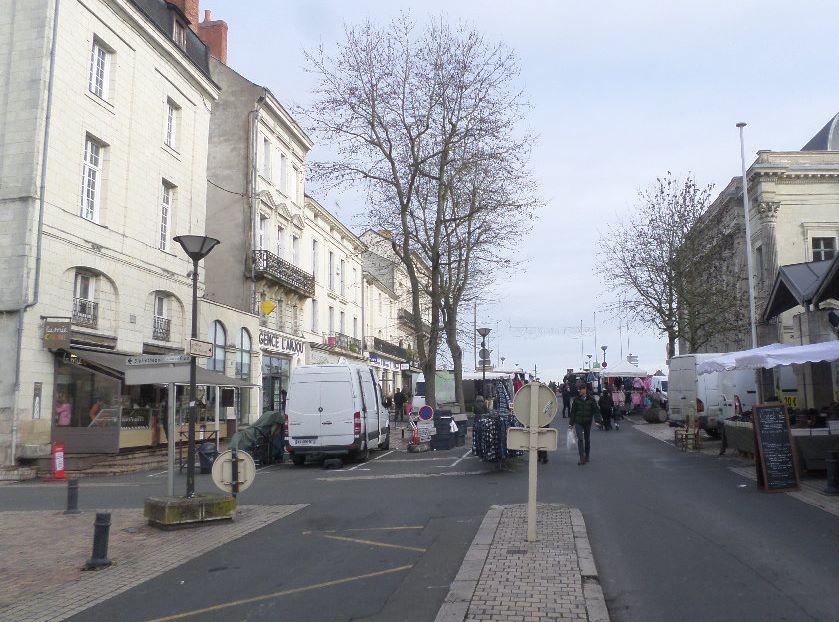
In 1913, the Place de la Bilange offered around its perimeter eight cafes; complemented by a wide variety of shops. Its center is remodeled roughly every ten years. A stop for the tram makes a short appearance. In the early years of the 20C, the square was brightly lit by curious lampposts, comprising four gas burners surmounted by a huge electric bulb. In the 1950s, when it was decorated with a small fountain, very quickly filled with earth. In the 2000s, the shopping mall appeared. Some of the nice buildings to see here are at no. 1 to 6 – The Bourse building and the following houses were built in 1772-1773, in the style of the facades of rue Molière. No 15 – Large solemn building from 1876, covered with moldings, coats of arms, pediments, fruit, flowers and bearing the initials “CP. At no. 16 – House bearing the date of 1731 on its skylight. No. 17 – Building dating back to 1746 . At the angle of the place de la Bilange and the quai Carnot see the Budan hotel, this luxurious hotel, completed around 1852, became the residence of all passing personalities. And finally the Place de la Bilange did not escape its English roundabout, intended to smooth the circulation as in traffic circle.
I move on to the Place Saint Pierre was briefly called in 1794: Place de la Fraternité during the French revolution. It is a wonderful picturesque square today and back been call the Place St Pierre for its Church St Pierre. The place de l’église and a passage, the carrefour de le Cohue, that is to say the carrefour de la Halle. This passage is very narrow; it crosses an old building built on pillars and comprising on the ground floor halls surrounded by small shops and, above, the Palais de Justice or Palais Royal. The square is covered with buildings and framed by two streets. On the northern flank, at the bottom, the narrow rue de la Pâtisserie is cited from 1387-1388; later, it was baptized “rue du Petit-Maure and, in 1794, the” rue des Amis “. The widening of its end, which joined the rue du Paradis, was, on a map at least, called the rue de Rome On the southern slope, above, the extension of rue du Paradis, tortuous ancestor of rue Dacier.
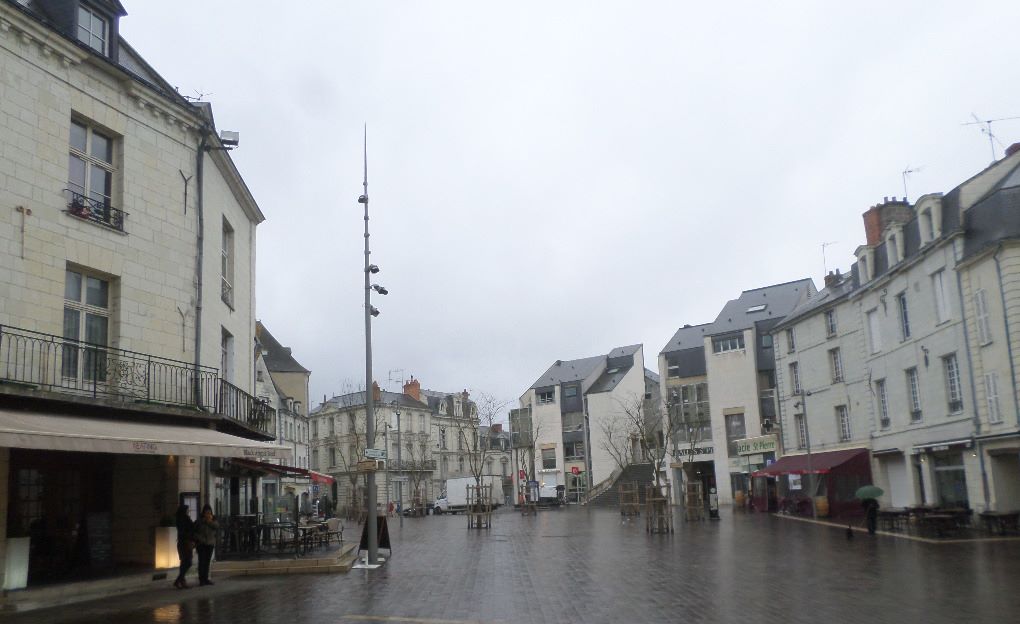
The Royal Palace, threatening to collapse, was deserted by the courts in 1757, and it was destroyed with some neighboring buildings in 1766. This tiny space was successively called Place du Marché au Blé and Place du Minage, and carrefour Royal in the 18C and carrefour Dacier in 1818. It was decided by the city of Saumur to build a covered market or halles in a medieval style between the new City Hall and the current rue Corneille. Finally, the city completed in 1902 the construction of a new covered market The halles were destroyed in February 1980, The Place Saint-Pierre has some nice buildings we like here are at no. 18 to 36 – replaces the covered market offering more usable space and has parking. Its mirror facade reflecting the Saint-Pierre Church At no 12 and 10 – High buildings from the 17C, corresponding to the curved facades of the old rue du Petit-Maure. At no. 6 and 8 house forming the angle with the rue de la Tonnelle meets the standard of the years 1770-1820. Further to the right, Auberge Saint-Pierre has a marked overhang; as on the house at no.3 bis, its half-timbering is formed of sophisticated wooden cross-pieces often taking the form of cross of Saint-André. In 2011, the owner carrying out renovation work in the cellar discovered a treasure consisting of 18 coins struck at the time of kings François I and Henri II, probably a nest egg buried by a resident who fled the city at the start of the Wars of Religion and who has not returned! At no.. 7 and 9 – Very vertical houses, built in the 17C on the site of the Maison du Minage. At no. 15-17 – Large house dating back to the 17C, but only the first floor has kept its original condition.
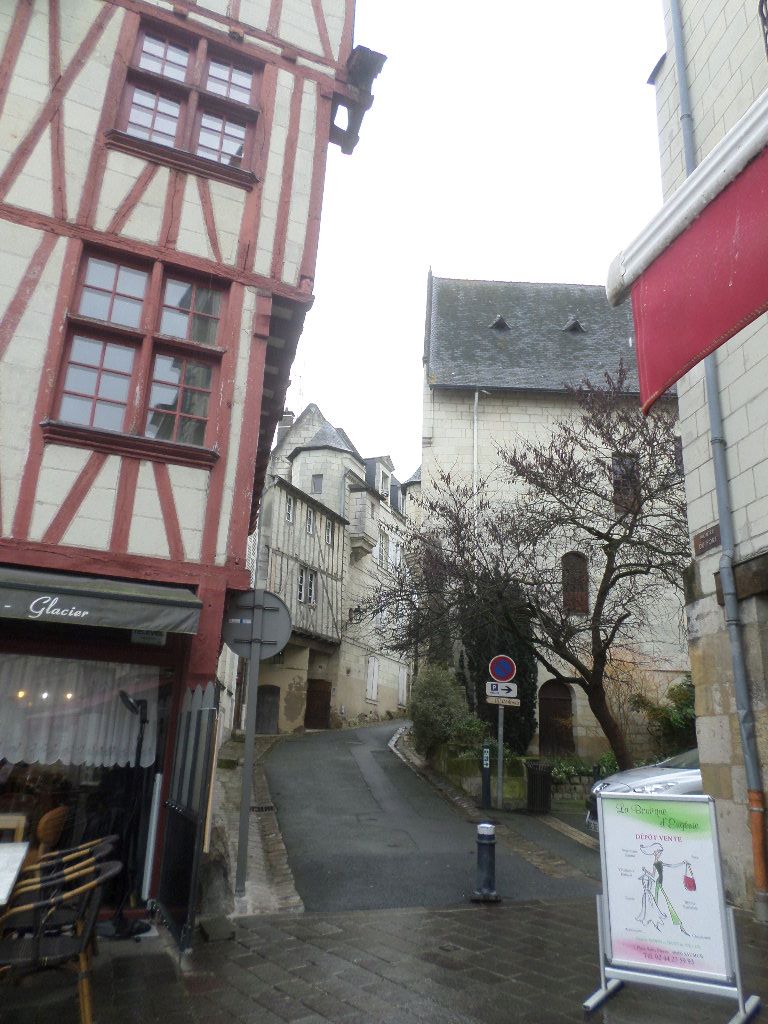
Then, you have the Montée or rue du fort is one of our favorites to walk! A narrow, steep path leading from the Carrefour royal, today from Place Saint-Pierre to the western entrance to the Château. Its existence and its route probably go back to the origins of the city, that is to say in the 10C. In its upper part, the road makes a large loop, which allows it to follow a lower slope line. This large loop was also called rue de Bellevue in the second half of the 18C and in the 19C. Built in its lower part from the 14-15C, the street is in its upper part lined with gardens or sparse houses. From now on, the climb or rue du Fort abruptly stops on rue des Patenôtriers, first percée Saint-Pierre, located below. The right side of the climb ,remains of an old door giving access to the enclosure of Boile 11-12C, door knocked down at the beginning of the 17C and which, by cross-checking, identifies as the Porte Marcouard gate. Left side of the climb at the corner of Place Saint-Pierre a 16C house, half-timbered over four floors, with a large overhang. Simple frame, well highlighted by the tufa slabs. The following houses, from the 16-17C, are built against the old 14C wall. At No. 7, the far left, has a wooden frame resting on a beam placed at an angle. At No. 9 is a large house. with a turret integrated into the house and a high perched watchtower.
Going over to the rue de Puits Neufs as it is call today was called Puyneuf in 1542 . The well, which was located at the end of rue de la Cocasserie, had probably just been dug at that time. The toponym Puits-Neuf or new well, indicates at that time an island of houses in the surroundings, and not a particular street . From 1794 to 1818 it was called the rue du Puits-Commun; and from 1818 the rue de Puits-Neuf prevails over the rue de la Laiterie. Some I like are at no 1-3 – These facades, squared by relief paintings and by the unadorned frames of the bays, characterize the civil residences of the end of the 18C and the beginning of the 19C. The lintel stones corresponding to two seats, these houses can be dated to the beginning of the 19C.
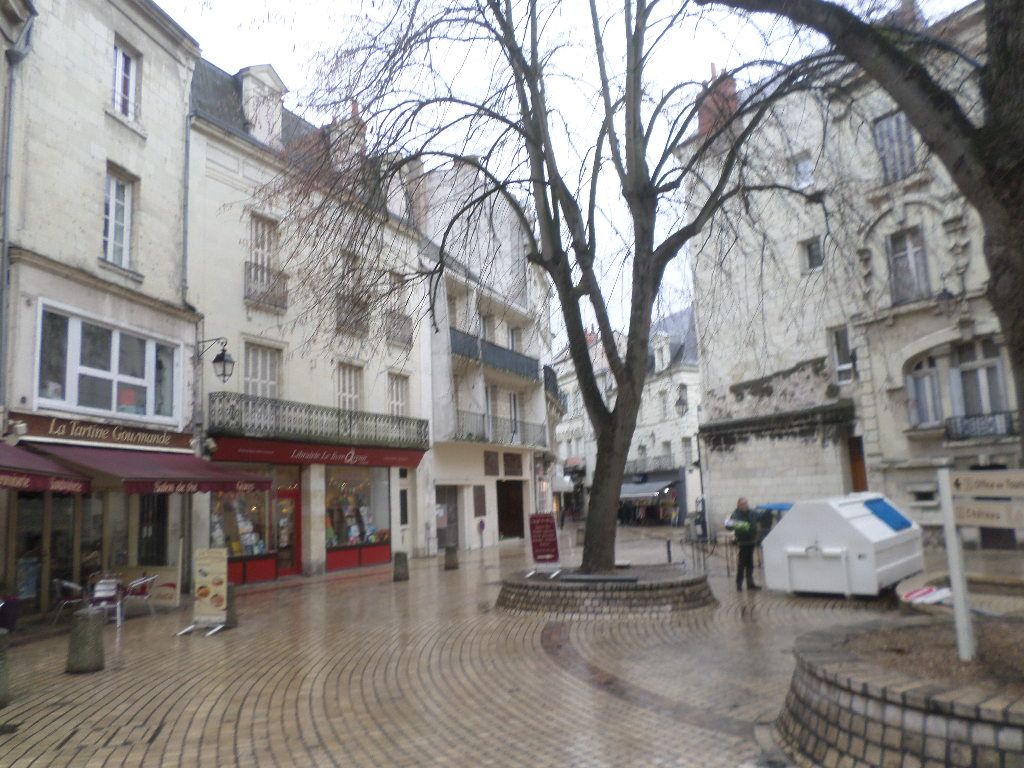
And we arrive at a modern name for a change but still an old street, the Rue Franklin Roosevelt . The narrow rue de l’Ecu or rue de l’Ecu de France extended the rue du Portail-Louis and joined the Place de la Bilange at an angle. Several passages opened to the west, one leading to the chapel of the college of Oratorians installed in the former Auberge de l’Ecu. The other opening into the courtyard of the hôtellerie de l’Ecu de France, which gave its name to this short, unimportant street. The layout of the future Pont Cessart bridge and the large rectilinear gap which will cross the town somewhat groped on the final location of our current Rue Franklin-Roosevelt and rue d’Orléans.
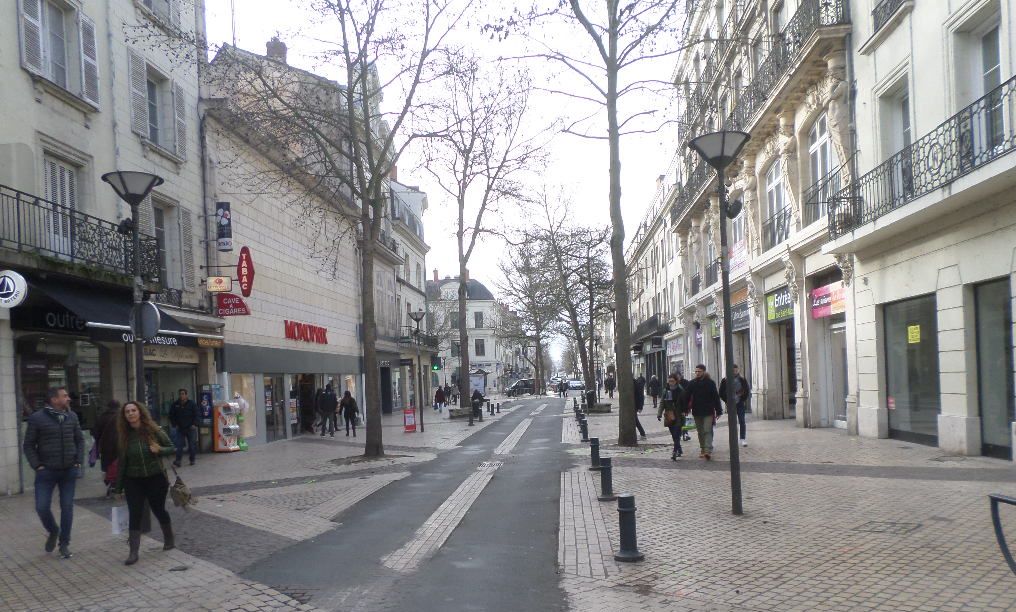
Another peculiarity of this first section of the old rue d’Orléans: it is, in the city, the only department store district, vast multi-purpose complexes dependent on a national chain, in which entry is free and the price fixed without haggling possible. In 1910, at no 6, 8 and 10, Arthur Duthoo, founder of the Grand Bazaar of Tours, inaugurated his Nouvelles Galeries, arranged around a large central staircase and resting on self-supporting metal structures, like the Parisian department stores . On the other side of the street, at number 15, was built around 1922 the Palais des Marchands ,hence the initials PM on the balconies, then renamed the Palais du Vêtement (Clothing palace). Astonishing set by its flashy decor and the trompe-l’oeil of the first floor. Conversely, at number 11, the Monoprix, which succeeded the Printemps, has a modern and austere facade. In any case, you are in the department store district. The location of the former hôtellerie de l’Ecu de Bretagne hotel is retained. The post office was done here because it dominates the new perspective created from the Cessart bridge. It was not completely completed until 1870. The death, on April 12, 1945, of the President of the United States caused great emotion and explained that he was awarded the name of this artery . The new denomination was finalized on Monday, July 21 1947, the first day of the carousel, when Brigadier General Tate, representative of the United States ambassador, came to cut a three-color ribbon at the entrance to the street.
The city of Saumur on its heritage and things to see: https://www.ville-saumur.fr/patrimoine-architectural
The Saumur tourist office on things to see: https://www.ot-saumur.fr/arts-et-histoire/villes-et-villages/saumur/
There you go folks, a nice walk really can be done in a day! we love it and hope you do too , Walking the streets of Saumur is going back in history and seeing wonderful beautiful architecture. Again, hope you enjoy this post on the streets of Saumur !!! as I
And remember, happy travels, good health, and many cheers to all !!!

 Paris1972-Versailles2003