
Another of my memorable times while living in Versailles and working in Paris for 9+ years was coming to these quant towns off the beaten path such as Rosny sur Seine. I found some pictures in my cd rom vault that should be in my blog for you and me, And again thanks for reading me since Nov 2010! Therefore, this is my take on curiosities of Rosny sur Seine !!! Hope you enjoy the post as I
The town of Rosny-sur-Seine is located in the Yvelines department,no, 78 in the Île-de-France region of my belle France. This small town, situated in a bend of the Seine river, is historically known as the land of Sully. It is located 6 km from Mantes-la-Jolie (see posts),5 km from Buchelay (see post), 50 km from Versailles, 57 km from Paris, and 442 km from my current home. The Normandy motorway (A13) runs entirely through it without directly serving it. A service area is located there as it crosses the town.
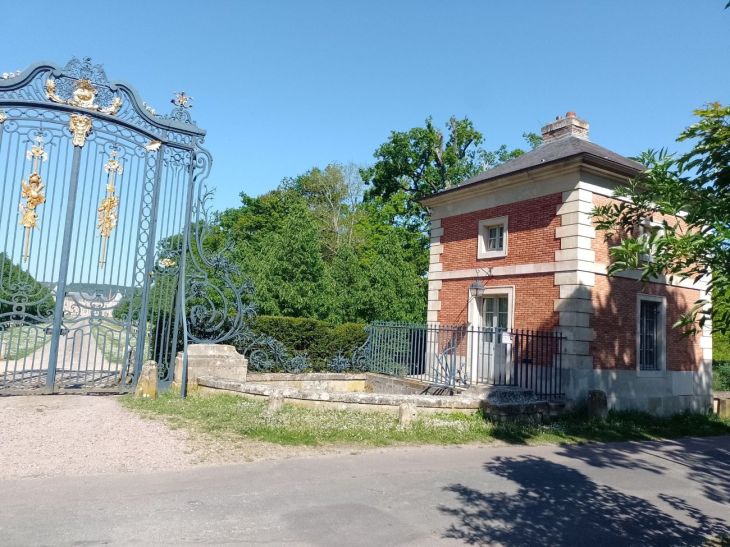
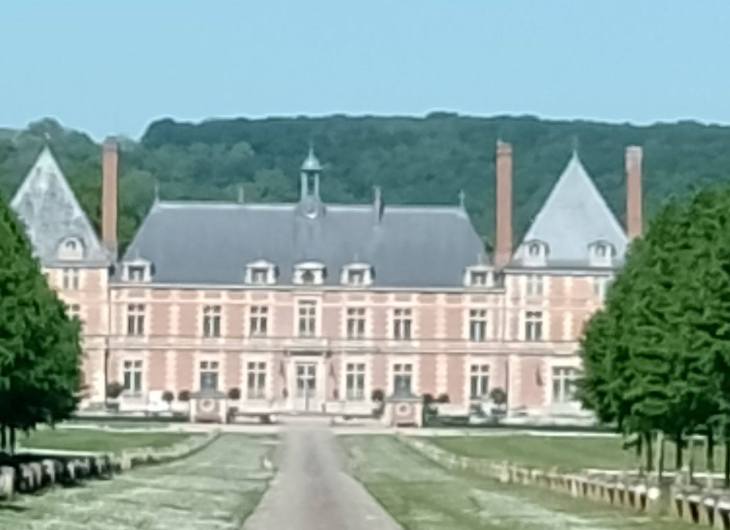
The Château de Rosny located at 4, rue du Guernes was built in brick and limestone by Maximilien de Béthune, Duke of Sully, at the end of the 16C, several residences preceded the current estate: a feudal fortress belonging to the lords of Mauvoisin, a besieged castle, burned and razed by the English during the Hundred Years’ War and which finally returned to the Béthune family in 1529. Acquired in December 1984 by a Japanese company, it was stripped of its furniture and sold at auction. Since 1999, the castle has belonged to successive private owners, the last having undertaken to completely restore the estate.
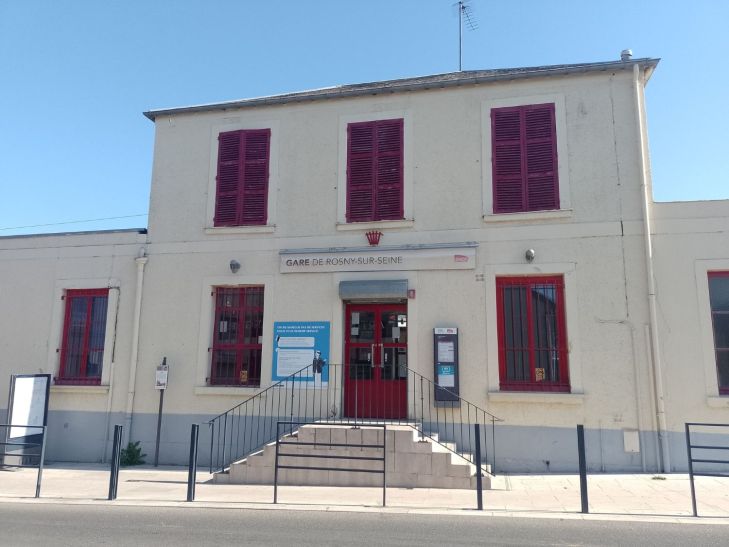
The Gare de Rosny train station, on the Paris-Rouen line, opened to passenger transport on May 9 , 1843. The inauguration on May 3, attended by the Government and the sons of King Louis-Philippe, was lavish. It was built on two floors, with a rendered facade on bricks. This architecture is still visible on the current building, although it has been rebuilt. The main passenger services are on the ground floor and the station master’s accommodation is upstairs. The tracks were electrified on January 14, 1966. Just passing by never use it.
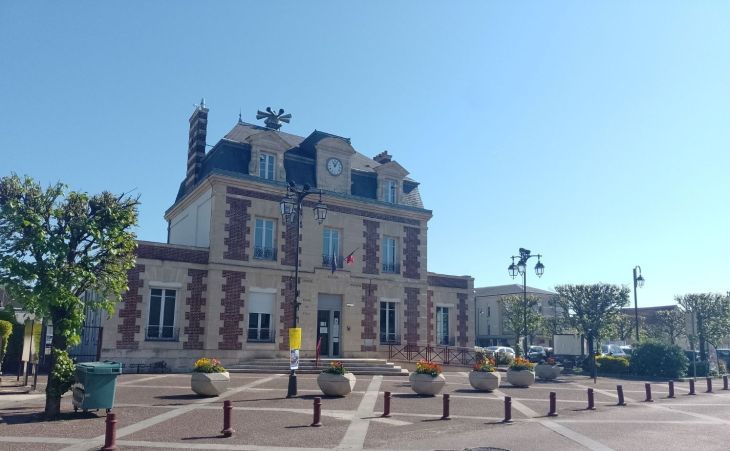
Since 1791, municipal affairs were conducted at the Mayor’s home. Jean-Baptiste Mercier, a farmer from Rosneville, sold his fully restored house to the town in 1831. This building, located at the end of a courtyard, was converted into a City/town hall. For nearly 50 years, the site retained its function. Deemed too small, it was sold in 1876. The current City/town hall was inaugurated in 1880.
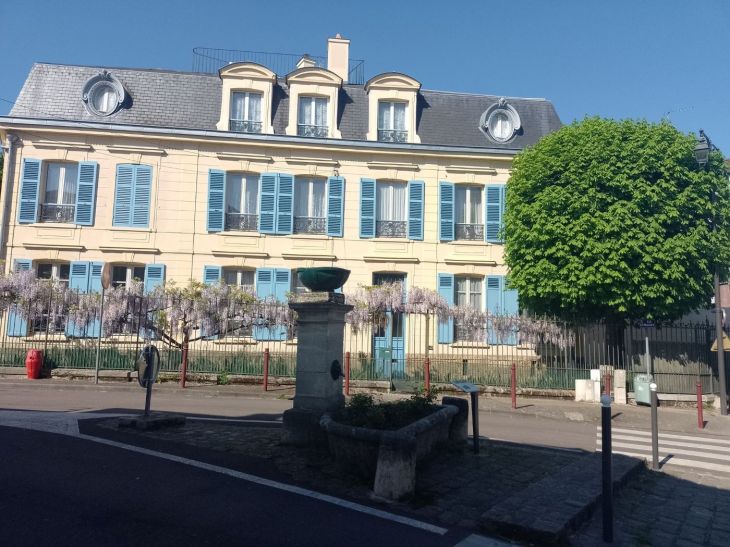
The town has two fountains: one located in Place de l’Eglise; the second, better preserved, the spout is still visible, at the intersection of Rue Lebaudy and Rue Nationale. Built by the Duchess of Berry, they were supplied by conduits connected to the large canal of the castle, formerly dug by the Count of Senozan. Gustave Lebaudy subsequently had artesian wells dug to supply the residents with drinking water, and this before 1914. If the basins emptied of their water were filled with earth to be flowered, the fountains remain an element of the town’s heritage.
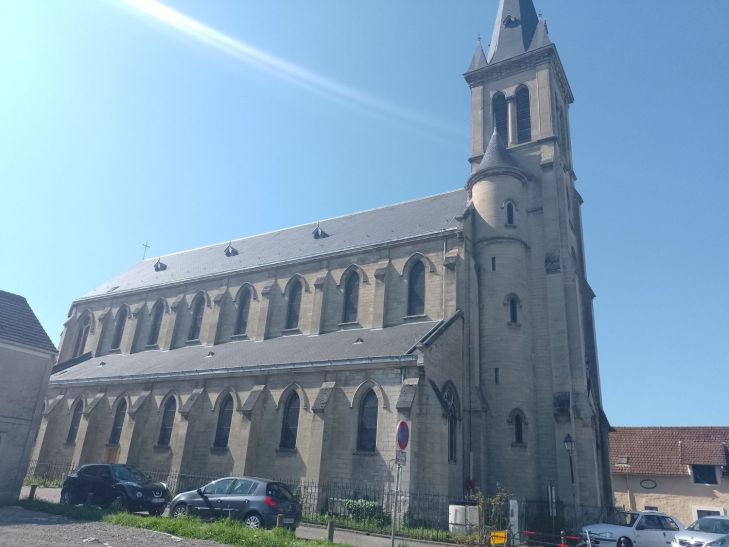
In 1892, the Saint-Lubin church dating from the 6C was destroyed. 145 sarcophagi were discovered on nearly one hectare, some of which were decorated with roundels, rosettes, or Christian motifs: a first group composed of 60 limestone sarcophagi and organized around a tomb in which rested a “warrior” with a Frankish helmet with net, sword, and lance; a second consisting of 85 plaster sarcophagi. The skeletons were of exceptional stature! Glass bead necklaces, belt plates, and perfume boxes were also unearthed. A further excavation conducted in 1969 confirmed the extent of the necropolis. Of the 19 sarcophagi rediscovered, three of the five tombs and burials excavated contained complete skeletons. The Church Saint-Jean-Baptiste was built in 1890 opposite Saint-Lubin and was opened for worship in 1892. A year later, its organ was inaugurated. It preserves a painting by Camille Corot created in 1840, The Flight into Egypt.
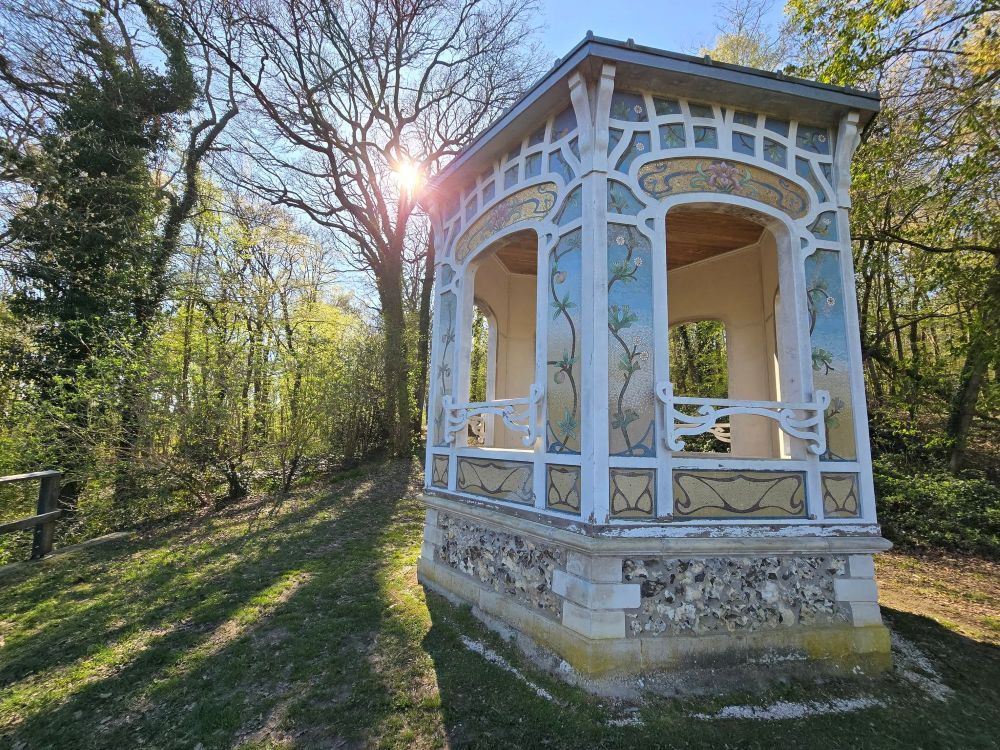
The Châtillon belvedere bandstand is located in the Rosny-sur-Seine forest. Situated on a belvedere, it overlooks the Seine Valley. This bandstand is one of two hundred built for the 1900 Universal Exhibition. Its function is undefined, and hypotheses range from a reception desk, a kiosk for merchants, or a bandstand. At the end of the exhibition, it was purchased and converted into a hunting lodge. This six-sided bandstand is in the Art Nouveau style. The decorations, featuring flowering and fruiting plants made of Briare enamels and tesserae covered with gold leaf, are particularly striking.
Other things to see here , me think are the Saint-Charles hospice built in 1820 and its chapel consecrated in 1824 by the Bishop of Chartres. Marie-Caroline, Duchess of Berry,had it built adjoining the castle fulfilled a dual function, caring for the sick and raising poor children, for more than a century. It was also the headquarters of a private agricultural school until 1968. It was then deconsecrated and abandoned. In 1983, the urban district of Mantes decided to restore it and make it a cultural center which notably presents exhibitions of paintings and sculptures, Some notable historical figures worth mentioning are Maximilien de Béthune , Duke of Sully born in Rosny, was Baron then Marquis of Rosny. He was also Sovereign Prince of Henrichemont and Boisbelle, Marquis of Nogent-le-Rotrou, Count of Muret and Villebon, Viscount of Meaux, and became Minister of Henri IV, which earned Rosny a visit from the King of France. His monumental white marble statue, created in 1817, was erected at the entrance to Rosny in 1931. Marie-Caroline de Bourbon-Siciles Duchess of Berry, daughter-in-law of Charles X and mother of the Count of Chambord (to be Henri V). She sold her land in Rosny to the English banker George Stone in September 1831.
A bit of history I like tell us that in 848, an order from Charles the Bald named the parish church of Rosny among the possessions that depended on the abbey of Fontenelle. In the Middle Ages, Rosny was the capital of a powerful lordship with a very important judicial center where bailiffs, prosecutors, bailiffs, notaries resided… The first lord of Rosny, in 1070, was Raoul I Mauvoisin known as the Bearded, who with the lords of Jouy, Septeuil and other knights of Mantes, helped Philip I, King of France, to repel William the Conqueror, Duke of Normandy. In the 16C, Rosny, property of the Melun d’Epinoy family, passed through marriage to the House of Béthune, where Sully, minister of Henry IV, was born in 1559. The latter, advisor to King Henry IV and also Superintendent of Finance, had the current castle built. On March 14, 1590, after the Battle of Ivry, King Henry IV of France visited Rosny Castle, where he held a public supper and, breaking with etiquette, admitted to the honor of his table the generals who had fought alongside him. In March 1814, after Napoleon’s return, Rosny Castle burned down.
The town of Rosny sur Seine on its heritage : https://www.ville-rosny78.fr/Rosny,-un-patrimoine-%c3%a0-d%c3%a9couvrir/265/
The local Terres de Seine tourist office on Rosny sur Seine : https://www.terres-de-seine.fr/?s=rosny+sur+seine
There you go folks, another quant off the beaten path trip in my old backyard. Oh yes there is more to see an ever ending source of wonderful architecture and history in my belle France, I am working on it ! Rosny sur Seine is nice and walking its main streets is a delight. Again, hope you enjoy the post on curiosities of Rosny sur Seine !!!as I.
And remember, happy travels, good health, and many cheers to all !!!

 Paris1972-Versailles2003