
As usual lately, digging into my cd rom vault of memories found me new pictures that should be in my blog for you and me. Vire now Vire Normandie is a town worth the detour to see in detail ,I was just passing by Vire as several times ! Therefore, this is my take on curiosities of Vire !!! Hope you enjoy this new find as I.
The City of Vire is located in the Calvados department 14 of the Normandie region of my belle France. The town is 30 km from Flers, 38 km from Saint-Lô, 60 km from Caen, 249 km from Versailles , and 264 km from my current town. The town is crossed by the departmental road 577 from Villers-Bocage to Mortain and by the D 524 from Argentan to Granville. The D 674 from Vire to Carentan joins the D 577 to the north of the town. Flers, in the direction of Paris, is accessible by the D 524, Saint-Lô by the D 674 and Caen by the D 577. I took the N24 dir Rennes, then around the rocade or N136 to connect with A84 dir Caen ,briefly becomes N175 around Avranches but continue dir Caen at exit/sortie 37 take the D924/524 dir Vire,.The train station of Vire is on the line of Paris-Vaugirard (Montparnasse 3) in Granville by which Villedieu- les-Poêles, Flers and Argentan can also be joined.
The Donjon or Dungeon on the right bank of the Vire river, a granite promontory dominates the entire valley. Bordered to the east, and west by an escarpment, it constitutes an ideal site. Only the northern side, connected to the plateau, must be solidly protected. The first wooden fortifications probably date back to the reign of Charlemagne. In 1106, the King of England, Henry I Beauclerc, reconquered the Duchy of Normandy after defeating his brother Robert Curthose at Tinchebray. But many lords contested his authority and received support from the Count of Flanders, the Count of Anjou, and the lords of Brittany. To protect Normandy, Henry Beauclerc then decided to build fortresses along the borders of the Duchy; thus, Avranches, Mortain, Domfront, and Vire became the essential points of defense of Lower Normandy against Brittany. In 1123, Henri Beauclerc had a square stone keep built in Vire, completed by a vast masonry enclosure.

The ruins of the 12C Tour de Coulonces. The sloped curtain platform located to the east of the castle. It currently serves as a retaining wall for the Place du Château. The ramparts will be demolished from 1720, and the ditches filled in. The Coulonces Tower is the only remaining tower from the castle walls. It is visible behind the bandstand. During the Middle Ages, the Coulonces family provided several captains and governors to the fortress castle of Vire. It is named after Baron Coulonces, one of the first Bocains (locals) to resist the English occupation during the Hundred Years’ War.

The Porte Horloge ,one of the entrance gates to the city,in the 13C and 15C is a square tower 33 meters high. The Clock Gate The bourgeois of Vire probably obtained privileges of emancipation as early as the 13C, under the reign of Philippe Auguste. They sent delegates to the assembly convened by Jean le Bon in 1350 and to the Estates General of 1468 under the reign of Louis XI. However, this king granted the lordship of Vire, including the town and the castle, to Pierre de Rohan in 1476. The latter ceded it to Pierre de la Chapelle in 1480. In an edict of September 22, 1483, Charles VIII annulled the previous donation and Vire returned definitively to the royal domain. Thus freed from lordship tutelage, the bourgeois built a belfry at the top of the Gastinet Gate to clearly demonstrate their independence. In 1499, the tower was equipped with a bell and a clock. The oldest mention of “Viscount of Vire and mayor of this town” dates from April 1586. This magistrate was then appointed by the king. The city did not build a City/Town Hall; meetings were held in the hall at the Saint-Sauveur gate or in houses rented for the occasion.

The Tour Saint-Sauveur ,only the north tower remains,The Saint Sauveur Tower, 13C, Porte Vieille, or Saint-Sauveur Tower, named after its small protective statuette. Under the Ancien Régime (monarchy), it served as a City/Town Hall for a time. In August 1944, American troops, eager to facilitate the flow of trucks supplying the front, attempted to dynamite this tower. It was narrowly saved by the energetic intervention of Mayor André Halbout. The 1946 urban plan redesigned Rue Chaussée, which now runs on the other side of the tower, and created Rue des Remparts, which highlights it. Its twin tower, to the south, disappeared in 1788.

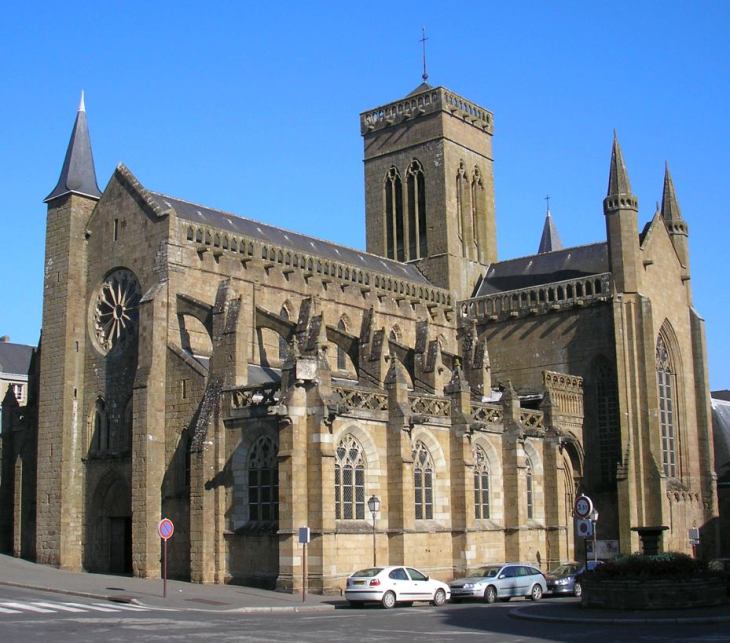
The Church Notre Dame is from the 13-16C. Built from around 1230, on the foundations of this chapel, in the primitive Gothic style, a new church was dedicated to Notre Dame or Our Lady on July 20, 1272. It had to be restored in 1948 after the bombings of June 6, 1944. The Church Notre Dame was until the 12C, the Saint-Blaise chapel, at the foot of the dungeon, served as the parish church. But with the growth of the town it became necessary to build a new church, outside the castle walls. A first Romanesque chapel, built around 1150, proved too small and under the reign of Saint-Louis the construction of the nave and side aisles of a new Gothic building began. On July 20, 1272, after 42 years of effort, the church was dedicated to Notre Dame. At the beginning of the 14C, the south transept and the porte aux sabots or door of clogs were added. Shortly after, during the Hundred Years’ War, the central tower was raised above the transept. This was built in the 15C thanks to funds provided by the drapers’ brotherhood; The side chapels of the nave were built at the same time. In the 16C, construction of the choir began in flamboyant Gothic style. Work began on February 3, 1511, with the use of local materials: the granite came from Gast, Maisoncelles or Vaux, the wood for the framework from Saint-Germain-de-Tallevende while the slates were extracted from Pont-Féron. The choir was completed in July 1535. Later, the sacristy in 1653 and the new chapel 1764 were added.
The City of Viré-Normandie on its heritage : https://www.virenormandie.fr/decouvrir-vire-normandie/histoire-et-patrimoine/les-monuments/
The Viré country tourist office on its heritage : https://www.paysdevire-normandie-tourisme.fr/sites-et-lieux-de-visite/patrimoine-historique-et-bati/
There you go folks, a nice short and sassy visit to quant ,nice Viré, for the memories of my road warrior trips. Looking forward to a formal visit, eventually, worth the detour. Again, hope you enjoy the post on curiosities of Viré !!! as I.
And remember, happy travels, good health, and many cheers to all !!!

 Paris1972-Versailles2003