
The village of Craon is worth the detour to see the real countryside of my belle France, I was passing in my road warrior trails and glad stop by briefly to see the church. And course, glad found me these older pictures in my cd rom vault to show in my blog for you and me, The village of Craon is located in the Vienne department no 86 in the Nouvelle-Aquitaine region of my belle France Therefore, this is my take on this is little Craon !!! Hope you enjoy the post as I.
Craon is a small village with 186 inhabitants in the Poitou-Charentes region. It belongs to the district of Châtellerault and the canton of Moncontour. The village is a member of the Pays Loudunais community of towns. It is 144 km from Nantes,66 km from Saumur, 39 km from Poitiers, and 286 km from my current home, I get there on the N165, pass Nantes take the N249 dir Vallet/Cholet, dir Bressuire here take the N149 to connect with the D46 dir Saint Loup-Lamarie continue to connect with the D29 dir Assais les Jumeux here take the D60 which same road becomes the D30 and connects with the D45 to Craon, Easy as this is country deep France best with a gps,
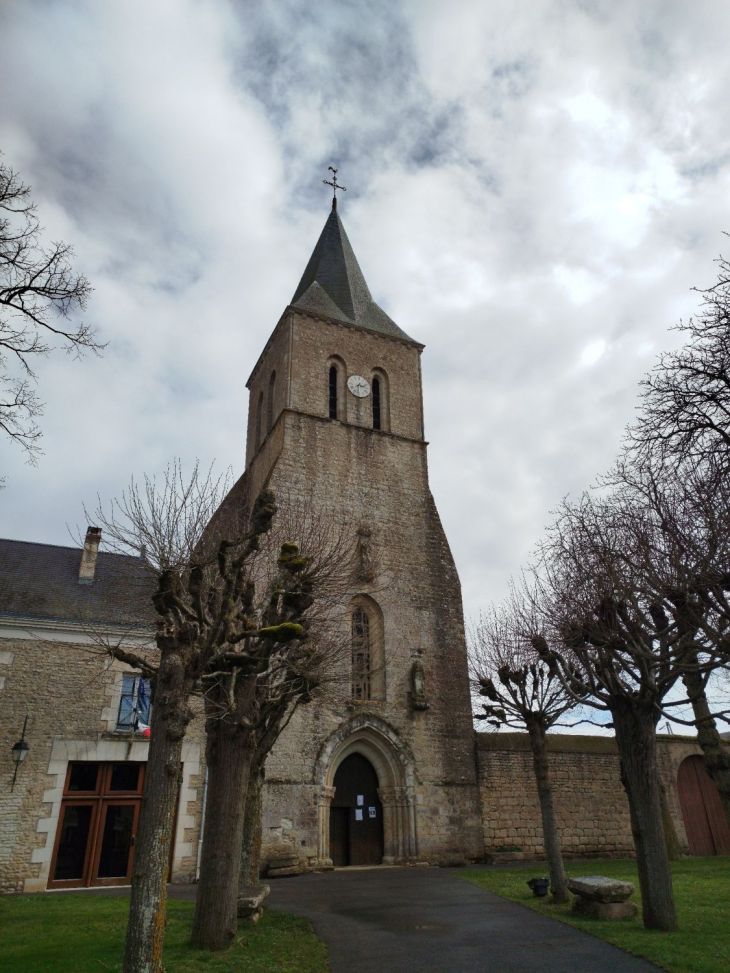
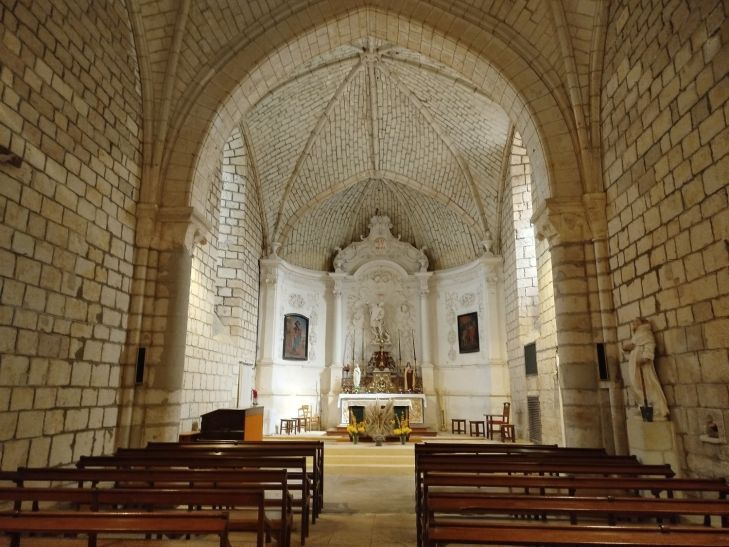
The Church Saint-Michel had a first church back to 1094. The current church is from the 13C. It is in the Angevin Gothic style, composed of a nave divided into three bays. It is preceded by a bell tower-porch with buttresses. The portal is a pointed arch with three arches supported by small columns with capitals. The latter are carved with crocheted foliage. Above the portal, a high bay with a pointed arch is surrounded by three decapitated statues. These statues represent a bishop, an angel and Saint John the Baptist. During the Wars of Religion, the church burned down. The bell dates from 1764. The Church Saint Michel is a pretty little church, whose sobriety contrasts with the richness of its high altar. It is worth a visit. The church was a priory-rectory of the Abbey of Canons Regular of Saint-Augustin d’Airvault. Its titular saint is the Archangel Michael, whose feast day was celebrated not on September 29 but on May 8, the feast of the Apparition of the Holy Archangel to the Bishop of Siponte on Mount Gargan in southern Italy. Saint Fiacre, a 7C Scottish hermit, has his statue in the church. The choir is occupied by an imposing altarpiece that occupies the entire apse around the high altar. It dates from 1735. It is made of wood, stone, and plaster. Two oil paintings on canvas face each other and depict the baptism of Christ and Saint James in the habit of a pilgrim of Compostela.
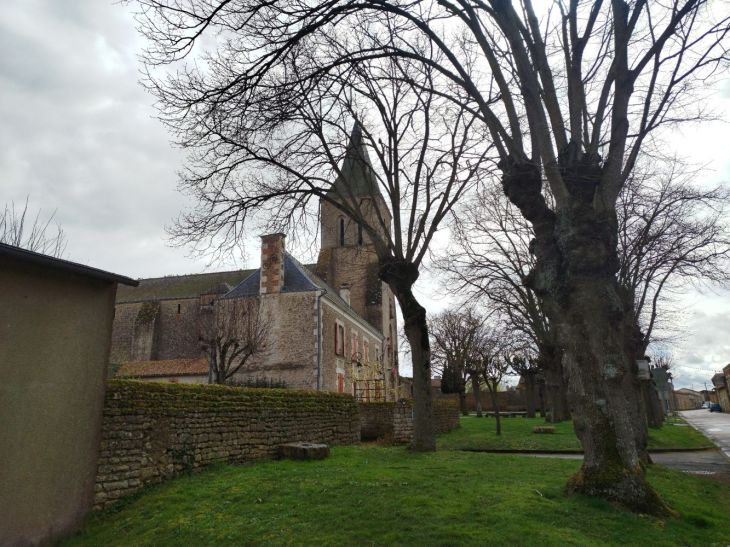
A fairly homogeneous church. The exterior is very austere, a simple rectangle about 30 meters long and about 10 meters wide, preceded by a bell tower-porch. The bell tower-porch, precedes the wider nave. The square bell tower has a bell room pierced by two bays on each side. It has a bronze bell from 1764. The slate-covered spire rises to 36 meters. The weather vane rooster, installed in 1890, was replaced in 1981. The narthex, a lower room under the bell tower, contains a 17C statue of a Virgin and Child. In the first bay, on the right, a confessional with a single penitent’s seat is preserved. In the 17C, this one-sided confessional was called Malchus, in reference to the episode of Jesus’ arrest in the Garden of Olives, when Peter draws his sword and cuts off the right ear of Malchus, the servant of the High Priest. The confessional only appeared in the 16C and is said to have been instituted by Saint Charles Borromeo, Archbishop of Milan.
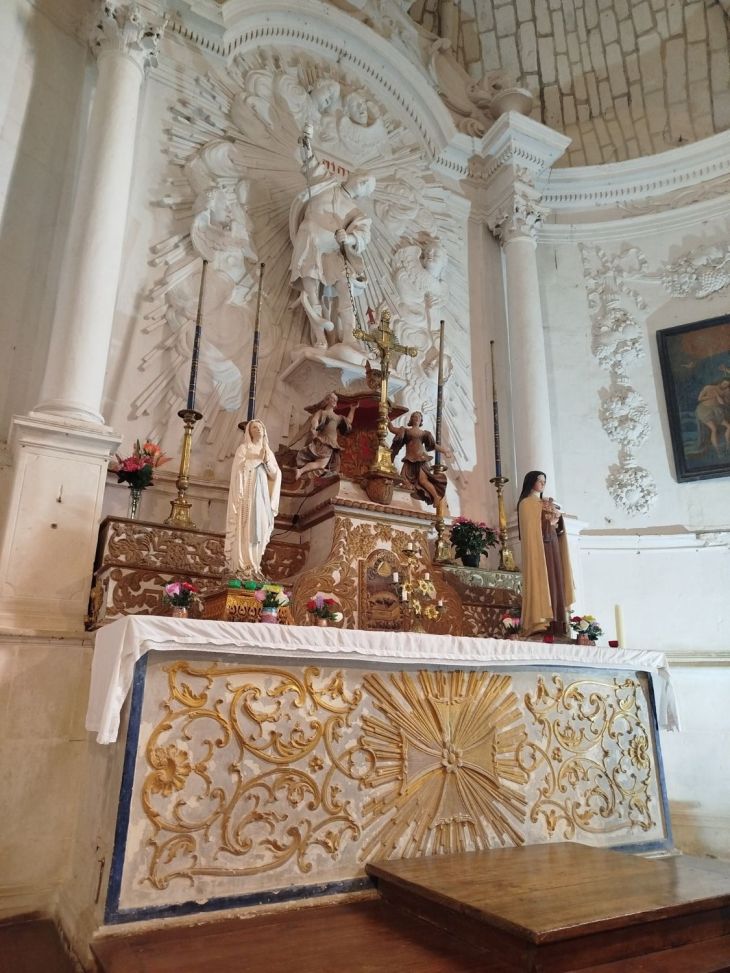
The door of the tabernacle is decorated with an equilateral triangle inscribed in a circle as a way of evoking the Trinity that Saint Augustine rejected and a Lamb lying on the book with the seven seals. The tabernacle embedded in two heavy tiers seems to be from the Louis XVI period. The exhibition canopy is between two angels. The altarpiece has in its central part a statue of Saint Michael slaying the Dragon, against a radiant background and cherubs. Michael is surmounted by the meaning of his name (Hebrew): Quis ut Deus, “who is like God”. On the left is a painting representing a pilgrim Saint James, against a landscape background, with the name of the artist from 1785. On the right is a painting of the Baptism of Christ, popular art of the 18C.
Other things to see in the village with more time are in the square of the above church stands a statue of Joan of Arc. The tower of the Maidens is located at Grands Ormeaux; it is from the Middle Ages. The hosanna cross dates from 1780, according to a barely legible inscription. It is of the Templar cross type. And of course, this is wine country too as it in the zone Haut-Poitou, a French AOC (Appellation d’Origine Contrôlée) wine label as well as a European AOP (Appellation d’Origine Protégée) label. Haut-Poitou produces white, rosé and red wines that are good and inexpensive,
The village of Craon has no official webpage but part of the community of towns Loudunais, see map lower left hand:https://www.pays-loudunais.fr/pays-loudunais/la-communaute-de-communes/les-communes/
The Vienne dept 86 tourist office: https://www.tourisme-vienne.com/en/
The Nouvelle Aquitaine region tourist office: https://www.nouvelle-aquitaine-tourisme.com/en-us/places-to-go
There you go folks, another wonder in my belle Franceindeed. It was a long road warrior trip and glad we stop by in the village of Craon,a quant off the beaten path to see, Again, hope you enjoy the post on this is little Craon !!! as I.
And remember, happy travels, good health, and many cheers to all !!!

 Paris1972-Versailles2003