
The city of Châtellerault is full of beautiful architecture, wonderful history, and just plain beautiful facades to enjoy it for long. I was passing in my road warrior trip of my belle France and briefly got into City center. The city of Châtellerault is located in the Vienne department no, 86 in the Nouvelle-Aquitaine region of my belle France. Situated on the borders of Poitou and Touraine, on the banks of the Vienne River, Therefore, this is my take on this is Châtellerault !!! Hope you enjoy the post as I.
The A10 autoroute d’Aquitaine passes through the municipal area at exit/sortie no, 26. A second interchange, no 27 and located in the town of Naintré, serves the city from the south. The local road here is the D910 (formerly the N10). The city is located 71 km from Tours, 37 km from Poitiers, 184 km from Nantes,302 km from Versailles, and 326 km from my current home, We came by N165, then N249 ,and D725 to town.
The Church of Saint-Jean-Baptiste,(St John the Baptist) is on Boulevard Blossac, and was consecrated on May 23, 1469. It was built to replace the church of Saint-Jean-Hors-les-Murs, which was falling into ruins. It was built in the Gothic style and its entrance was in the opposite direction, that is to say on Rue Saint-Jean, close to former Grand’ Rue, today Rue Bourbon. The nave and the side aisles, which were approximately 2/3 of their current length, were preserved in the extension carried out in 1860 on the site of the old ramparts. Saint-Jean-Baptiste was located opposite the city hall during the expansion of the town towards the east, under the Second Empire. It has a 19C stained-glass window depicting the baptism of Jesus in the waters of the Jordan River, as well as a 16C Virgin and Child.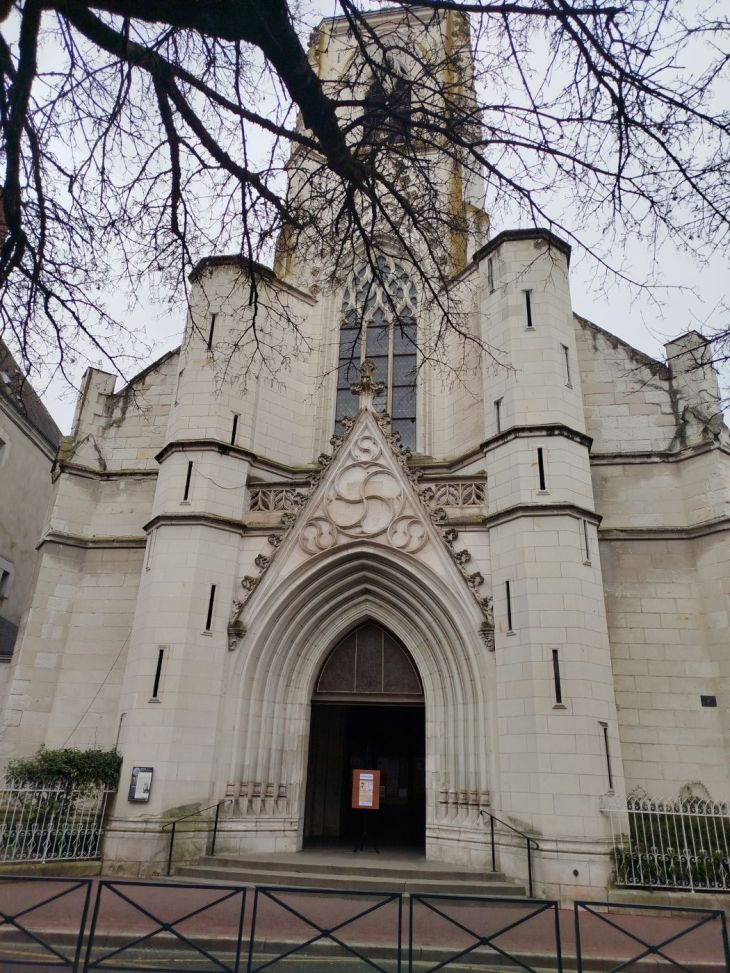

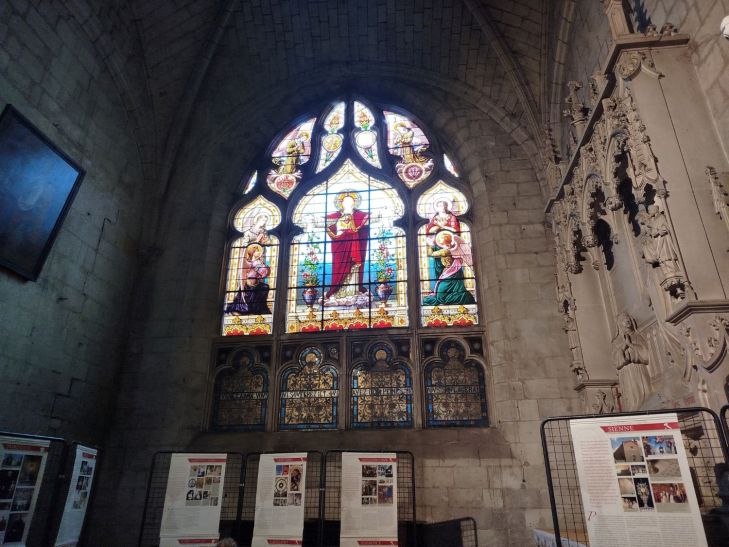
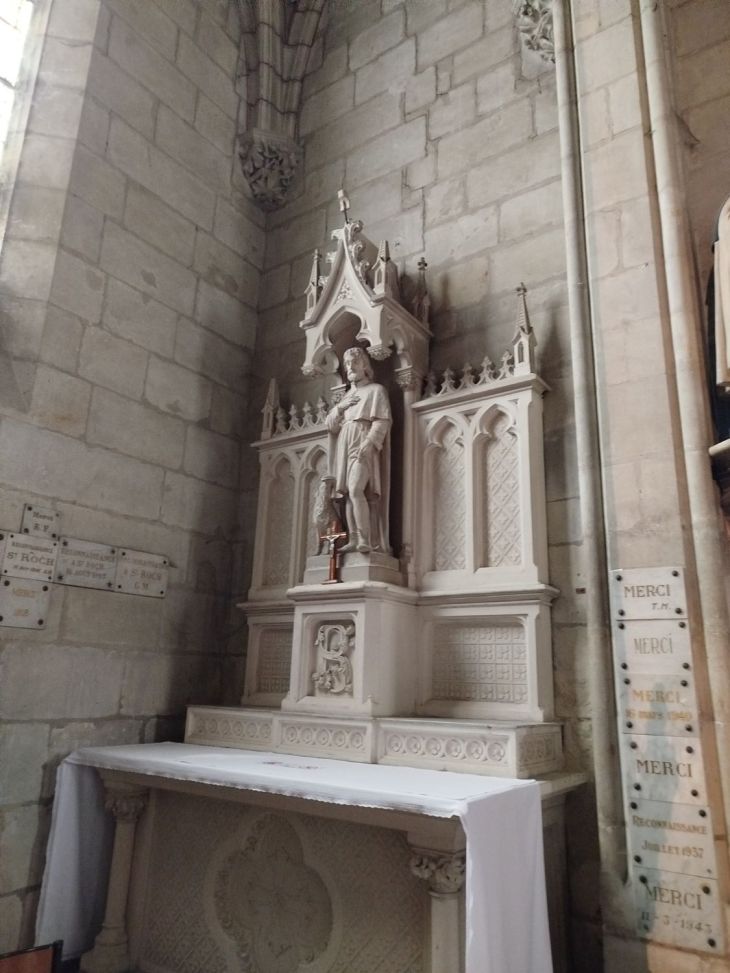
In 1097–1100, Bishop Pierre II confirmed the churches owned by the Abbey of Saint-Cyprien in Poitiers to Abbot Rainaud. The confirmation included two parts: the churches long owned by the abbey, and those recently acquired in the last years of the 11C. The Church of Saint-Jean-Baptiste in Châtellerault was one of these recent acquisitions. Around the middle of the 15C, after the Hundred Years’ War, the three naves of the Romanesque church were rebuilt in the Gothic style. The dimensions of the Romanesque church were respected and part of the Romanesque walls were preserved, as evidenced by, on the north side, two blocked Romanesque bays, a cornice and a buttress. It is this half-Romanesque (transept and apse), half-Gothic (the naves) church that the young René Descartes must have known. His grandfather, Pierre Descartes, was buried in the adjoining cemetery, which remained in use until the French revolution. In the 18C, the Romanesque apse was replaced by a flat chevet. Towards the middle of the 15C, after the Hundred Years’ War, the three naves of the Romanesque church were rebuilt in Gothic style.


Other things to see here with more time are The “Manu” (site of the former weapons factory), with the car, motorcycle, bicycle museum and the two towers. The Sully Hotel is a 17C mansion that was built with the surplus stones intended for the construction of the Henri-IV bridge. Since 1986, it has housed the Châtellerault Museum, created in 1891 for a public opening in 1893. The Descartes House, a beautiful mansion that belonged to the grandparents of the famous philosopher, René Descartes. Built at the beginning of the Renaissance, this building is characteristic of the mansions of this period. Located in the commercial axis of Châtellerault, Descartes stayed there regularly. The old college, located opposite the house, hosted Descartes for a few years. The Henri-IV bridge was commissioned in 1565 by Catherine de Medici to replace a wooden bridge. It was inaugurated in 1611, The Camille-de-Hogues bridge, the first reinforced concrete road bridge in France, built in 1899 , The Estrées bridge, a bridge over the Envigne, on the road from Paris to Bordeaux, was rebuilt between 1728 and 1732. The bridge was restored and widened in 1933. In 1975, the stone bridge was rebuilt in concrete masonry. Notre-Dame Church. Saint-Romain Church , The Saint-Jacques Church, rue Saint-Jacques, its construction began in the year 1008, thanks to Isembert II, bishop of Poitiers, on the ruins of the chapel of the Saint-Jacques priory. It was consecrated in 1066 by the same bishop. The church was completely restored in 1858. The Church of Saint-Jean-l’Évangéliste, rue Clément Jannequin is remarkable for its stained glass windows and the Russian bell from 1897 offered by Tsar Nicholas II of Russia. The Church of Saint-Georges, rue Marcel Pagnol, is in the former village of Targé, which merged with Châtellerault in 1972. It was built in the 11C and then remodeled several times. The Commandery of Ozon, a Templar commandery then a Hospitaller commandery. This commandery was, with the one located in La Rochelle, the main bailiwick of the province of Aquitaine. It was founded between 1130 and 1140 under William X of Aquitaine, who died in 1137, or Eleanor of Aquitaine.
A bit of history I like tell us that in 952, at the confluence of the Vienne and the Clain rivers, there was a ford that the descendants of Airaud had protected by a wooden tower built downstream on a mound, near the current Saint-Romain Church. The town of Châtellerault was built around it, on the left bank of the Vienne river. In the 11C, the town returned by marriage to the La Rochefoucauld family. In March 1429, Joan of Arc passed through Châtellerault on her journey from Chinon to Poitiers. In 1929, a stele was erected in Place Sainte Catherine to celebrate the five hundredth anniversary of this event. In 1482, following the death of Charles V of Anjou, the viscounty of Châtellerault was attached to the royal domain of France. In 1487, Charles VII offered the viscounty to Jean d’Armagnac. In 1505, Anne of France, Duchess of Bourbon, took possession of the town. In 1514, Francis I elevated the viscounty to the rank of duchy in favor of Francis of Bourbon. In 1549, Henry II ceded the duchy to the Scottish Earl James Hamilton, entrusting it to his son, the Earl of Arran, who promoted Protestantism there. In 1597 and 1598, the Assembly of the Reformed of France created the Edict of Nantes. Under Louis XV, the Blossac promenades were created in the town, named after the intendant of Poitou who promoted them, Paul Esprit Marie de La Bourdonnaye, Marquis de La Bourdonnay and Count of Blossac, and which still exist today. Châtellerault welcomed the advances of the French revolution.
The city of Châtellerault on its heritage: https://www.chatellerault.fr/sorties-et-activites/culture-et-patrimoine/patrimoine/
The Châtellerault tourist office on its heritage: https://www.tourisme-chatellerault.fr/en/decouvrir/nos-pepites/
The Vienne dept 86 tourist office on Châtellerault: https://www.tourisme-vienne.com/en/webzines/5-good-reasons-to-fall-in-love-with-chatellerault/
There you go folks, another wonder in my belle France indeed. It was a long road warrior trip and glad we stop by in Châtellerault, We shall be back eventually! Again, hope you enjoy the post on this is Châtellerault !!! as I.
And remember, happy travels, good health, and many cheers to all !!!

 Paris1972-Versailles2003