
And glad to found some older pictures in my cd rom vault of historical beautiful Sens, in the Yonne dept 89 ,in the region of Bourgogne-Franche-Comté of my belle France, I was here with friends and then family. A very nice town for walks sightseeing the history and architecture. Therefore, this is my take on the Cathédrale Saint Etienne de Sens, part III !!! Hope you enjoy it as I.
The Cathédrale Saint-Etienne de Sens or its true title as the Metropolitan and Primatial Cathedral Saint-Stephens of Sens, is the catholic cathedral of the archdiocese of Sens. Saint Etienne (St Stephen) is considered the first martyr: his cult is associated in Sens with that of Saint John the Baptist and the Blessed Virgin Mary. It should be remembered that Sens was then the metropolis of an important archdiocese made up of the dioceses of Paris, Meaux, Orléans, Troyes, Chartres, Auxerre and Nevers. It is one of the first churches of Gothic architecture of Christianity with the Saint-Denis Basilica, then abbey church. Let me brief here as have the history of Sens and the cathedral in another post, Saint Louis married in Sens and later takes possession of the relics acquired to be revered in the Sainte Chapelle of Paris. The interior length of the cathedral is roughly 114 meters (Notre-Dame de Paris: 128 m). Exterior length: 122 meters ; height of the southern tower: 78 m (Notre-Dame de Paris: 69 m). Including the height of the terrace: 66 m. Width of the facade: 48.5 m (Notre-Dame de Paris: 44 m). Begun around 1130-1135, its nave and choir are devoted in 1164, and its facade was finished at the end of the 12C. Its southern tower, the bell tower, was completed much later by 1532–1534. As for the transept, which dates from the years 1490–1515, it is one of the most beautiful masterpieces in flamboyant Gothic.
The three portals of the facade are dedicated from north to south respectively in Saint John the Baptist, Saint Stephens and the Blessed Virgin Mary. They were sculpted in the 12C, The oldest part of the Western facade was the north tower or leaded tower, so because done with lead blades. Its portal is dedicated to Saint John the Baptist: the central portal is largely survived by the collapse of 1268, and is therefore part of the old portion of the facade. The southern portal is dedicated to the Virgin Mary. We can admire the representation: Dormition and assumption on the lintel; of the coronation of the Virgin by Jesus Christ on the tympanum. The sud or southern facade with the superb Moïse portal dates from the years 1490-1500 The lower parts of the facade date from the 14C, when its started construction was abandoned by the Hundred Years War.

The tour Sud or southern tower has the bells is also called stone tower. We notice on the third floor of the tower a group of five statues. They are part of a gallery of ten sculptures representing ten archbishops in Sens and correspond to an equivalent group, on the posterior side of the tower. They were placed there in the 19C. The bell tower is flamboyant Gothic style. The southern tower always carries the two most important pieces of the very famous medieval ringtone, the two Bourdons bells ;their name is a tribute paid to the first two bishops of Sens, Saint Savinien and Saint Potentien.

The very wide nave of about 15 meters is bright and low at about 24 meters. It has a three -story elevation: large arcades, blind triforium and tall windows. North of the nave houses a very special funeral monument, commanded by Archbishop Tristan de Salazar in honor of his deceased parents, Jean de Salazar and Marguerite de la Trémoïlle, and completed in 1516. A private altar backed by a monumental altarpiece parallelepiped in white limestone, in an exuberant late Gothic style, where a certain Renaissance sensitivity begins to appear. Its main face has three statues, including two, Saint Etienne and the Virgin and Child, the style illustrates fairly well the school of sculpture of towers around 1500, carrying out the transition between Gothic art and the Renaissance. The third statue representing a holy bishop is a late re -implementation replacing a saint of Chaleveau stolen from the 16C.

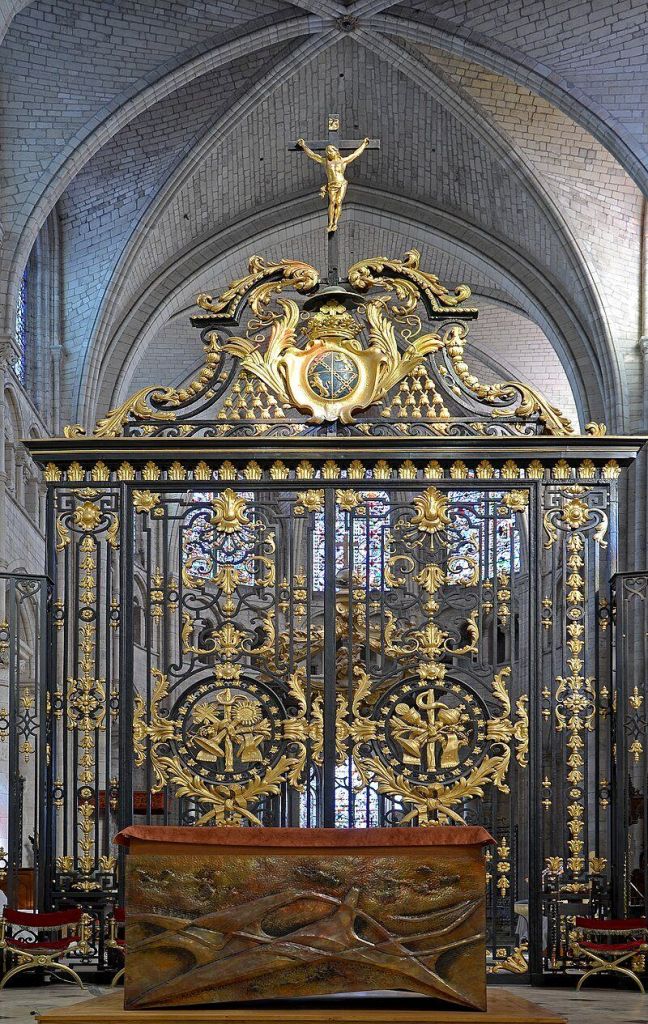
The high altar, dates from 1742. It was surmounted by a ball of the red marble columns from the monument dedicated to Louis XIV at Place de la Victoire in Paris. Behind the high altar is the altar of the Saints-Pierre-et-Paul. The big 19C Lar Larcrin, vandalized in 1987, found its place after being restored in 2015. The cathedral has a very beautiful collection of stained glass from the 13C to the 18C. Most stained glass windows are found in the ambulatory of the choir and in the two crossbours of the transept and mostly date from the 13C and the 16C. A famous 13C stained glass window is in the northern ambulatory of the choir. He commemorated the arrival in the 12C of Thomas Becket, Archbishop of Cantorbéry. He takes refuge in Sens to protect himself from the anger of King Henri II of England, against which he defended the privileges in particular judicial of the Church. He later returned to England where he was assassinated by Henri II envoys. The cathedral has had organs since the 15C, placed in the north side and inaugurated in 1440. In 1722, it was placed in the choir and in 1729 it was dismantled to be placed in the gallery.

The Synodal Palace was built in the 13C at the angle with the southern side of the cathedral facade. It is on two levels and intended to house the following religious activities: a ground floor dedicated to the functioning of the officiality (religious court) upstairs a large room covered with six vaults with crusaders of warheads, for Synods.

The choir is bordered by a stroll several chapels arranged around the ambulatory: the first chapel is a baptistery dedicated to Saint John the Baptist which has preserved a novel choir; the first southern side chapel shelters a statue of Notre Dame 14C, from which it is consecrated; the very luminous axial chapel of the 13C evokes Saint Savinian, martyr and first bishop of Sens: the stained glass relating the life of the saint is masked by a sculpture of the 18C representing its takeoff, the axial chapel is framed by two other chapels of the 16C and 18C, that of the left the Chapelle Sainte-Colombe chapel ,housing the tomb of the Dauphin of France and his wife Marie-Josèphe de Saxe, parents of Louis XVI, Louis XVIII and Charles X of France, of the Queen Clotilde de Sardinia and Madame Élisabeth, “the purest victim of the French revolution”. It is a work of 1777, Under one of these arcatures we notice the statue of Thomas Beckett.
The city of Sens on the Cathedral: https://www.ville-sens.fr/lieux-equipements/la-cathedrale-saint-etienne-de-sens/
The Sens tourist ofice on the Cathedral: https://en.tourisme-sens.com/i-discover/my-essentials/the-cathedral-of-saint-stephen-of-sens/
The Yonne dept 89 tourist office on the Sens Cathedral: https://www.tourisme-yonne.com/patrimoine/cathedrale-saint-etienne-2
There you go folks, a wonderful beautiful cathedral of Sens ,another spot that is a must to visit in my belle France. Again, hope you enjoy this post on the Cathédrale Saint Etienne de Sens,part III !!! as I.
And remember, happy travels, good health, and many cheers to all !!!

 Paris1972-Versailles2003