
And again, found me an older picture in my cd rom vault that should be in my blog for you and me. Great to dig into my vault of pictures a never ending source it seems , and a great source of info for future travelers/visitors and locals alike. Therefore, this is my take on the Saint Pierre abbey of Brantôme !!! Hope you enjoy the post as I.
The town of Brantôme-en-Périgord is located in the Dordogne department no. 24, in the Nouvelle-Aquitaine region of my belle France. It was created on January 1, 2016, under the status of a new town, by grouping together the two former towns of Brantôme and Saint-Julien-de-Bourdeilles, then absorbed six other former towns on January 1, 2019: Cantillac, Eyvirat, La Gonterie-Boulouneix, Saint-Crépin-de-Richemont, Sencenac-Puy-de-Fourches and Valeuil. In 2017,it was designated at one of the Les Plus Beaux Détours de France ,a French association of small tourist towns located off the main roads. It is located 21 km from Périgueux, 58 km from Angoulême, 74 km from Bergerac, 101 km from Brive-la-Gaillarde, 476 km from Versailles and 476 km from my current home, The town is located at the intersection of the roads leading to Périgueux and Angoulême , the D939 to Thiviers and Ribérac , the D78 as well as to Nontron , the D675, We came on the N20 to the new D2020 dir Orléans,then A71 dir Lamothe-Beuvron, Vierzon,takes the name of A20 dir Châteauroux, Limoges, takes the name of N21 dir Thiviers,then D707 ,D78 to Brantôme.
The Saint Pierre Abbey is, from an architectural point of view, a Romanesque abbey. However, the vault of the church, rebuilt in the 15C, is Gothic. The bell tower of the abbey church 11C is certainly the oldest campanile in France. The troglodyte caves, today partly hidden by the convent buildings of the Saint-Pierre abbey, are the remains of the first Benedictine monastery of Brantôme 8C dug into the limestone cliff. One of the large troglodyte caves, called the Grotte du Jugement dernier or the cave of the Last Judgement contains two monumental bas-reliefs. which dates from the end of the 15C dominated by the silhouette of God the Father, this bas-relief is the subject of many interpretations: composition obtained by reworking an earlier sculpted panel representing a pagan divinity, a Virgin and Child, a Christ in glory… On the right, the second bas-relief which dates from the 17C represents the Crucifixion of Jesus at the foot of which are Mary Magdalene, the kneeling Virgin Mary and the apostle John, with a kneeling religious figure on each side.
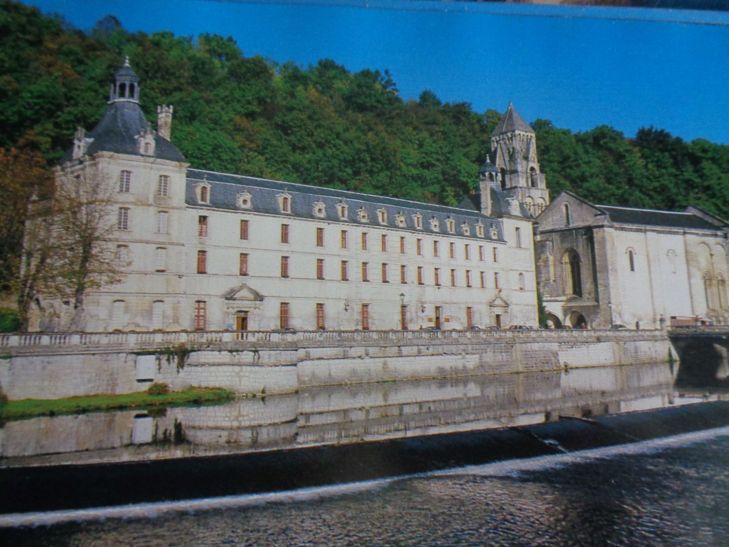
The Saint-Pierre Abbey is a former Benedictine abbey founded in 769 by Charlemagne in the diocese of Périgueux. It was suppressed during the French revolution. Today, the abbey church 11-13C, part of the cloister 14C and the convent buildings 18C remain, which house two municipal museums as well as the City/town hall of Brantôme. The Benedictine Saint Pierre abbey is undoubtedly one of the jewels of religious heritage in Périgord. Founded according to legend by Charlemagne who is said to have deposited there the relics of one of the Holy Innocents named Sicaire, it was originally a troglodyte before gradually freeing itself from the rock. On the ground floor of the vast 18C monastic wing that rises between the river and the rock, a museum presents the mediumistic works of the etcher Fernand Desmoulin who produced mysterious drawings signed by three different spirits from 1900 to 1902. the cloister gallery having survived the 19C restorations, to end the visit with the ascent of the bell tower.
Other things to see are the former Notre-Dame church, 16-17C, deconsecrated at the end of the 19C to become a market hall and then a village hall. Since 2011, it has been restored and converted to house the new intercommunal tourist office. Castel de la Hierce or Château de la Hierce, Renaissance 16C, private property, open to visitors. Manoir du Chatenet, 17-18C, private property, now a hotel.
A bit of history tell us that the abbey may have been founded under Pepin the Short, although this foundation is often attributed to Charlemagne, who placed relics of Saint Sicarius there. The church was consecrated by Pope Leo III in 804. Following the marriage of Eleanor of Aquitaine and Henry II Plantagenet in 1152, Brantôme came under English rule. It was therefore King Edward I of England who gave the town greater independence from the abbey with the signing of a charter of franchise on 29 November 1271. During the Hundred Years’ War, in 1356, the Prince of Wales and Prince of Aquitaine Edward of Woodstock entered Brantôme. The town finally freed itself from English rule in 1376 in exchange for a commitment to maintain seven English fortresses and a ransom to be paid by the abbey. The town was not too affected by the Wars of Religion thanks to its abbot at the time, Pierre de Bourdeille. In 1569 and on 15 October 1570, he saved the abbey from pillaging by the Reformed troops, because he had managed to remain on good terms with Coligny.
The town of Brantôme en Perigord on history of Brantôme: https://brantomeenperigord.fr/fr/rb/233079/brantome
The Dordogne en Perigord tourist office on Brantôme en Perigord: https://www.dordogne-perigord-tourisme.fr/sinspirer/une-destination-aux-multiples-facettes/villes-villages-caractere/petites-cites-de-caractere/brantome/
The local Périgord Dronne belle tourist office on the abbey of Brantôme: https://perigord-dronne-belle.fr/en/brantome-abbey-in-perigord-2/
The official plus beaux detours de France on Brantôme en Perigord: https://www.plusbeauxdetours.com/tous-les-plus-beaux-detours/detour-par-brantome-en-dordogne/
There you go folks, another dandy spot in my road warrior trails. This is beautiful country indeed all around, theDordogne area of my belle France. Again, hope you enjoy this post on the Saint Pierre abbey of Brantôme !!! as I
And remember, happy travels, good health, and many cheers to all !!!

 Paris1972-Versailles2003