
If you have been reading my blog and thank you for it doing it since Nov 2010; then you know my sentimental attachment to Honfleur. A city gear to the ocean and fishing and Normandie, I have several posts on it in my blog and they are all special to me. I had to go there at least once a year for a personal duty, Let me tell you again on curiosities of Honfleur ,part VIII !!! Hope you enjoy the post as I.
The village of Equemauville located 4 km from Honfleur sits high on the hill or Plateau of Grâce up the road from the vieux bassin or old basin of Honfleur, These monuments are covered by Honfleur and even in my blog even if administratively belongs to Equemauville, Just for clarification.
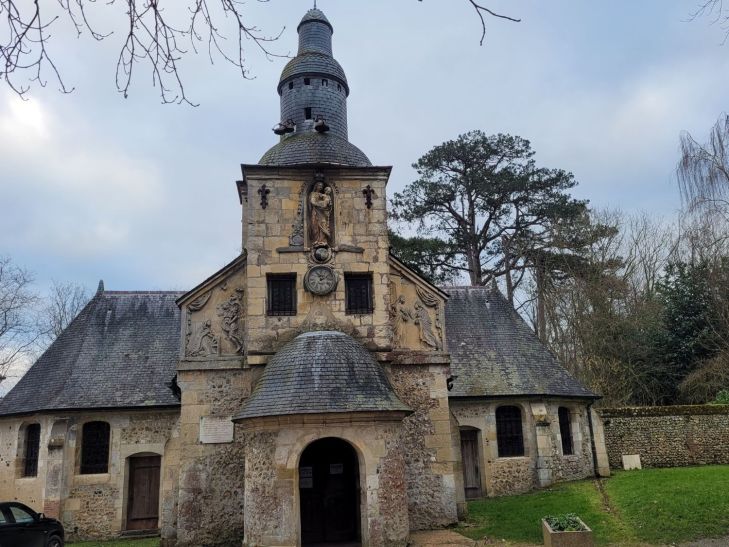
The Notre-Dame de Grâce Chapel is built in 1600-1615 on land given by Madame de Montpensier by the burghers and sailors of Honfleur at the site of an old chapel that disappeared in a landslide of the cliff in 1538. This primitive chapel was founded before the year 1023 by Richard II, then duke of Normandy to fulfill a vow made during a storm in which he had almost perished. Since then, the cult of Our Lady of Grace has been perpetuated. It was at this time that the Capucin fathers planted a wooden cross to indicate the location of the old chapel, a cross that was about thirty meters from the present Calvary. One of our pilgrimage while in near town.
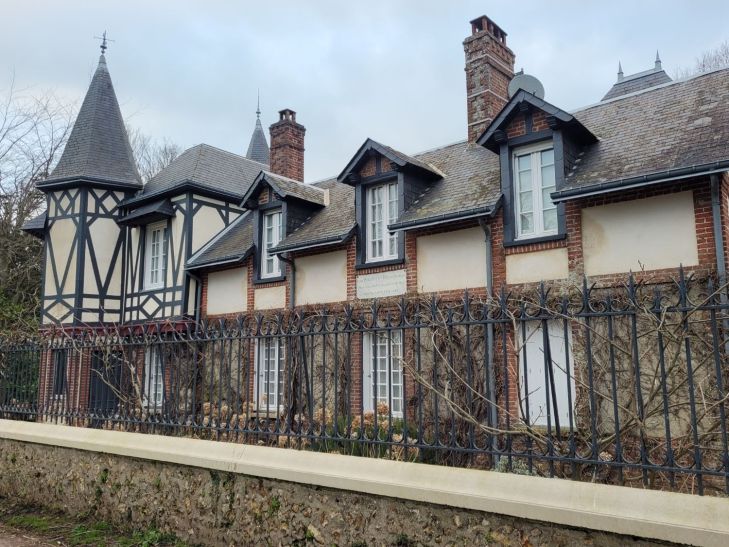
The Pavillon de la Reine,or Queen’s pavilion,or Pavillon de la Grâce was built on the plain which from the hill in Equemauville dominates the city of Honfleur below, not far from the Chapelle Notre Dame de Grâce chapel, The pavilion welcomed Queen Marie-Antoinette before being the home of Lucie Delarue-Mardrus, who had become a woman of letters. During the summer of 1907, on the occasion of a bicycle walk, Lucie and her husband made an incredible discovery at the bottom of the slope, halfway between town and plateau, seven old oaks, shelted from a ruin of pink bricks whose windows with small tiles still retain a few windows, these are the ruins of a charming 18C pavilion, built in 1787, for Louis XVI, which became the prey of vegetation. The farmers of around claim that this place is haunted at night by white and black ladies, hence the nickname of castle of the devil, The windows open on the estuary or on the valley. The pavilion does not include a floor: on the right, a bedroom, on the left, a small room. Without harming the aesthetics of the whole, they had an annex for the kitchen and the commons in 1909, Lucie Delarue-Mardrus, built an anchor in her real home: Normandy “herbagic, brilliant and wet”, as she wrote. The castle of the Devil is renamed the Pavillon de la Reine or Queen’s pavilion and became the home of Lucie until she left Honfleur, death at heart, in 1936. Today the Queen’s pavilion was transformed into a guest house, Lucie Delarue-Mardrus, born in Honfleur on November 3, 1874 and died in Château-Gontier (Mayenne no 53) on April 26, 1945, and is buried in the Sainte-Catherine cemetery in Honfleur was a poet, novelist, journalist, historian, sculptor and designer, The writings of this prolific author, which has left more than seventy novels, collections of poems, stories, biographies, memories, tales, news, travel stories, verse pieces and plays, reveal a painter of intimate life and nature.
The Honfleur tourist office on the chapel: https://www.ot-honfleur.fr/en/cultural-site/chapel-of-our-lady-of-grace/
The official presbitery on the chapel: https://presbytere-de-grace-honfleur.fr/la-chapelle-de-grace/
The village of Equemauville on its heritage: https://www.mairie-equemauville.com/histoire-et-patrimoine
There you go folks, another dandy beautiful and nostalgic spot in my belle France. Honfleur is a must to visit for any reason. Again, hope you enjoy the post on curiosities of Honfleur, part VIII as I
And remember, happy travels,good health, and many cheers to all !!!

 Paris1972-Versailles2003