
It was the first castle that I visited in France way back in 1990 when my dear late wife Martine took me there as it was her native area. Its still the nostalgic favorite ,visited several times over the years, and friends of the castle. The luxury and architecture of it is immense, but a lot of folks missed the wonderful gardens. They are magnificent. This is the Château de Fontainebleau, in the dept 77 of Seine et Marne ,in the Île de France region of my belle France, Therefore ,let me tell you more of Le Parc et les Jardins du Château de Fontainebleau, part III !!! Hope you enjoy it as I.
Covering an area of 130 hectares and extending beyond the drop in the Cascades basin, the park of the castle of Fontainebleau once marked the limits of the royal domain to the east. From the village of Avon, it was crossed by the main access road to the castle. Its current configuration, the organization of the network of star-shaped alleys and waterfalls, results from the creation of the canal under Henri IV, 2,000 meters long and 40 meters wide, Initially planted with more than sixty thousand trees where the rows of white poplars, oaks and fruit trees, this closed park, and its canal were the pride of the king, who followed the construction site, monitoring the progress of the work. In 1609, it took more than a week to fill it and, from autumn, the king sailed there with his Dauphin (son).
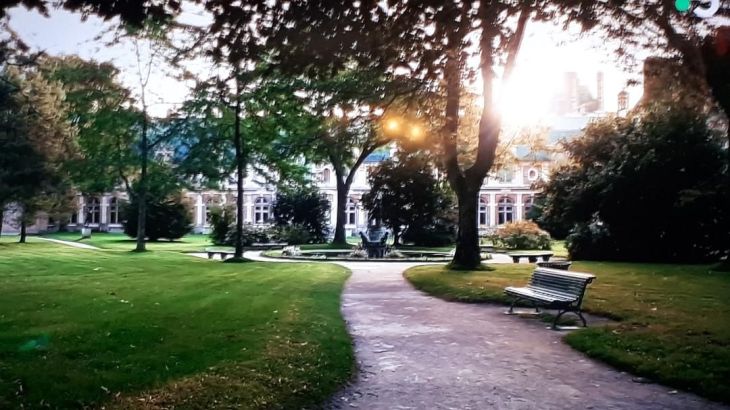
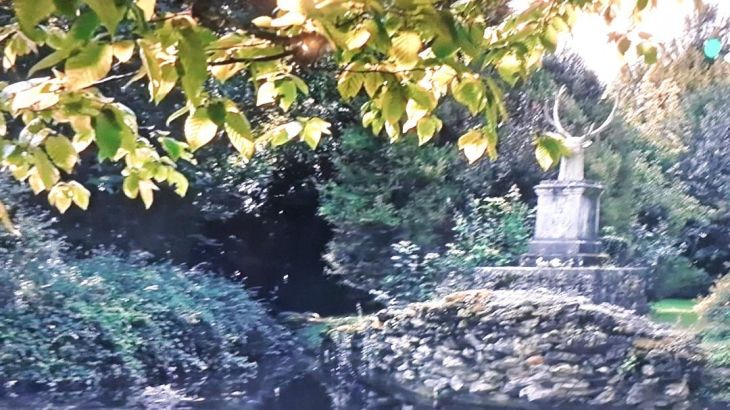
See the Jardin de Diane and relax in the shade of large beech trees in this English garden formerly the private reserve of the Queen, It is bordered by the most intimate spaces of the sovereigns (small apartments of the Empress, Turkish boudoir of Marie-Antoinette). Indeed, this garden was, until the 19C, closed by buildings whose destruction, followed by the purchase of an additional strip, allowed the expansion on the side of the city. Redeveloped in an English landscaped garden, planted with remarkable trees such as a cata or a virginia tulip tree, it takes its name from a fountain decorated with a statue of Diane Chasseresse. The only survivor of the rich fountains created under Henri IV, she is positioned in the center of a circular with stalks. On the lower part of a pedestal presenting in majesty the armed goddess of her quiver, four heads of deer in bronze as well as four dogs, recall that Fontainebleau was considered to be the “Temple of Diane”, castle of Hunting prized by the sovereigns.
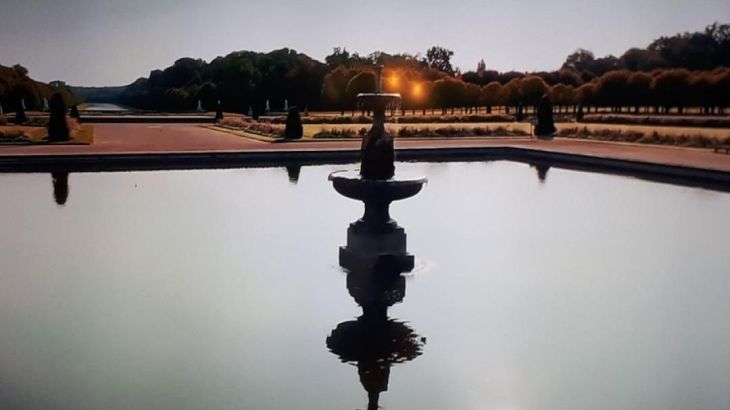
The creation of the Grand Parterre from 1660 to 1664 ; the largest in Europe, with its 14 hectares by André Le Nôtre and Louis Le Vau, testifies to the clarification of the space desired by Louis XIV in Fontainebleau. Buis embroidery in this French garden disappeared under Louis XV. The general layout of grass compartments remain, basins decorated with statues, including that of waterfalls 17C and 19C, looking at the Henri IV canal. Since 1817, a large basin, known as “Pot bouillant” or boiling pot, has taken place in its center while at noon, on the side of the forest, the water circle is decorated with a statue of the Tiber. Four sandstone sphinges, leonine goddesses sculpted in 1664, mark from Louis XIV the border between the Parterre and the Park. André Le Nôtre had the water square in the middle of which stood the boiling pot which was replaced by a basin in 1817, a round of water where a molding of the ancient Statue of the Tiber was installed in 1988 in its center, a channel called “Le Bréau” which delimits the parterre in the south and the “cascades” or waterfalls to the east which fuel the Grand Canal and which were redone in the 19C.

The Jardin Anglais layout of this English landscaped garden is due to Hurtault, the architect of the gate of honor in 1810-1812. If we know that Napoleon I did not particularly appreciate the gardens of this type, it however corresponds to the fashion of time. Planted with rare species from the whole world and arranged with narrow and winding paths, it is covered with an artificial river and still contains, in its secret corners, the « fontaine Belle-Eau » or beautiful water fountain which gave its name to the castle, and whose fountain was constantly highlighted by the sovereigns. It succeeds a series of gardens created from the reign of François I in this western part of the area won over the land of the religious, including the famous Jardin des Pins garden.
The Marin d’Eau Douce pier is located in front of the castle at the Etang des Carpes. Come and enjoy this idyllic setting by granting you a ride aboard the rowing boats that will delight young and old. From the Etang des Carpes or carp ponds you can take distance to admire the size and extent of the Château de Fontainebleau located not far from the forest. From the freshwater marine pier taking out the boats you have the possibility of admiring the castle , but also the gardens and the pond pavilion located in the very center of this pond. And the cour de la Fontaine,closed on three sides and looking at the carp pond, this court took its name from the monumental fountain which was built there in the 16C, then surmounted by the Hercules of Michelangelo. This court arises from the space defined in the south by the bank of the pond, and to the north by the wing of the François Ier gallery connecting the Royal Logis of the Dungeon and the Chapel of the Trinity. The courtyard is closed, to the east, by the wing of the Belle-Cheminée du Primatice or Primatice’s chimney, organized around two stair railings magnifying the entrance to the new apartment of the King. Faced with to the west, the aile des Reines-Mères or wing of queen’s mother ends with the Gros Pavillon of Gabriel , participating in the Louis XV project to endow the castle with elegance and good taste for French classicism. On the ground floor of this Gros Pavillon or large pavilion, the dogs of Fô Chinese mark the entrance to the « musée de l’impératrice Eugénie » or Empress Eugénie Museum which the latter had the arrangement in the 1860s.

The Association Arbres Remarquables et des Amis de la Forêt or theAssociation remarkable trees and friends of the forest, fourteen particularly beautiful, old or rare species of the castle gardens received the label “Remarkable tree set” One felled and is kept on site already gaining roots!

The official Château de Fontainebleau on the gardens : https://www.chateaudefontainebleau.fr/en/courtyards-and-gardens/
The Fontainebleau tourist office on the castle gardens : https://www.fontainebleau-tourisme.com/en/discover-the-region/patrimoine-2/the-chateau-a-grand-history-book-of-france/the-chateau-gardens/
For my love of the castle, this is the official Friends of the Castle : https://www.amischateaufontainebleau.org/category/actualites/discovering-fontainebleau/
There you go folks another wonderful gem of my nostalgic Seine et Marne dept 77 awaits for you and yours. This is a must to walk it while there, go all the way back to the Grand Canal, Again, hope you enjoy the Parc et les Jardins du Château de Fontainebleau, part III !!! as I.
And remember, happy travels, good health, and many cheers to all !!!

 Paris1972-Versailles2003