
I like to have memories and nowdays even more. I remember Chateau de Fontainebleau as it was in the Seine et Marne dept77 that my dear late wife Martine, took me first to show me her department/region back in 1990. We have come here ever since,and it is one of my favorite castles been friend of the association that helps protect its heritage. Their office is on your left once entering the main entrance to the castle fyi. I have written many posts on it before, so peruse my blog, and see beauty before your eyes. These are new pictures to my blog thanks to my vast cd rom vault, Of course, this is also in the Île de France region of my belle France, Therefore, here is my take on curiosities of the Château de Fontainebleau, part I !!! Hope you enjoy the post as I.
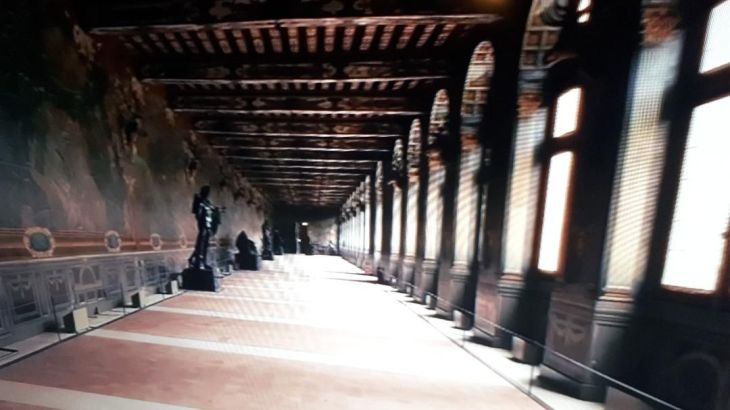
The Galerie François I is a large ceremonial gallery located on the first floor of the Royal Castle of Fontainebleau . Built between 1528 and 1530, it is approximately 64 meters long and 6 meters wide, and was formerly a covered bridge with openings on both sides. King Francis I made it built and decorates, in order to connect his apartments to the Trinity Chapel (see post). He kept the keys and made it visited by his chosen guests. The gallery was entrusted to the Italians Rosso Fiorentino and the Primaticcio who decorated it in an original way with paintings, paneling, frescoes and stuccoes. The works were done from March 1535 to May 1537 for the stuccos, starting from 1536 for the frescoes, and were completed just before the visit of Charles Quint at Christmas 1539. The carved walnut woodwork realized from 1535 with rare essences, but turned almost exclusively to walnut wood from 1539, when the floor of the gallery is executed and the paneling. King Louis XVI split the wing in 1786 by adding apartments, depriving it of the opening on Diane’s garden, but making false windows to keep a symmetrical appearance. Napoleon I transformed the gallery into a gallery of illustrious by placing busts of generals and drawings of his military campaigns.
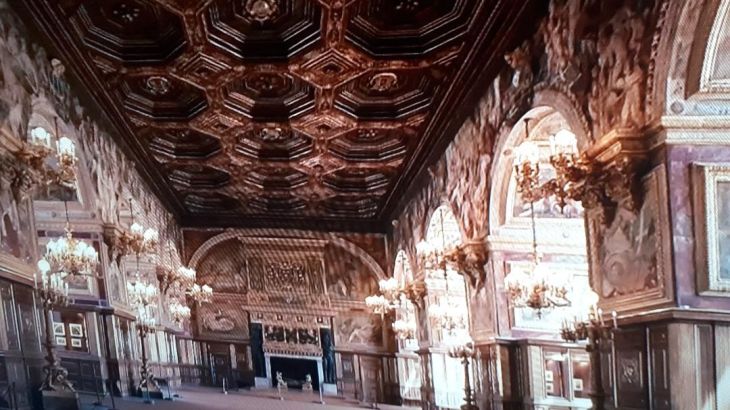
The galerie des Cerfs or Gallery of Stags that was given the name because of the heads of stags that is decorated with and were a replacement to the statues done by the Primatice in 1540. Decorated with rider views from the domains of royal hunts, this vast gallery 74 meters long and 7 meters wide built by Henri IV is punctuated by twenty heads of deer. The gallery is also decorated with bronze statues, melted by Primatice, in Fontainebleau, for François Ier. The deer gallery is the perfect place for the organization of gala dinners, festive evenings, or even fashion shows. It was Henri IV, the great reconciliator king of France, the great King builder of Fontainebleau that we owed the creation, in 1600, of the galerie des Cerfs, the only element still visible of the three constructions that the king had made build around the Queen’s garden. Its dimension, its colorful elegance, its interior decoration make it an original and precious whole, both in its place in the history of the castle and by the admirable works of art that it contains. One more testimony of the wonders of the royal house of Fontainebleau. This gallery of royal trophies contains, a collection of bronze statues, including the Diane Chasseresse “thrown in bronze” in 1603, according to the ancient original in white marble, today in the Louvre. But the major pieces of this collection are the great bronzes that François I had caused to Fontainebleau from the mussels reported by Primatice of the Vatican around 1542. Trying the influence of antiquity on European artists of the 16C, these replicas of ancient masterpieces of the Laocoon, the Apollo of the Belvedere, the Venus of Cnide or the sleeping Ariane, devoted Fontainebleau in “New Rome”, gateway to Greco-Roman cannons in France of the Renaissance.
The Château de Fontainebleau is home to one of the flagship works of the inner decor, furnishings and objects of French art from the 18C: the boudoir d’Argent or silver boudoir of Marie Antoinette. It was in 1786 that it was redecorated in arabesque style and refurnished with an unparalleled refinement for the queen Marie-Antoinette. The work is carried out under the direction of the architect Pierre Rousseau, while the sculpture of the woodwork, of an incredible finesse in particular the ribbons turning on the rosaries of pearls is executed by Pierre-Joseph Laplace. Located on the first floor, between the king’s ceremonial chamber and that of the queen, boudoir d’Argent or silver boudoir is a small rectangular piece with two sides cut over one length and lit on the other by two windows. Four doors allow access. One of them leads to a corridor which leads to the cabinet of the Queen’s chair, a room intended for the use of a pierced chair. A staircase allows you to go up to the Turkish boudoir and go down to the children’s of France apartment. The decorative style of the boudoir translates the change of taste that takes place in the third quarter of the 18C in Europe. With the excavations engaged in Pompeii from 1748, the taste for Greco-Roman antiquity gained all areas of art. The painters cover the paneling of a decor which refers to antiquity taking up the patterns of the cameos, painting from the bas-reliefs in trompe-l’oeil with a shades of blue raised with touches of white, resorting to the iconographic repertoire of some ancient frescoes . For Marie-Antoinette, this taste for antiquity is coupled with a very particular attraction for nature. In the silver boudoir, this passion for nature is expressed by the profusion of floral patterns on furniture, including the seats. The naturalism of flowers is pushed to the extreme: blueberries, margueres, roses, wheat and ivy are easily identifiable, the great feature of the boudoir is to offer a floral profusion intimately mixed with patterns belonging to an ancient inspiration. This rereading of antiquity and the emergence of these naturalistic floral motifs characterize almost all the royal decorations of the reign of Marie-Antoinette, to the point that we have been able to speak of a “ancient flower” style.

The chambre du roi or the King’s bedroom, to which the courtiers accessed after having crossed the antichamber and work office. Napoleon I transforms it into a throne room, the last preserved today in France.In Fontainebleau, the sovereigns have preserved the heritage of past centuries while adapting the premises to their own uses to form a synthesis that Napoleon I will qualify in his memoirs as “true house of kings”. The king’s room is no longer visible today in his state of ancient regime: after the French revolution, in 1808, Napoleon I had a throne room, which was to be used until the Second Empire (Napoléon III). However, of the royal chamber which was the heart of the palace, the paneling, the marble chimney with the rich golden bronze ornaments, the sculpted and golden medallions carrying the motto of Louis XIII. Empty of its furniture, its bed and its balustrade during the French revolution, this former center of the court liturgy, where large leverages and large public layers of the monarch took place, is today in the last Napoleonic throne room still existing. The throne has indeed taken the place of the bed in the alcove. The mayor of purple, and its sowing of golden bees, is an impressive staging of the Napoleonic symbolism: imperial figure, ancient eagles and laurel crowns testify to the will of Napoleon I to stage,in an almost heraldic way, its power at the heart of the “house of centuries” as he ,also, put it.

The official Château de Fontainebleau on the Galerie François 1er: https://www.chateaudefontainebleau.fr/collection-et-ressources/les-collections/peintures/galerie-francois-ier-a-fontainebleau/
The official Château de Fontainebleau on the galerie des cerfs (stags) : https://www.chateaudefontainebleau.fr/en/gallery-of-stags/
The official Château de Fontainebleau on the apartments, so king’s bedroom (throne room) : https://www.chateaudefontainebleau.fr/en/explore-the-castle-and-gardens/fontainebleau-rooms/the-grands-apartments/royal-apartments-fontainebleau/?phrase=+King%27s+bedchamber#
The Fountainebleau tourist office on the heritage of the castle: https://www.fontainebleau-tourisme.com/en/discover-the-region/patrimoine-2/the-chateau-a-grand-history-book-of-france/
The Seine et Marne dept 77 tourist office on the castle: https://tourisme.seine-et-marne-attractivite.fr/670011-chateau-de-fontainebleau
The Île de France region tourist office on the Chinese room of the Empress Eugénie (museum) : https://www.visitparisregion.com/en/empress-eugenie-s-chinese-drawing-room
There you go folks, yes another jewel in my belle France, a must to visit, The Château de Fontainebleau is one of the wonders of our world ! The history of France, Europe, and the World was written from here, Again, hope you enjoy the post on curiosities of the Château de Fontainebleau, part I !!! as I
And remember, happy travels, good health, and many cheers to all !!!

 Paris1972-Versailles2003