
I have come to this wonderful region of family roots on wife’s side for its architecture, history, culinary delights and the wines, oh yes the wines ! , especially the wines ! As said, it is a tradition in my house and makes it a good reason to come here, I like to dwell again into one of my favorite wine region, And yes this is the Sud Ouest or southwest of my France, Therefore, here is my take on the Madiran, Pacherenc du Vic Bilh, the Béarn, Irouléguy, Jurançon, and Saint-Mont wines !!! Hope you enjoy it as I,
The village of Madiran is located in the Hautes-Pyrénées department,no 65 in the Occitanie region of my belle France. It is 4 km from Aydie, 41 km from Tarbes, 47 km from Pau, 148 km from Toulouse, 753 km from Versailles, and 672 km from my current home, I came from Pau to connect with the D943 to connect with D139 road to D58 to Madiran.
The village of Madiran is part of the controlled designation of origin (AOC) zones of Madiran, Pacherenc-du-Vic-Bilh and Béarn, as well as the IGP Bigorre. Vine growing is a nearly thousand-year-old activity. It was the Benedictine monks who introduced and disseminated it. The AOC was only obtained in 1948. The grape varieties used are Cabernet and Sauvignon, but also grape varieties specific to Madiran, namely: Tannat, Pacherenc and Palissé. Located at the foot of the Pyrenees, at the crossroads of the departments of Gers, Pyrénées-Atlantiques and Hautes-Pyrénées, on unique and exceptional terroirs, they have 1,400 hectares of vines. Made from an original and rare grape variety: tannat, Pacherenc du Vic-Bilh is known as the white version of Madiran wines. The sunny valleys of the old country produce original, fresh and very aromatic dry white wines (citrus, tropical fruit, white-fleshed fruit) with intense, well-balanced mellow aromas of candied fruit, honey, dried fruit and nuts.
My latest taste of Madiran was the Domaine d’Aydie. From Pacherenc du Vic Bilh I had the Carte d’Or from the Cave de Crouseilles.
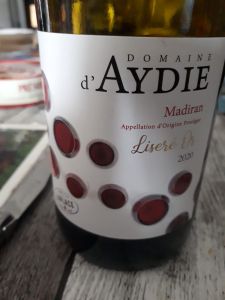
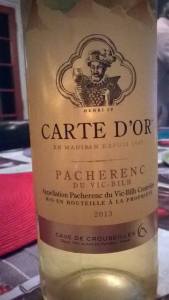
The official wines of Madiran and Pacherenc du Vic Bilh : https://madiran-pacherenc.com/en/
Other things to see here me think are the monastery, founded by Benedictine monks in the 11C, only a few remains remain near the church. The monastery was occupied by the Jesuits between 1625 and 1776, and again by the Benedictines from 1936 to 1952. The Church of Sainte-Marie which on September 1, 1569, Protestant troops from Mongommery, on the orders of Jeanne d’Albret, mother of the future King of France, Henry IV, burned the priory and the church. On the exterior of the north facade, the stones reddened by the fire can still be seen. The nave of the church was extensively remodeled in the 18C. The church choir has arcades and capitals, one of which depicts a peasant putting up a vine firmly attached to a stake. The church houses a statuette of Notre Dame, The lavoir or washhouse.
A bit of further history tell us that its foundation dates back to Roman times. It appears in history in 1030/1088 with a reference to the founding of the priory of Madiran found in the archives of the Jesuit fathers of Toulouse,
The village of Madiran on its heritage : https://commune-madiran.com/patrimoine/culturel/
Béarn is an area of controlled designation of origin or AOC produced across three departments: Pyrénées-Atlantiques, Hautes-Pyrénées and Gers, and two regions: Nouvelle-Aquitaine and Occitanie. It was during the Roman colonization that a vineyard was planted on the hillsides between Salies-de-Béarn and the village of Bellocq. Gaston VII de Moncade, Viscount of Béarn, had a fortress built in Bellocq. This allowed the construction of a fortified town. The new inhabitants contributed to the development of the vineyard. As the Way of St. James crossed the valley, pilgrims on their way to Galicia or returning from the pilgrimage popularized Béarn wine beyond the regional borders. Jeanne d’Albret, mother of Henry IV, who was here on her lands, particularly appreciated Béarn wine. In the 17C, Béarn Protestants, exiled in Holland or England, organized the trade of their wines to Northern Europe. The appellation was recognized as a VDQS (Very Descriptive Domain) in 1951, then as an AOC in 1975. The Béarn-Bellocq AOC was recognized in 1991. The appellation area covers 259 hectares spread across 74 villages in the Pyrénées-Atlantiques, 6 in the Hautes-Pyrénées, and 3 in the Gers. Reds and rosés represent the largest share of production. Light and full of flavor, they should preferably be drunk within the year. The dry whites are known as “Rousselet de Béarn.” Production is handled by two cooperative wineries and twenty-eight independent wineries. See my entry on the cave de jurançon,
My latest tasting of the Béarn region : Béarn Arraditz from the cave de Gan,
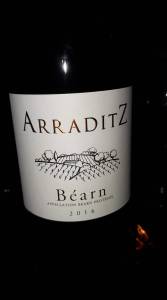
The local Coeur de Béarn tourist office on its wines : https://www.coeurdebearn.com/deguster/les-vins-du-bearn/
The village of Irouléguy is located in the Pyrénées-Atlantiques department no 64 , in the Nouvelle-Aquitaine region of my belle France. It is 123 km from Pau, 51 km from Bayonne, and 47 km from Mauléon-Licharre. The Irouleguy vineyard is located around Saint-Étienne-de-Baïgorry and Saint-Jean-Pied-de-Port. It is one of the smallest vineyards in France, the only one in the northern Basque Country.
The Irouléguy is a controlled designation of origin wine named after Irouléguy, a small Basque village in Lower Navarre. Its name in Basque is Irulegiko arnoa. On January 23, 1953, Irouléguy was granted AOVDQS status. On October 29, 1970, Irouléguy wines were classified as an AOC. It represents a production of 5,500 hectoliters, divided into approximately 70% red wine, 20% rosé wine, and 10% white wine. The area is 240 hectares, spread over the territories of fifteen villages. In red and rosé, the wines are based on tannat, cabernet franc and cabernet sauvignon. The white wines are made from courbu blanc, petit courbu B, petit manseng and gros manseng.
My latest tasting here were Irouleguy Gorri or red in basque.

A bit of history tell us the vineyard is linked to the pilgrimage to Santiago de Compostela. In fact, it was formed in the 11C by the monks of Roncesvalles who planted vines around the old Saint-Vincent church in the village of Irouléguy for a wine intended for pilgrims. After the signing of the Treaty of the Pyrenees between France and Spain in 1659, the monks left their vineyard and the locals took possession of the vines.
The official wine syndicate of Irouleguy :https://www.irouleguy.net/fr/
The wine of the Jurançon: a good wine is made with good grapes, sun, rain and foehn. Its most famous grape varieties are the small and the big Manseng (petit et gros manseng). On the vineyard of the piedmont Pyrenean, the vines are planted in the direction of the slope and are oriented to the South in order to be sheltered from the West wind. Harvest by hand, sort with love, vinify patiently… so many steps necessary to the quality of the wines of the Jurançon. Planted at an altitude of 300 meters facing the Pyrenees mountain range, the vineyard stretches over some 40 km from east to west, between the Gaves de Pau and Oloron. The grapes are the Gros Manseng, Petit Manseng, Courbu, Camaralet and Lauzet as the indigenous grapes used in the Jurançon region. The Jurançon Secs (dry) offer an aromatic freshness in their young age: they develop very expressive notes of citrus and exotic fruits. Lively but controlled, their acidity is sought after because it is very refreshing. Young, we appreciate the Jurançon for their aromas of fresh fruits: pineapple, citrus fruits, passion fruit. The Jurançon are also wonderful wines for laying down: rich with a gold to copper color, they then develop aromas of white flowers, honey, toast and candied fruits.
My latest Jurançon tasted Jurançon Apéritif Henri IV from the Cave de Jurançon (see post),
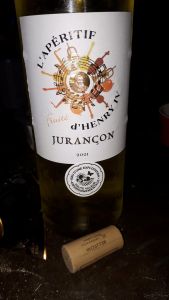
The official Wines of Jurançon: https://www.vins-jurancon.fr/page/12-Terroir
The village of Saint-Mont is located in the Gers department no 32 in the Occitanie region of my belle France. It is 16 km from Madiran ,153 km from Toulouse, 667 km from Versailles, and 729 km from my current home, The village is very rural with a population of 313 in 2022. Saint-Mont is home to the AOVDQS/AOP Côtes de Saint-Mont, the “Vignerons du Saint-Mont” cooperative winery, which sells the finest local wines: AOP Saint-Mont, Madiran (AOP), and Pacherenc du Vic-Bilh.
The Saint-Mont vineyard dates from 1050 when the Benedictines founded the Saint-Mont monastery Later on, in the 16-17C, the wines were exported and the Adour River became one of the main navigational routes for inland and maritime trade. In Bayonne and Vieux Boucau, Saint Mont wines were loaded onto boats leaving for the UK and the Netherlands. In 2011 the 1,200 hectares were granted AOC status. Red wine varieties : Tannat ,Pinenc (Fer Servadou),Cabernet Franc and Sauvignon, White wine varieties :Petit and Gros Manseng,Petit Courbu,Arrufiac,
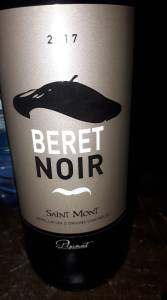
My latest Saint Mont tasted was the Saint Mont Beret Noir
Other things to see here me think are the Church Saint-Jean-Baptiste The abbey church of the 11-13C rests on powerful buttresses necessitated by its position on a steep cliff of the Adour. The church has a single nave, a flat chevet, a large triumphal arch, a semicircular apse, remarkable 11C capitals, and traces of Romanesque paintings.
A bit of history tell us that Saint-Mont is built on a rocky spur overlooking the Adour, a Gascon river. In 1050, the Count of Gascony and Armagnac Bernard Tumapaler founded the monastery dedicated to Saint John and attached to the Order of Cluny on the ruins of the old oppidum. The monks occupied the site until the French revolution and in 1791, the monastery was sold at auction as national property.
The official wines of Saint Mont : https://www.vins-saintmont.com/en/
The Village of Saint Mont : https://mairie-saintmont.com/
The Gers dept 32 tourist office on the wines of Saint Mont : https://www.tourisme-gers.com/voyage/vins-saint-mont-338
There you go folks, a wonderful town of my belle France. The southwest wines are dear to my family, and we have spent quite a bit of time in it from several years already even from before settling in France , A region Sud Ouest, worth the detour,especially for its wines, me think, Again, hope you enjoy the post on the Madiran, Pacherenc du Vic Bilh, Béarn, Irouléguy, Jurançon, and Saint-Mont wines !!! as I.
And remember, happy travels, good health, and many cheers to all !!!

 Paris1972-Versailles2003