
I have come to Cahors for its heritage but especially its wines ! As said, it is a tradition in my house and makes it a good reason to come here, I like to dwell again into one of my favorite towns ,and wine regions. Therefore, here is my take on this is Cahors!!! Hope you enjoy it as I,
The town of Cahors is located in the Lot department ,no, 46 in the Occitanie region of my belle France, It is 234 km from Bordeaux, 112 km from Toulouse, 60 km from Montauban, 565 km from Versailles and 651 km from my current city. It is located between two autoroutes or highways junctions A20-A89 in Brive-la-Gaillarde and A20-A62 in Montauban. I came by on the A10 to Orléans then A71 to Vierzon, then A20 to exit/sortie 57 along the D49 to trafic circle take the D820 to trafic circle take the D620 to Cahors.
However, the main thing that brought me here initially was the wine ! The Cahors AOC was created in 1971 and is reserved exclusively for red wines crafted from Malbec grapes. The specifications governing the appellation allow two secondary grape varieties: Tannat and Merlot, but Malbec must represent at least 70% of the blend. Cahors is the cradle of Malbec or Cot Noir, also call Auxerrois . Another specificity of the vineyard is its great diversity of terroirs, making it possible for winegrowers to craft original Malbec wines. the AOC represented a planted vineyard area of 3,323 hectares, out of a total of 21,700 hectares covering 45 towns and villages for the delimited AOC area. Three-quarters of the producers are private wineries. The remaining quarter are members of the only cooperative winery in the appellation: the Côtes d’Olt, based in Parnac, which is now part of the Vinovalie Group. On average, up to 15 million bottles are produced each year, depending on the vintage. Most Cahors wines are sold in France, but they are also exported all over the world. The 3 main export markets today are the United Kingdom, the United States and Canada.
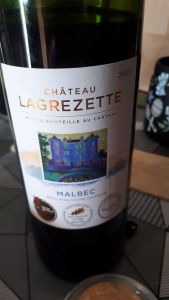
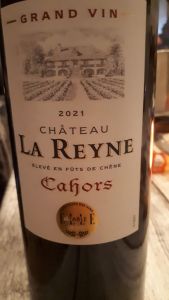
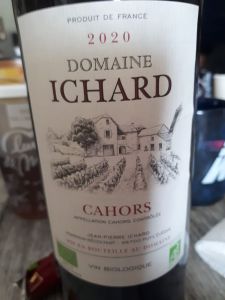
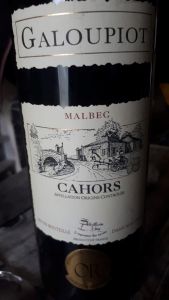
The wines of Cahors came to be very reputable even to be the wine of the Russian Orthodox Church and of tzar Peter the Great as well as in Northern Europe, I like to put here some of my latest bottles from the Château Lagrezette in Caillac, Château de la Reyne in Puy L’eveque , Domaine Ichard in Puy L’eveque, and the great find Le Galoupiot of Pelvillain Vins in Pescadoires, with vast vineyards in the Fronton AOP.
Some of the things to see here, me think are the Pont Valentré bridge ,the emblem of the city. Built from 1308, this 172-meter-long bridge is a unique example of medieval architecture. Since 1995, the Valentré Bridge has been pedestrianized. Access to the bridge is free. The Church Saint-Barthélemy rue Saint-Barthélemy. Dating from the 14C built in the highest part of the old town; its bell tower dates from the 13-14C. The Palais Duèze Palace, whose tower known as “Pope John XXII”, 34 meters high, is the only remaining part of the palace built by Pierre Duèze, brother of Pope John XXII. The Saint-Étienne (St Stephens) Cathedral located on Place Jean Jacques Chapou, it combines elements of Romanesque and Gothic styles from the 11C to the 17C. Its cloister was begun around 1506. A masterpiece of the flamboyant Gothic style. Maison Henri-IV or Hôtel de Roaldès 15C on Place Henri-IV. Church of Saint-Urcisse. Rue Saint-Urcisse, in Gothic style, and the Henri-Martin Museum, housed in the former episcopal palace,
A bit of history tell us that the town of Cahors has long been disputed, and besieged more often than not: from the Roman Julius Caesar or the Frank Thibert to the King of Navarre Henry IV, passing through the English pretensions of Richard the Lionheart and later, the Black Prince. It was raised from its ruins by Bishop Saint Didier, also known as Saint Géry, who had the first cathedral built there in 650 as well as a wall whose route corresponds to the current Boulevard Gambetta. But the city was again pillaged by the Saracens in 732, then by the Vikings and the Magyars. In the 14C, Cahors benefited from the generosity of Pope John XXII, born Jacques Duèze in 1244 in Cahors, and elected pope in 1316. The Duèze family was well established in the town and linked to notables. Having died in Avignon in 1334, John XXII had cared greatly for his hometown, his family and his fellow citizens. During the Hundred Years’ War, the town was temporarily under English rule. On October 20, 1320, Pope John XXII bought everything that had belonged to the Templars in Cahors from the Grand Master of the Hospitallers, Hélion de Villeneuve, and gave it to the Carthusians. During the Renaissance, Cahors remained an active craft and industrial town. Its wines, known since the Romans and appreciated in the world of the time, which ensured its income, suffered fierce competition from those of Bordeaux, supported by the English. The city is crossed by one of the pilgrimage routes to Santiago de Compostela, the Via Podiensis. It had several hospitals including that of Saint-Jacques which was first near the current Place Galdémar. In 1683, it was transferred to the place called the Croix des Capucins. A chapel dedicated to the apostle of Spain was called Saint-Jacques-des-Pénitents in the 16C from the moment it was the seat of a brotherhood of the Blue Penitents, a very interesting altarpiece was preserved there. Cahors will be occupied by the nazis army from November 11, 1942 Cahors, capital of the French department of Lot, was the first city to declare itself a citizen city of the world: Cahors Mundi. On August 25, 1973, the city of Cahors was the site of a historic and unprecedented meeting between the two co-princes of Andorra: President Georges Pompidou and the Bishop of Urgel Joan Martí i Alanis.
The official wines of Cahors : https://vindecahors.fr/en/cahors-vineyard/
The City of Cahors on its heritage : https://cahorsagglo.fr/index.php/le-territoire-0
The local valley of the Dordogne tourist office on Cahors : https://www.vallee-dordogne.com/la-vallee-de-la-dordogne/villes-et-villages/cahors
The Vignobles de le sud ouest or vineyards of the southwes on Cahors: https://www.vignobles-sudouest.fr/us/destination-cahors-malbec/
The Lot dept 46 tourist office on Cahors: https://www.tourisme-lot.com/cahors/visiter-cahors/
The Occitanie region tourist office on Cahors : https://www.visit-occitanie.com/en/discovering/major-sites/cahors-lot-valley/
There you go folks, a wonderful town of my belle France. The Cahors wines and its many other attributes are dear to my family, and we have spent quite a bit of time in it from several years already even from before settling in France , A town must to see me think, Again, hope you enjoy the post on this is Cahors !!! as I.
And remember, happy travels, good health, and many cheers to all !!!

 Paris1972-Versailles2003