
Let me tell you about a dandy in my road warrior rounds in the wonderful sublime Loire Valley. This is a spot have come several times even shopping for wine, and visit the gorgeous castle, I found me again nice pictures in one of my cd rom that should be in my blog for you and me. It was a great experience, and always looking forward to be back, eventually ,Do see my several posts on the castle and City in my blog, This time let me tell you again on the Château d’Amboise, part III !!! Hope you enjoy the post as I.
The Royal Château of Amboise, you first arrive at the Terrases from the 15-16C as it was the first castle to introduce the Italian renaissance style in France. From the outside the castle is a prime example of the Renaissance of which king François I was the initiator. The castle, of course, is in Amboise, in Indre-et-Loire dept no, 37, in the Centre Val de Loire region of my belle France, It is located 23 km from Tours, 94 km from Orléans, 222 km from Nantes, 219 km from Versailles, and 380 km from my current home.
The Royal Logis faces the Loire at the end of the Châteliers spur. Its architectonics is international Gothic. From the outside the castle is a prime example of the Renaissance of which king François I was the initiator.
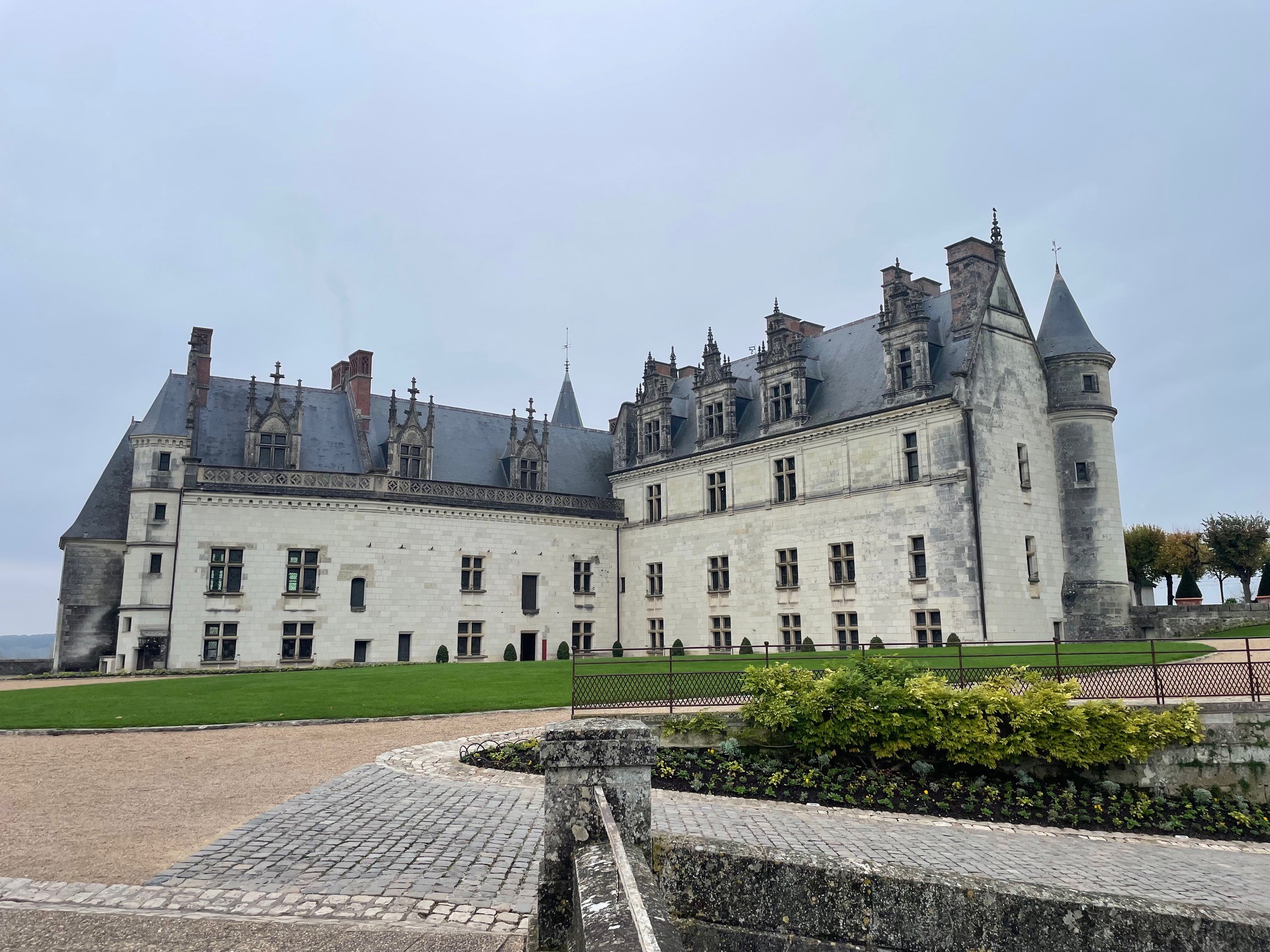
The Galerie d’ Aumale is a gallery appointed in honor of Henri d’Orléans, 5th son of Louis-Philippe and Duke of Aumale, who became the owner of the castle in 1895. The gallery originally linked the Royal Logis to Henri II apartments.
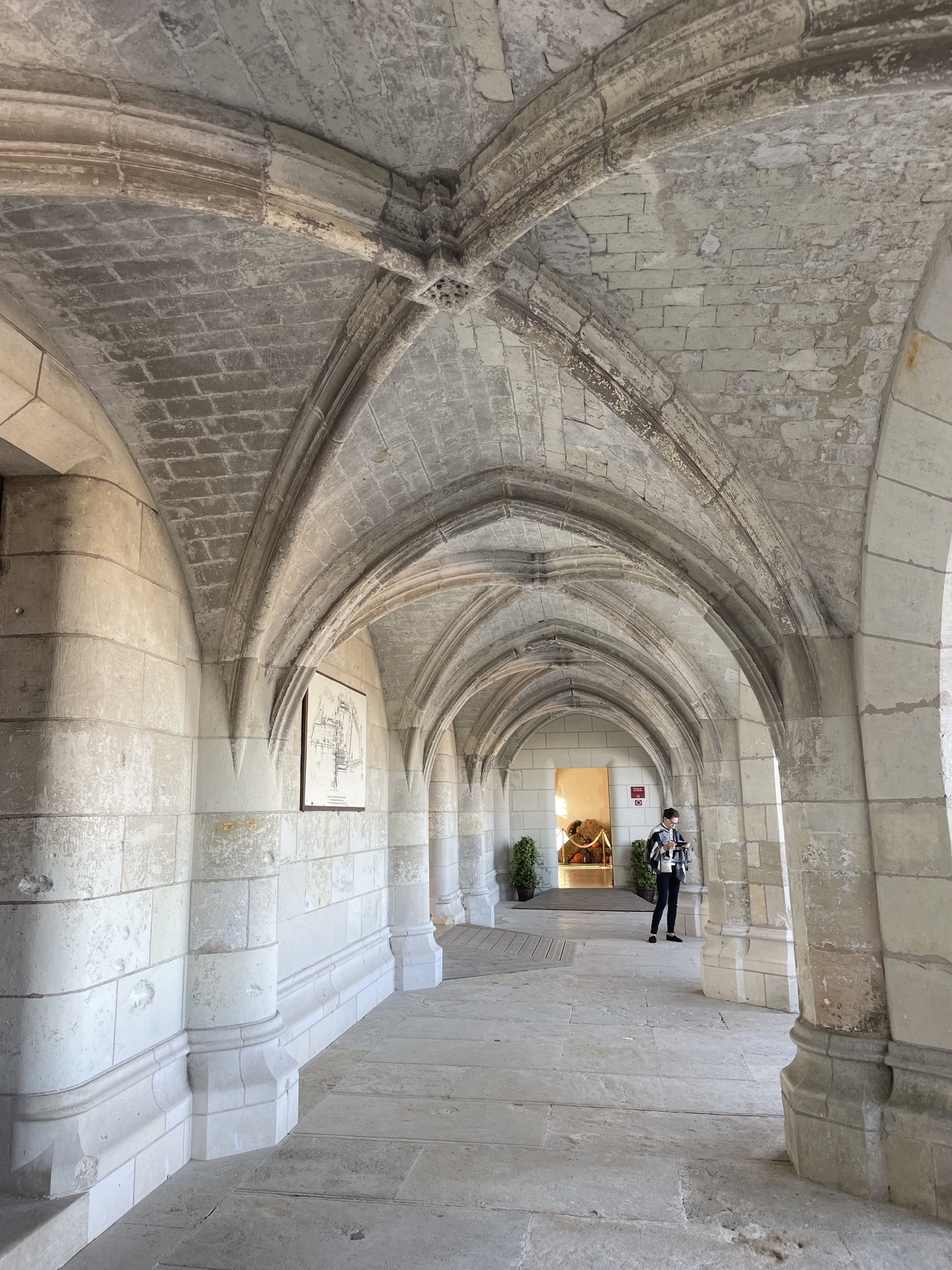
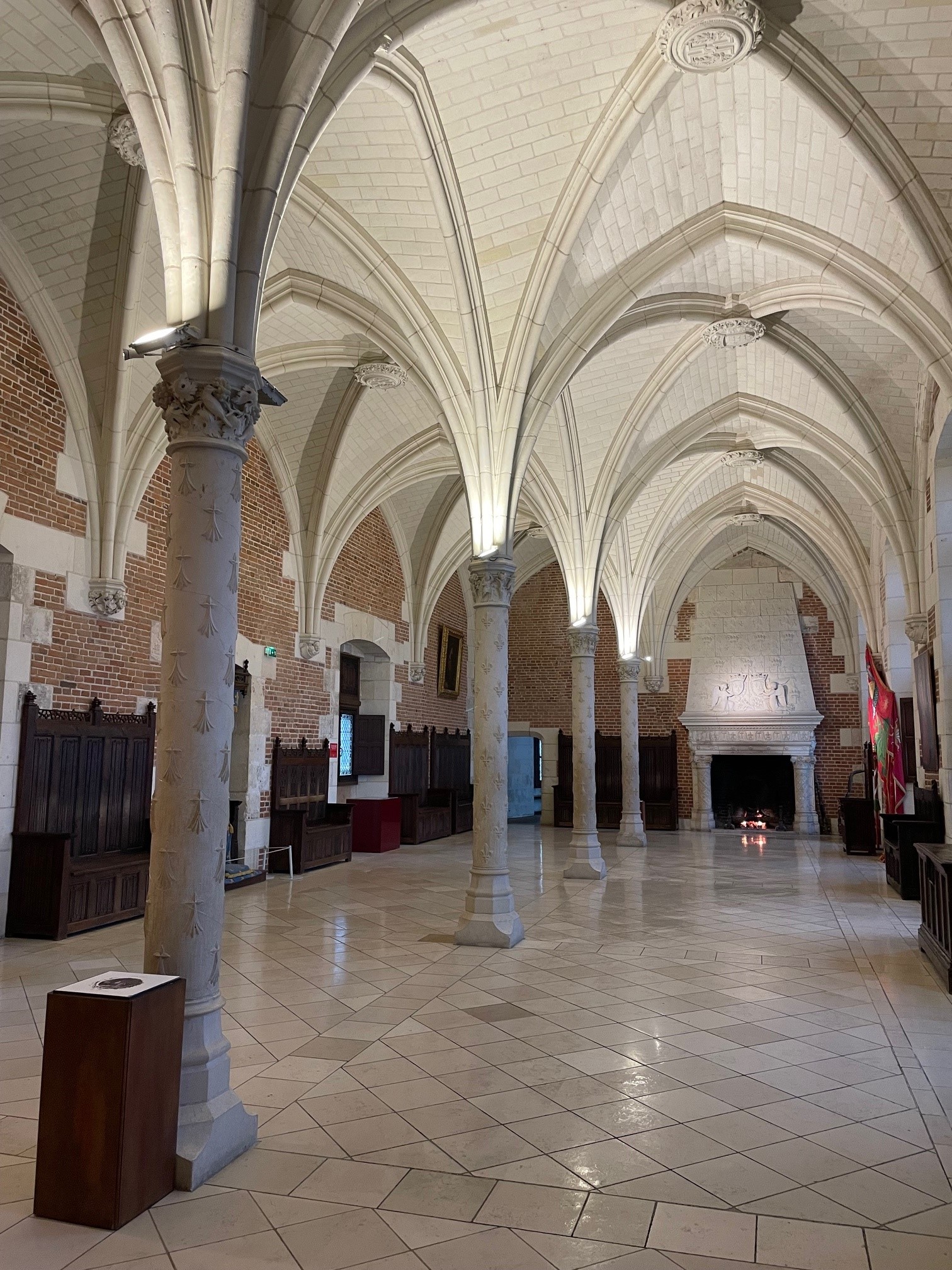
In the Charles VIII wing, see the Salle des States aka Council It is in this vast room ,the largest in the castle, that the king brought together his council, a true pole of royal power. The room has two chimneys: the first, with a trapezoidal hood, is still marked by the Gothic tradition while the second at the other end of the room, illustrates the Renaissance style. Anne de Bretagne coat of arms of Brittany , decorate many elements of the room: hood of the first fireplace, central pillars, stained glass windows on Loire. The emblem of Charles VIII ,also adorns the hood of the first fireplace. On the ceiling are inscribed monograms of Charles VIII C , and Anne de Bretagne A, .On the sides, leaning against the walls, there are large benches with files adorned with towel folds in Gothic style. On the walls are exhibited from the portraits of Bourbon kings: Henri IV , and Louis XIII.
The Terrasse de Naples located on the left of the Galerie d’Aumale has three belvederes which dominate the Loire. It welcomed a Renaissance garden at the end of the 15C,
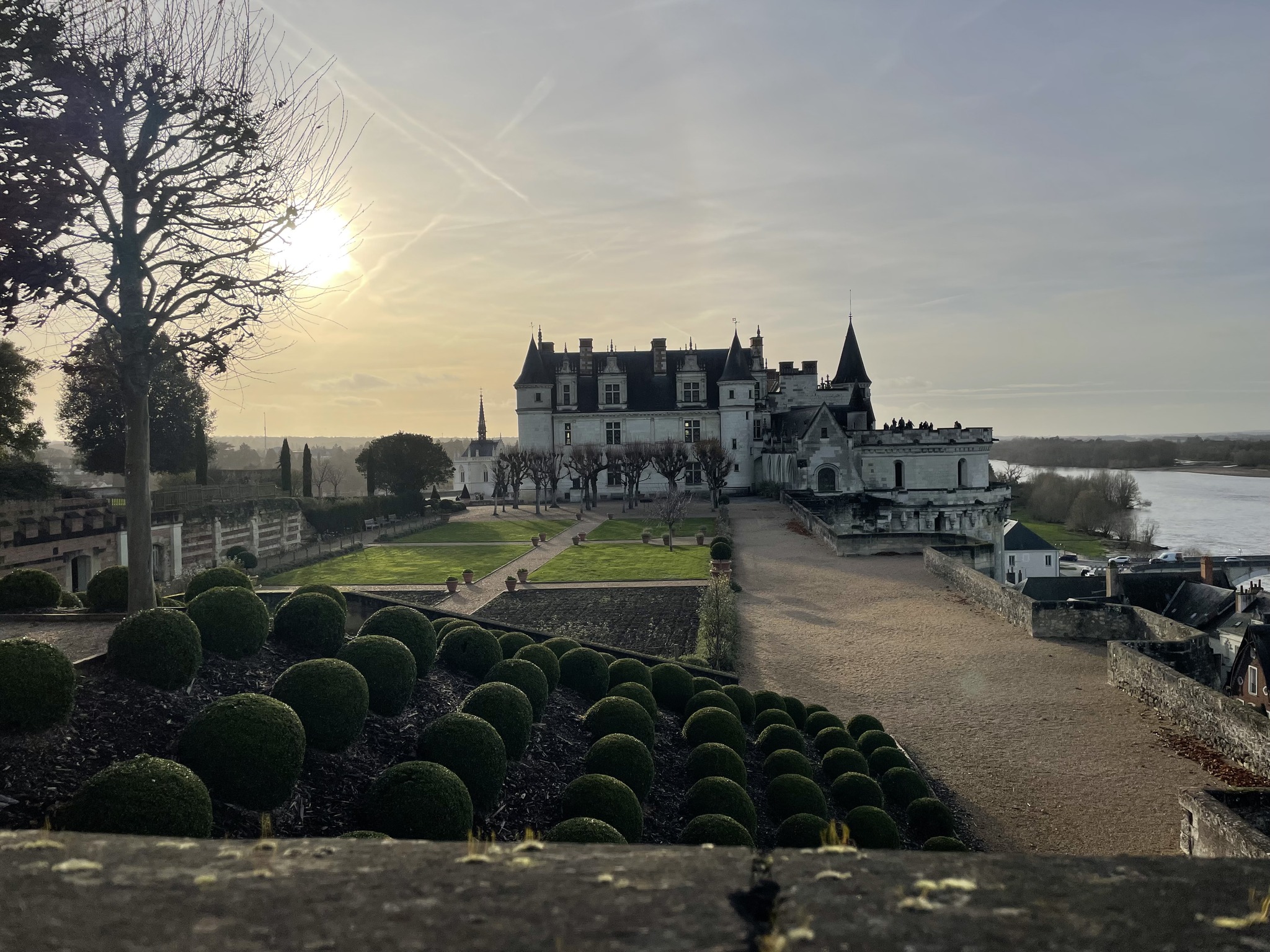
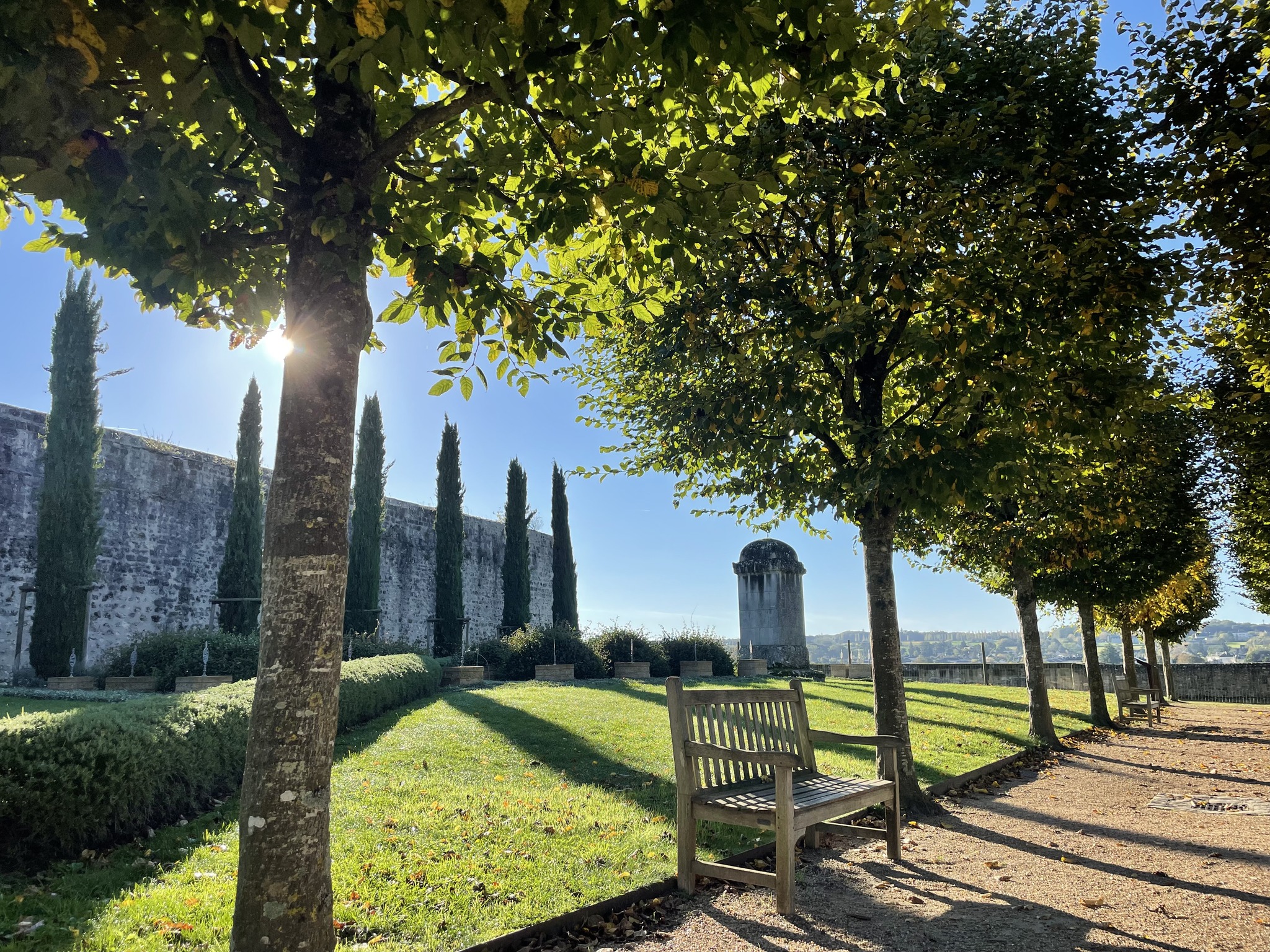
The Jardins paysagers or landscape gardens oriented south consists of alleys bordered by vertices, boxwood, cypress and muscat vines. It is extended on the side by the Jardin d’Orient or Oriental Garden, in honor of the companions of the Emir Abd El-Kader who died during their captivity. An alley oriented towards Mecca crosses the alignment of the steles.
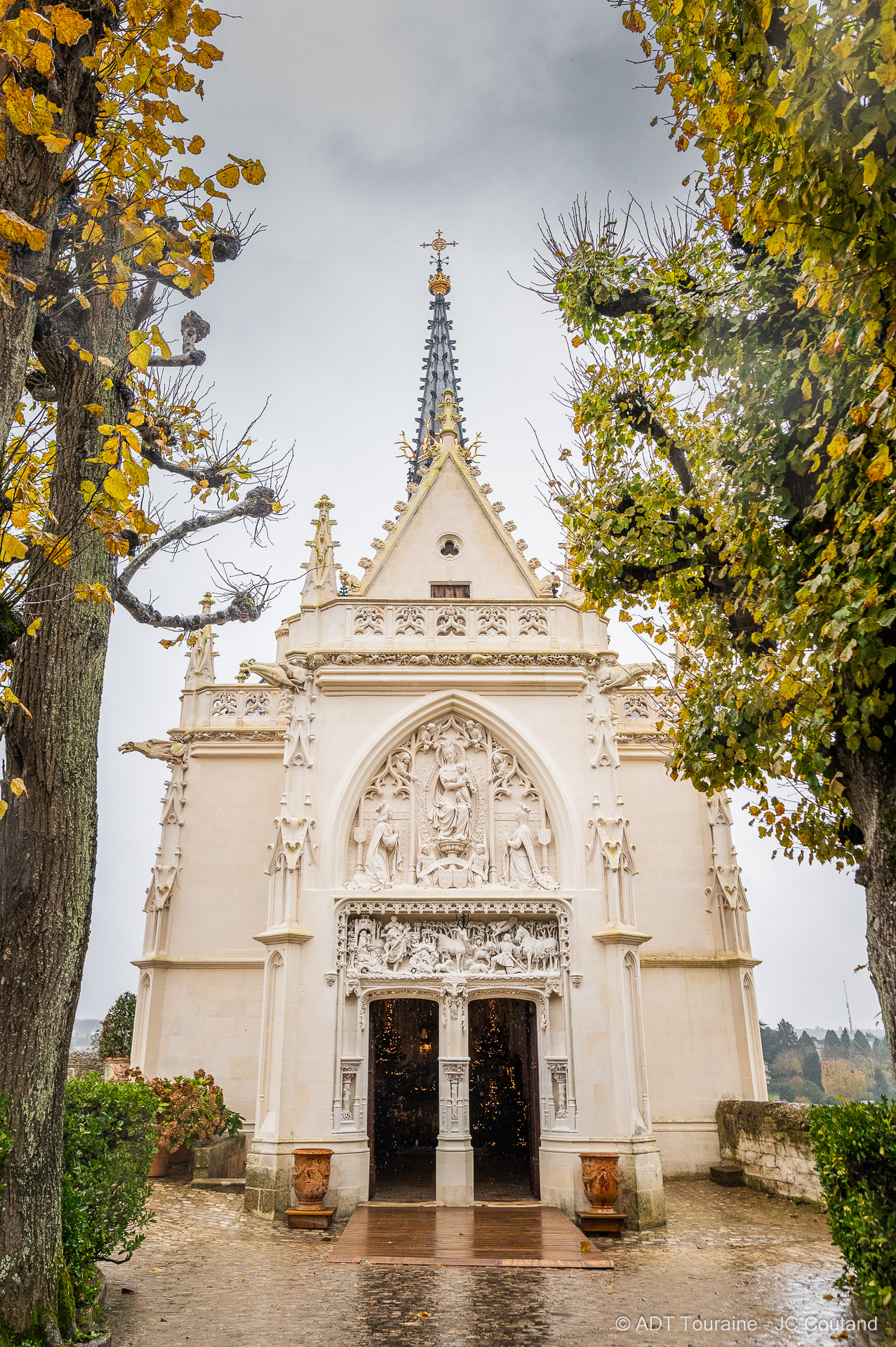
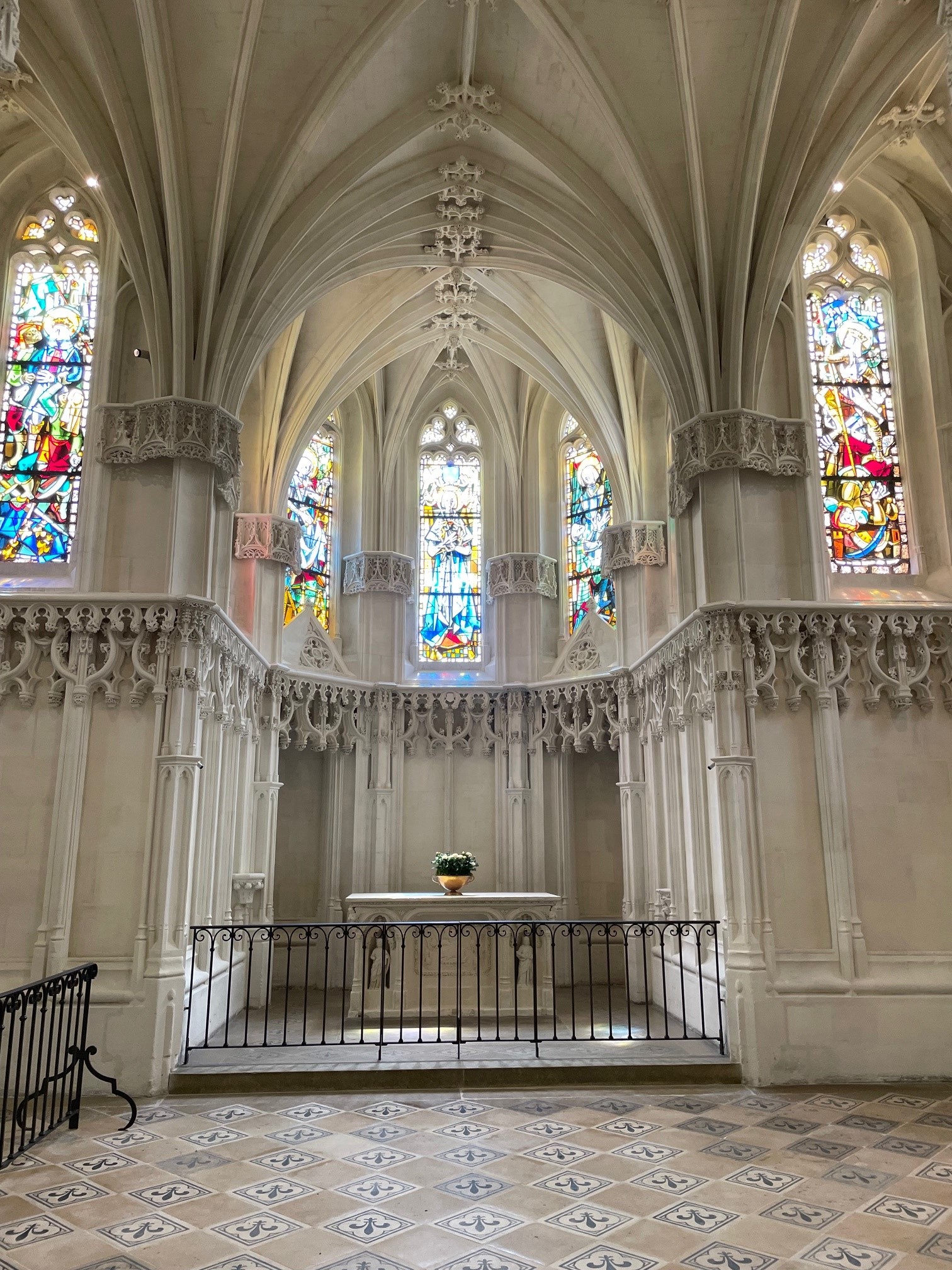
In the terraces you see the Chapelle Saint Hubert, (see post) dedicated to the patrons saint of hunters built under king Louis XI and finished by king Charles VIII, it is the resting place of the genius Leonardo da Vinci from May 2,1519. The Chapelle Saint-Hubert was built and sculpted between 1491 and 1496 by Flemish artists in The pure Gothic taste flamboyant in white tuffeau on the initiative of Charles VIII. The chapel then serves as an oratory in Anne of Brittany, before becoming the last presumed home of the body of Léonardo da Vinci, died in Amboise in 1519. The lintel of the front door represents the hunt of Saint Hubert. The stained glass windows, quite recent, retrace episodes of the life of Saint Louis, and the tympanum dating from the 19C, represents Charles VIII and Anne de Bretagne. From the fall of 2021 to the spring of 2024, the Saint-Hubert Chapel has been the subject of a large renovation site. Sculpted, frame, stained glass sets .etc restoring all its magnificence at the chapel.
A bit of history, again, that I like tell us that in 1431, Louis d’Amboise, one of the members of the stately family, participated in a plot against Georges I of Trémoille, favorite of Charles VII. Unmasked, he was first sentenced to death before being pardoned. His castle, on the other hand, was confiscated in 1434. From then on, Amboise entered the royal domain and quickly became a royal home. In 1433, King Louis could find refuge in Amboise in the event of a threat from the allies of the Burgundians, during the civil war between Armagnacs and Burgundians. On October 7, 1461, Louis XI came to greet his mother, Marie d’Anjou, after his coronation in Reims. She lived in Poitou so that Queen Charlotte de Savoie and their daughter Anne de France can settle there. Louis XI then raised his own son (the future Charles VIII). Being born in 1470 at the castle, the Dauphin Charles appreciates Amboise and in fact his predilection home. He was raised under the care of a lord of Touraine, Jean Bourré. Louise de Savoie, her son François I and Marguerite of Austria, were also educated there. Charles VIII is raised there and, having become king, makes it a real palace. He made the first striking constructions there from the start of his reign, and undertook deep modifications from 1492 to 1498 such as the Chapelle Saint-Hubert; The Charles VIII wing, also of flamboyant Gothic style, including the houses of the king and the queen; the two rider towers (Tour des Minimes and Tour Heurtault); A park is set up on the terrace; There will later have a bust of Leonardo da Vinci and a Muslim memorial for the accompanying people of Abd El Kader who died in Amboise during his captivity. Charles VIII dies in Amboise of a cerebral hemorrhage after having violently struck his head to a lintel of stone of a low door of the Hacquelebac gallery, On April 7, 1498. Louis XII, his cousin and successor, built a second wing, perpendicular to the Charles VIII wing, in the Renaissance style. He yields the domain to Louise de Savoie, who raises his two children there, Marguerite and François. Under François Ier the courtyard still often lies at the royal castle but his stays will gradually be spaced. Although the construction continues, with the completion of the Heurtault tower and the redevelopment of the Louis XII wing, the king will prefer other residences such as the castles of Chambord, Blois or Fontainebleau. In 1560, under the ephemeral reign of François II, the castle was the scene of the Conjuration of Amboise, a prelude to the wars of religion. From Henri III, the royal stays were becoming increasingly rare. The castle then turns into a luxury prison for the great characters of the State, such as César de Bourbon, Duke of Vendôme, and his brother Alexandre de Vendôme, prior of the Order of Saint-Jean de Jerusalem, both interned for having participated in the conspiracy of Chalais against the Cardinal de Richelieu, in 1626. The castle then passed to Gaston de France, Duke of Orleans, brother of Louis XIII. He carried out some demolitions there in the 1660s. Louis XIV confiscated it, and gave it the prison rôle as the king had Nicolas Fouquet and Antonin Nompar de Caumont, Duke of Lauzun there. Having become the property of Étienne-François de Choiseul, Duke of Choiseul in the 18C, he abandoned it around 1760 for the benefit of Chanteloup,(see post) a few kms south of Amboise. After his death, the Château d’ Amboise and Chanteloup are bought by Louis-Jean-Marie de Bourbon, Duke of Penthièvre. When he died, they become national domain, and the state becomes the owner. A large part of the castle was demolished under the first empire, when Napoleon I offered the castle, already in poor condition, to ex-consul Roger Ducos who, not having the means to restore the whole, preferred to destroy both third of the building such as the Saint-Florentin collegiate church and the Logis des Reines in particular, between 1806 and 1810. Louis-Philippe inherited the castle through his mother. He cleared the old ramparts by destroying the adjoining houses and redecorates the Louis XII wing. The State became owner again following the revolution of 1848. In 1848, following a surrender treaty not respected by the French authorities, the Emir Abd El-Kader and a hundred companions were placed in captivity, before being released by Napoleon III, on October 16, 1852. In 1873, the castle returned to the family of Orleans and his son.Henri d’Orléans, Duke of Aumale, transforms it into a host house for the elderly. In 1974, the Count of Paris (Jean d’Orléans would have been the illegitimate king Henri VII) entrusted it to the Saint-Louis Foundation, of which he was the founding president.
The official Château d’Amboise : https://www.chateau-amboise.com/en/
The city of Amboise on its heritage: https://www.ville-amboise.fr/88/monuments-a-visiter.htm
The local Val de Loire tourist office on the château d’Amboise : https://www.touraineloirevalley.co.uk/cultural-heritage/royal-chateau-of-amboise-amboise/
The Centre Val de Loire region tourist office on the Château d’Amboise : https://www.loirevalley-france.co.uk/discover/loire-chateaux/royal-chateau-amboise/
There you go folks, another dandy town and beautiful castle, always great memories of always ! . It was a great experience to know it, always wonderful uplifting and with great history and architecture I like. Again, hope you have enjoy the post on the Château d’Amboise, part III !!! as I.
And remember, happy travels, good health, and many cheers to all !!!

 Paris1972-Versailles2003
❤️
LikeLiked by 1 person
Gorgeous! I visited le château d’Amboise several years ago. I only had a short stay, but a lovely one all the same. Thanks for sharing!
LikeLiked by 1 person
Yes it is ! Thanks for stopping by Cheers
LikeLiked by 1 person