
I bring you back to historical Sens in the department of Yonne 89 of the Bourgogne-Franche-Comté region of my belle France, A beautiful town on history and architecture that I had visited by chance! I found these pictures spread on couple posts and decided to do credit to it by creating on post on the beautiful cathedral . I came here by car from Paris 7éme with a group of friends,and later with the family, Therefore, here is my take on the Cathédrale Saint Etienne de Sens, part I !!! Hope you enjoy the post as I.
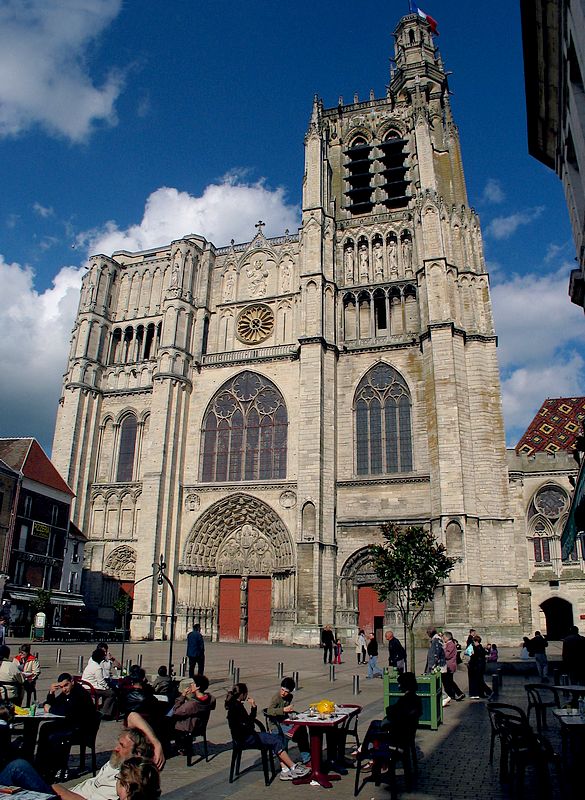
The Cathédrale Saint-Etienne of Sens with its complete title Metropolitan and primatial Saint-Etienne de Sens, is the Catholic cathedral of the Archdiocese of Sens, It is one of the first churches of Gothic architecture of Christianity. Begun around 1130-1135, its nave and its choir are devoted in 1164, and the facade was finished at the end of the 12C. Its southern tower, the bell tower, was completed much later (1532–1534). As for the transept, which dates from the years 1490–1515, it is one of the most beautiful masterpieces in flamboyant Gothic. The energy and the means deployed to build the cathedral are due to the importance of both the archdiocese of Sens (which included Paris in its territory) and the bailiwick of Sens (which was the oldest and most extensive of France).Saint Louis married in Sens and later takes possession of the relics acquired to be revered in the Sainte Chapelle (see post). On May 27, 1234, the marriage of Saint Louis and Marguerite de Provence was celebrated in the cathedral of Sens The important personnages of the kingdom were present and the followers present includes his mother Blanche de Castille, his brothers Robert d’Artois and Alphonse de Poitiers, his cousin Alphonse de Portugal, many nobles including the faithful Barthélemy de Roye and several ladies who ensure the courtship to Marguerite the day after the marriage, on May 28, 1234, the young Marguerite was crowned queen of France.
The Cathédrale Saint Etienne or St Stephen’s Cathedral is at the heart of a complex that includes the old Synodal palace and the old archiepiscopal palace. On the left of the cathedral were also a chapter library and a missing cloister. The interior length of the cathedral: 113.5 meters, exterior length: 122 meters, height of the southern tower: 78 meters, including the height of the terrace: 66 meters. Facade width: 48.5 meters, nave height: 24.4 meters, and the inner length of the transept: 48 meters.Huge and beautiful indeed,
The three portals of the facade are dedicated from north to south respectively in Saint John the Baptist, Saint Etienne and the Blessed Virgin. The were the were sculpted the first in the 12C: the tympanum were assembled later. The oldest part of the western facade is the northern tower or a tower of lead, so called because covered until 1845 with an arrow covered with lead blades. Its portal is dedicated to Saint John the Baptist: the tympanum represents the baptism of Christ, the feast of Herod and the takeoff of Saint John the Baptist; In the arrangement ,other scenes from the life of the precursor: the angel’s announcement to his putative father Joseph, imposition of the name, circumcision …The central portal is largely survived by the collapse of 1268, and is therefore part of the old portion of the facade. The general composition of the decoration of the central portal presents from bottom to top: the terrestrial world in the foundations: a bestiary, the liberal arts and the work of the twelve months of the year; The celestial world in the areas: martyrs, saints, angels and stars. The southern portal is dedicated to the Virgin Mary. We can admire the representation: Dormition and assumption on the lintel; of the coronation of the Virgin by Jesus Christ on the tympanum.
The southern facade of flamboyant Gothic style gives in a courtyard bordered on the east side by the archiepiscopal palace and west side by the Synodal palace. The southern facade with the superb Moses gate dates from the years 1490-1500, To the south of the choir, a staircase communicates above the sacristy with the apartments of the archbishop from which it is possible to follow the offices from a platform. The 16C palace is arranged in angle with the choir, between courtyard and garden. Today it houses the archaeological museum of the city of Sens. The Synodal Palace was built in the 13C at the angle with the southern side of the cathedral facade. It is on two levels and intended to house the following religious activities: a ground floor dedicated to the functioning of the officiality (religious court) upstairs a large room covered with six vaults with crusaders of warheads, for Synods.
The bell tower is also called the stone tower. Notice on the third floor of the tower a group of five statues. They are part of a gallery of ten sculptures representing ten archbishops in Sens and correspond to an equivalent group, on the posterior side of the tower. They were placed there in the 19C. The bell tower is flamboyant Gothic style. The southern tower always carries the two most important parts of the very famous medieval ringtone, the two Bourdons bells: the Savinienne melted in 1560, with a diameter of 2.60 m, and weighs 9,620 kg; The Potentienne melted in 1560, with a diameter of 2.33 m, and weighs 7,680 kg.
Inside ,the very wide nave (15.25 meters) The first span is rectangular, the following four are square and with a sexpartite vault. The first span of the southern collateral or Chapelle Sainte-Croix , placed under the tower of the bell tower, is also called the bell chapel , because it is just under the two bumblebees of the cathedral. The fourth northern intersecting nave houses a very special funeral monument, commanded by the Archbishop Tristan de Salazar in honor of his deceased parents, Jean de Salazar and Marguerite de la Trémoïlle, and completed in 1516. A private altar leaning against a monumental altarpiece parallelepiped in white limestone, in an exuberant late Gothic style, where a certain Renaissance sensitivity begins to point. Its main face includes three statues, including two Saint Etienne (St Stephens) ,and the Virgin and Child are works whose style illustrates fairly well the sculpture school of Tours around 1500, carrying out the transition between Gothic art and Renaissance . The third statue representing a holy bishop is a late re -implementation replacing a Saint Jean de Chaleveau stolen from the 16C. The second part of the monument is a high ball made up of four fine columns carrying a stone table on which the praying of Jean de Salazar is perched, beheaded during the French revolution.
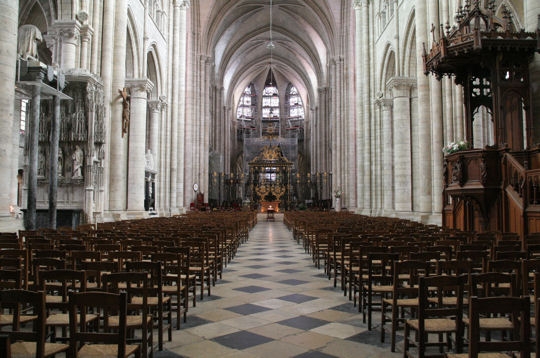
In a Flamboyant Gothic style, the elevation of the transept has only two floors: large arcades and tall windows. The choir is bordered by a wanderings of several chapels arranged around the ambulatory: the first northern side chapel is a baptistery dedicated to Saint John the Baptist which has preserved a Romanesque choir; the first southern side chapel houses a statue of Notre Dame du Xive, to the cult of which it is devoted; The very bright axial chapel of the 13C evokes Saint Savinian, martyr and first bishop of Sens: the stained glass relating the life of the saint is masked by a sculpture of the 18C representing its ascension. The axial chapel is framed by two other chapels of the 16C and 18C, that of the left sheltering the tomb of the Dauphin of France , and his wife Marie-Josèphe de Saxe , parents of the kings Louis XVI, Louis XVIII and Charles X of France, the Queen Clotilde of Sardinia and Madame Élisabeth, sister of Louis XVI and the purest victim of the French revolution. The Chapelle Sainte-Colombe, the Dauphin Louis, son of Louis XV, died of tuberculosis on December 20, 1765 at the Château de Fontainebleau (see posts). According to his last wishes, his body was buried in the cathedral of Sens. The body of the Dauphine Marie-Josèphe de Saxe, who died two years later of the same evil, was also transported to Sens.
The Cathédrale Saint Etienne ,also, has a very beautiful collection of stained glass windows from the 13C to the 18C. Most stained glass windows are found in the ambulatory of the choir and in the two crossbours of the transept and mostly date from the 13C and the 16C. A famous 13C stained glass window is in the northern ambulatory of the choir. It commemorates the arrival in the 12C of Thomas Becket, Archbishop of Cantorbéry. He takes refuge in Sens to protect himself from the anger of King Henri II of England, against which he defended the privileges in particular judicial of the church. He later returned to England where he was assassinated by envoys from Henri II The cathedral has had organs since the 15C, placed in the north side and inaugurated in 1440 in 1722, it was placed in the choir and in 1729 it is dismantled to be placed in the gallery.
The Catholic Parish of Yonne on the Cathedral: https://www.yonne.catholique.fr/sens-et-environs/visite-de-nos-eglises/cathedrale-st-etienne-de-sens
The Sens tourist office on the cathedral: https://en.tourisme-sens.com/i-discover/my-essentials/the-cathedral-of-saint-stephen-of-sens/
The official museums of Sens on the cathedral: https://www.musees-sens.fr/le-musee/cathedrale-saint-etienne/
The city of Sens on the cathedral: https://www.ville-sens.fr/annuaire/la-cathedrale/
There you go folks, this is a wonderful historical city to visit, Sens with all its splendors, not far from Paris. This monument is a must to visit and awesome square to see and indulge in all the best of Burgundy, Again, hope you enjoy this post on the Cathédrale Saint Etienne de Sens, part I !!! as I.
And, remember, Happy travels, good health and many cheers to all !!!

 Paris1972-Versailles2003