
We came back to the wonderfully beautiful Centre Val de Loire region, practically my backyard, and love it ; many times here. We were on my road warrior trip in the Loire valley and this was on the road between several places we came to see, This is another new town for us and glad passed by it Therefore, let me give you a bit on this is Genillé !! Hope you enjoy it as I.
The town of Genillé is in the Indre-et-Loire department, no, 37 in the Centre-Val de Loire region of my belle France. It is 39 km from Tours, 9 km from Montrésor ,10 km from Loches and 384 km from my current home. The town of Genillé is crossed by the D 764 linking Montrichard to Loches (which we took). By reaching Saint-Quentin sur-Indrois by the D 10, then taking the D 31, you reach the A85 autoroute after 17 km, via exit 11 Bléré which allows you to reach Tours and the A10 autoroute or Vierzon and the A71 autoroute.
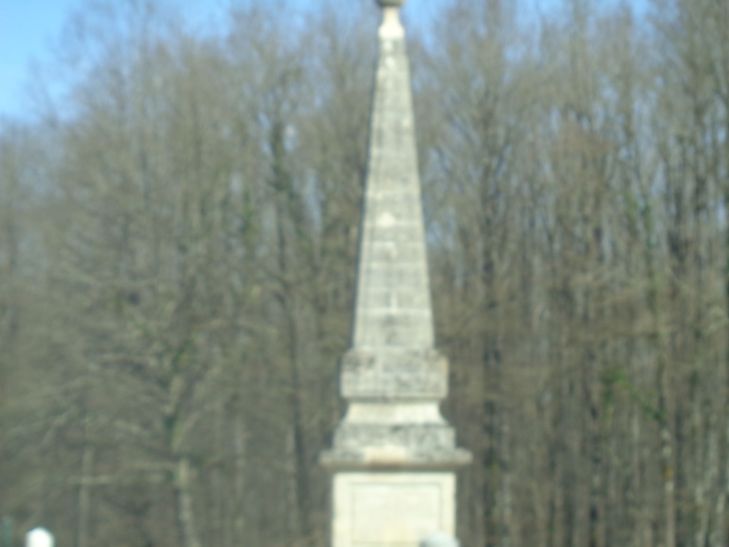
What we saw here coming on the road D794 was the pyramide of Genillé, To meet the requirements of logging and big game hunting, the Loches forest benefited very early on from a network of well-maintained paths. During the reign of Louis XV, a main road was widened and made passable: the Georges d’Amboise road, opened to the public in 1769. It also marks the boundary of the town. In order to structure traffic and organize hunting meetings, important crossroads were marked by pyramids that were built in 1778. In general, a forester’s house was built nearby. The pyramids were built along the Georges-d’Amboise forest road, which crosses the Loches forest. This road serves as a municipal boundary between Ferrière-sur-Beaulieu and Sennevières , and Saint-Quentin-sur-Indrois, Genillé and Chemillé-sur-Indrois on the other side0 Today, you can still admire the pyramids of Saint-Quentin, Genillé, and Montaigu. The pyramid of the Chartreux is the only one to have 5 faces, probably because it is located at the crossroads of 5 roads: Montrésor, Loché-sur-Indrois, Sennevières, Loches, and Genillé. Pyramid of Genillé is sometimes locally called pyramid of Beauchêne. Its cubic base, whose faces are molded and decorated with a frame, ends with a cornice that is also molded. The pyramid itself, whose edges also have moldings, ends with a sphere topped with a weather vane.
Other things to see here with more time are : The hamlet of Hys, on the edge of the territory of Genillé, is of very ancient creation. Designated in the 10C in a charter of Marmoutier under the name of Yvis, fief of the barony of Sennevières, it housed in the 12C a priory dependent on the abbey of Villeloin sold in 1791 as national property; although largely modernized, some of its houses retain architectural elements from the 15C, The Church of Sainte-Eulalie , oldest part of the church is the bell tower, whose foundations date back to the 11C; small-scale masonry is still visible at its base, on the north side. The nave was consolidated in the 13C. It was rebuilt around 1520 and covered with a paneled frame whose horizontal beams , and king vertical beams are visible. The painted decoration dates back to the 19C. The old camuserie is a building, recognizable by its hexagonal staircase tower, which was built in the 16C. The building served as a camuserie, the office of the accountant of the estates of the lord of Genillé. The Château de Rassay, built in the 17C, was partially rebuilt in the first half of the century. The Château de Marolles, stands on a fief known since 1130. Renovated in the 17C, it was extensively remodeled in the 19C. The Château de Genillé was built in the 15C by the Fumée family and enlarged two centuries later by the de Menou family. The four corners of the main building are flanked by two cylindrical towers and two watchtowers set on corbels. The Abbaye de la Bourdillière is a former abbey of Cistercian nuns founded in 1662 by Louis de Menou; the first 24 nuns belonged to his family. Initially a simple priory, it was raised to an abbey in 1688 but abolished in 1770 due to insufficient income. A 15C building belonging to the old castle is still visible, flanked by two towers.
A bit of history tell us that a charter of the Marmoutier Abbey from 984 announces the accession of Genillé, of which this is one of the first written mentions, to the rank of chief town of viguerie. In 987, Count Foulques III, known as “Foulque Nerra”, came to the head of the County of Anjou, whose possessions he endeavored to multiply in Touraine, to the detriment of the House of Blois. The Battle of Nouy, in 1044, marked the victory of Geoffrey II of Anjou, son of Foulque Nerra and ally for the occasion of King Henry I; many lands, including Genillé, became the possession of the supporters of the Counts of Anjou. From 1180, Philip Augustus tried to take advantage of this to regain control of the possessions of the House of Anjou. This was done in 1190 for Genillé and its region. Around 1430, or even around 1416 according to some historians, Adam Fumée was born in Tours. This key figure in the history of Genillé studied medicine in Montpellier. He became the first physician at the court of Charles VII. Having fallen into disgrace two years later, he was rehabilitated in 1461 by Louis XI, who employed him as a physician but also as a trusted man responsible for delicate negotiation missions. He was appointed Keeper of the Seals of France in 1479; he kept the same position under the reign of Charles VIII; all his activities with the kings allowed him to accumulate an immense fortune, thanks to which he bought the lordship of Genillé in 1483. Adam Fumée, lord of Roches, Saint-Quentin and Genillé, died in Lyon in 1494. He was buried in the chapel of his castle in Saint-Quentin. His descendants, including the Menou family, remained owners of the castle of Genillé until the French revolution. On December 1789, the property of the clergy was confiscated and the nobles fled the village. On February 28, 1791, the official birth certificate of the town of Genillé was consecrated within its territorial limits, which had not changed since. The Empire brought calm and stability to the town, From June 11 to 14, 1940. Genillé housed the Ministry of Colonies headed by Louis Rollin. When France was partitioned by the demarcation line, Genillé was placed in the free zone. On September 10, 1944, Genillé celebrates its liberation.
The town of Genillé on its heritage : https://genille.fr/decouvrir-genille/patrimoine-et-histoire/
The local Touraine Val de Loire tourist office on the Loches forest (see pyramids) : https://www.touraineloirevalley.co.uk/loches-national-forest/
There you go folks, I came to the magnificent Loire valley. The towns passed by needs more time and we will be back, eventually. This is another wonderful spot in my belle France, and glad passed by it. Again, hope you enjoy the post on this is Genillé !! as I.
And remember, happy travels, good health, and many cheers to all !!!

 Paris1972-Versailles2003