
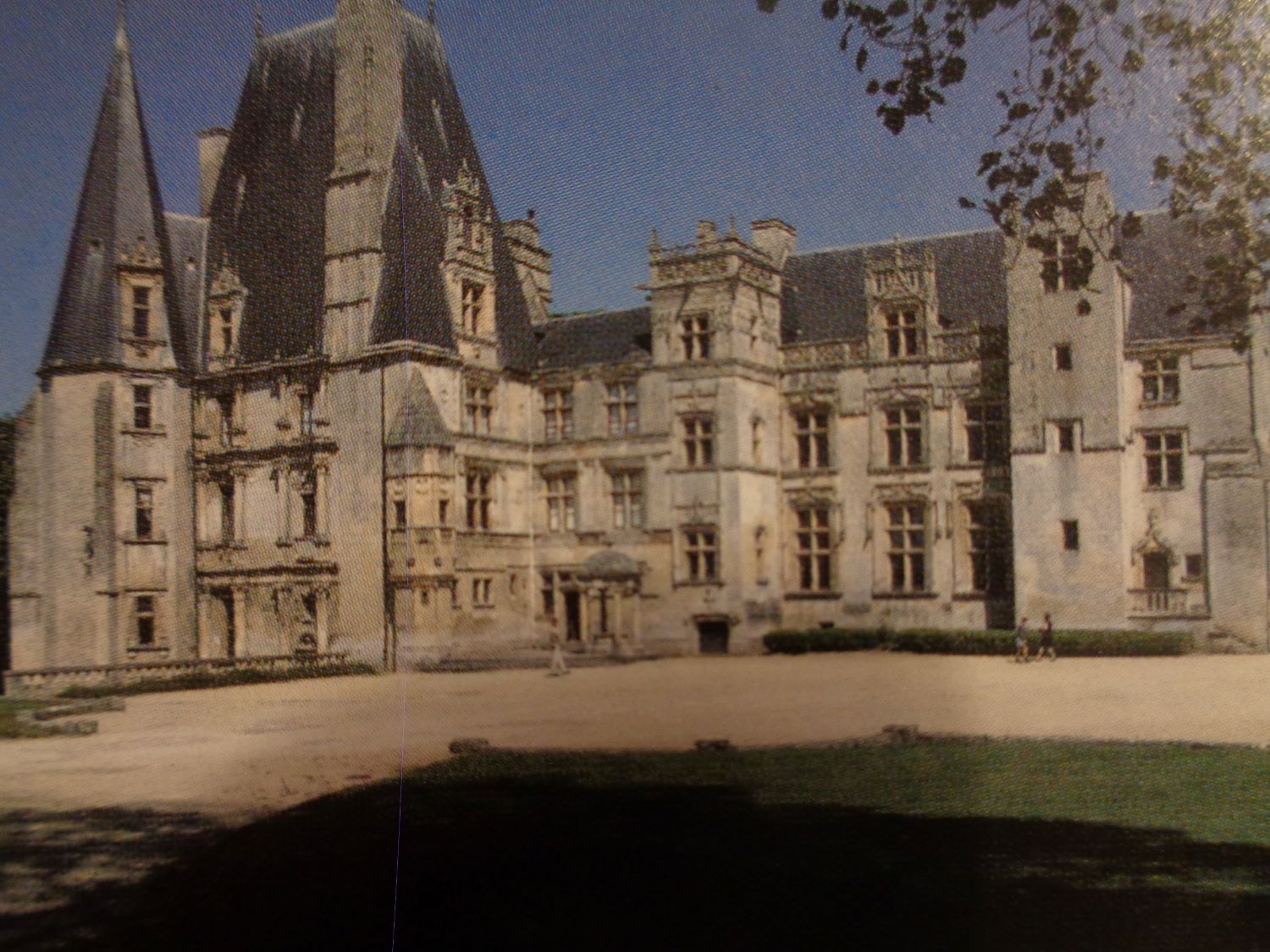
 From the sober Gothic of the Chapel and the Old Logis to the Louis XII style decor then Renaissance of the big pavilion, it is obvious that, from father to son, all had to be in agreement with the art of their time although remained unfinished, their remains remain one of the most precious testimonies of the evolution of the Norman taste of Charles VIII to Henri II , It then consists of a vast set of three buildings: the seigniorial logis , the Grande-Salle or reception room ,and the chapel, Despite all its magnitude, this fortress was destroyed during the Hundred Years War Of this period it reached us the segments of the 11C, the still all Romanesque chapel partly modified in the 16C, and the vaulted cellars in the crossed of warheads from the 12-13C which formerly formed the ground floor of the seigniorial house. By their sobriety, these elements are linked to the classic Gothic style (1180-1230) In 1374, by breaking with the primitive arrangement of the fortress which united Châtelet and main body, was reconstruct, from the end of the 14C, the north end of the wing to make it the housing of the farmers. Made in a very sober flamboyant Gothic style in the middle of the 15C, the staircase turret and the last span of the right of the central body correspond to this first phase of work, A total reconstruction of the flamboyant Gothic style of transition between the Gothic and the first Renaissance, in the full rise of the Louis XII style, It is with this last phase of work that all this long series of achievements comes to go. While significantly transforming the body of medieval mind into a real “Château de la Loire”, these works were the vector of a stylistic change, the patterns full of verve and Fantasy of the first Renaissance ended up evolving towards a clean classicism marking at the Château de Fontaine-Henry, the advent of the second Renaissance.
The chapel of the castle known as “Notre Dame du Val Busnel , today somewhat isolated in the park, it was an integral part of the medieval castle of Romanesque origin, The chapel is vaulted from crusaders of warheads , At the end of the 13C, in the heart of a wooded park, three historic gardens were created to trace the history of the gardens from the Middle Ages to the 18C. The medieval garden Notre-Dame inspired by the 13C Hortus Conclusus (“Enclos Garden”) was a small flowery enclosure developed in the cloister of monasteries by the monks around a statue of the Virgin Mary. Besides, many times been represented in artistic productions of the Middle Ages, linked in particular to the scenes of the Annunciation. The Gerbe du Parnasse ( wreath of the parnassus) served as a model in the drawing of the lawn which, in the château de Fontaine-Henry, makes the link between the court of honor, the castle and the chapel.
The official Château de Fontaine-Henry : https://www.chateaudefontainehenry.com/en
The town of Fontaine-Henry on its heritage : https://www.fontaine-henry.fr/crbst_23.html
The Calvados dept 14 tourist office on the castle : https://www.calvados-tourisme.co.uk/offer/chateau-de-fontaine-henry/
There you go folks, another wonder to be seen, worth the detour , me think. This is wonderful architecture and history to know and visit ,and even with more time. Again, hope you enjoy the post on the château de Fontaine-Henry of Fontaine-Henry !!! as I
And remember, happy travels, good health ,and many cheers to all !!!
From the sober Gothic of the Chapel and the Old Logis to the Louis XII style decor then Renaissance of the big pavilion, it is obvious that, from father to son, all had to be in agreement with the art of their time although remained unfinished, their remains remain one of the most precious testimonies of the evolution of the Norman taste of Charles VIII to Henri II , It then consists of a vast set of three buildings: the seigniorial logis , the Grande-Salle or reception room ,and the chapel, Despite all its magnitude, this fortress was destroyed during the Hundred Years War Of this period it reached us the segments of the 11C, the still all Romanesque chapel partly modified in the 16C, and the vaulted cellars in the crossed of warheads from the 12-13C which formerly formed the ground floor of the seigniorial house. By their sobriety, these elements are linked to the classic Gothic style (1180-1230) In 1374, by breaking with the primitive arrangement of the fortress which united Châtelet and main body, was reconstruct, from the end of the 14C, the north end of the wing to make it the housing of the farmers. Made in a very sober flamboyant Gothic style in the middle of the 15C, the staircase turret and the last span of the right of the central body correspond to this first phase of work, A total reconstruction of the flamboyant Gothic style of transition between the Gothic and the first Renaissance, in the full rise of the Louis XII style, It is with this last phase of work that all this long series of achievements comes to go. While significantly transforming the body of medieval mind into a real “Château de la Loire”, these works were the vector of a stylistic change, the patterns full of verve and Fantasy of the first Renaissance ended up evolving towards a clean classicism marking at the Château de Fontaine-Henry, the advent of the second Renaissance.
The chapel of the castle known as “Notre Dame du Val Busnel , today somewhat isolated in the park, it was an integral part of the medieval castle of Romanesque origin, The chapel is vaulted from crusaders of warheads , At the end of the 13C, in the heart of a wooded park, three historic gardens were created to trace the history of the gardens from the Middle Ages to the 18C. The medieval garden Notre-Dame inspired by the 13C Hortus Conclusus (“Enclos Garden”) was a small flowery enclosure developed in the cloister of monasteries by the monks around a statue of the Virgin Mary. Besides, many times been represented in artistic productions of the Middle Ages, linked in particular to the scenes of the Annunciation. The Gerbe du Parnasse ( wreath of the parnassus) served as a model in the drawing of the lawn which, in the château de Fontaine-Henry, makes the link between the court of honor, the castle and the chapel.
The official Château de Fontaine-Henry : https://www.chateaudefontainehenry.com/en
The town of Fontaine-Henry on its heritage : https://www.fontaine-henry.fr/crbst_23.html
The Calvados dept 14 tourist office on the castle : https://www.calvados-tourisme.co.uk/offer/chateau-de-fontaine-henry/
There you go folks, another wonder to be seen, worth the detour , me think. This is wonderful architecture and history to know and visit ,and even with more time. Again, hope you enjoy the post on the château de Fontaine-Henry of Fontaine-Henry !!! as I
And remember, happy travels, good health ,and many cheers to all !!! The Château de Fontaine-Henry of Fontaine-Henry!!!
This one was a while back in my road warrior tours of the Norman lands of my belle France I, again, found me older paper pictures that should be in my blog, glad to have found them, I have been all over France, but sometimes just touch base ,go on the run and lucky to be able to come back to many, but still work to do. Let me tell you about the château de Fontaine-Henry of Fontaine-Henry !!! Hope you enjoy the post as I.
The Château de Fontaine-Henry is located in Fontaine-Henry located between Caen and Courseulles sur Mer in the Calvados dept 14 of the Normandie region. Like a castle of the Loire lost in Normandy, the castle of medieval origin is made famous for its facades marked mainly by the styles Louis XII and Renaissance. Due to its high roofs culminating up to almost 15 meters high on the quadrangular “large pavilion”, the castle is also considered as the highest roofs in France, Today, surrounded by a English style park, It is 9 km from Courseulles sur Mer, 15 km from Caen, 22 km from Bayeux, 72 km from Honfleur, and 321 km from my house.
The château de Fontaine-Henry is a family domain that has gone through time by accumulating knowledge and objects. This has been made possible because the castle has never been sold and has been transmitted from generation to generation for about ten centuries having in turn the domain by inheritance, several names have succeeded it. On the site of a first fortress from the beginning of the 11C, Tilly’s family had a new castle built between 1200 and 1220. From this time, in particular, the chapel and vaulted rooms remain which formerly formed the ground floor of the stately house, still testifying today of the fullness of the castle during the classic Middle Ages. It is the Harcourt family who undertakes to rebuild the castle after the Hundred Years War. Keeping the estate for five generations, the work spread between the end of the 15C and the 1560s over almost a century, giving it its current aspect ,The current owners , the Marquis Pierre-Apollinaire d’Oilliamson, has largely opened its domain to tourism in order to highlight the historical and artistic heritage of the estate. In this perspective, the Marquis invites visitors to immerse themselves in 800 years of history with a summer program of entertainment baptized Les enchantées (the enchanted).
From the sober Gothic of the Chapel and the Old Logis to the Louis XII style decor then Renaissance of the big pavilion, it is obvious that, from father to son, all had to be in agreement with the art of their time although remained unfinished, their remains remain one of the most precious testimonies of the evolution of the Norman taste of Charles VIII to Henri II , It then consists of a vast set of three buildings: the seigniorial logis , the Grande-Salle or reception room ,and the chapel, Despite all its magnitude, this fortress was destroyed during the Hundred Years War Of this period it reached us the segments of the 11C, the still all Romanesque chapel partly modified in the 16C, and the vaulted cellars in the crossed of warheads from the 12-13C which formerly formed the ground floor of the seigniorial house. By their sobriety, these elements are linked to the classic Gothic style (1180-1230) In 1374, by breaking with the primitive arrangement of the fortress which united Châtelet and main body, was reconstruct, from the end of the 14C, the north end of the wing to make it the housing of the farmers. Made in a very sober flamboyant Gothic style in the middle of the 15C, the staircase turret and the last span of the right of the central body correspond to this first phase of work, A total reconstruction of the flamboyant Gothic style of transition between the Gothic and the first Renaissance, in the full rise of the Louis XII style, It is with this last phase of work that all this long series of achievements comes to go. While significantly transforming the body of medieval mind into a real “Château de la Loire”, these works were the vector of a stylistic change, the patterns full of verve and Fantasy of the first Renaissance ended up evolving towards a clean classicism marking at the Château de Fontaine-Henry, the advent of the second Renaissance.
The chapel of the castle known as “Notre Dame du Val Busnel , today somewhat isolated in the park, it was an integral part of the medieval castle of Romanesque origin, The chapel is vaulted from crusaders of warheads , At the end of the 13C, in the heart of a wooded park, three historic gardens were created to trace the history of the gardens from the Middle Ages to the 18C. The medieval garden Notre-Dame inspired by the 13C Hortus Conclusus (“Enclos Garden”) was a small flowery enclosure developed in the cloister of monasteries by the monks around a statue of the Virgin Mary. Besides, many times been represented in artistic productions of the Middle Ages, linked in particular to the scenes of the Annunciation. The Gerbe du Parnasse ( wreath of the parnassus) served as a model in the drawing of the lawn which, in the château de Fontaine-Henry, makes the link between the court of honor, the castle and the chapel.
The official Château de Fontaine-Henry : https://www.chateaudefontainehenry.com/en
The town of Fontaine-Henry on its heritage : https://www.fontaine-henry.fr/crbst_23.html
The Calvados dept 14 tourist office on the castle : https://www.calvados-tourisme.co.uk/offer/chateau-de-fontaine-henry/
There you go folks, another wonder to be seen, worth the detour , me think. This is wonderful architecture and history to know and visit ,and even with more time. Again, hope you enjoy the post on the château de Fontaine-Henry of Fontaine-Henry !!! as I
And remember, happy travels, good health ,and many cheers to all !!!
From the sober Gothic of the Chapel and the Old Logis to the Louis XII style decor then Renaissance of the big pavilion, it is obvious that, from father to son, all had to be in agreement with the art of their time although remained unfinished, their remains remain one of the most precious testimonies of the evolution of the Norman taste of Charles VIII to Henri II , It then consists of a vast set of three buildings: the seigniorial logis , the Grande-Salle or reception room ,and the chapel, Despite all its magnitude, this fortress was destroyed during the Hundred Years War Of this period it reached us the segments of the 11C, the still all Romanesque chapel partly modified in the 16C, and the vaulted cellars in the crossed of warheads from the 12-13C which formerly formed the ground floor of the seigniorial house. By their sobriety, these elements are linked to the classic Gothic style (1180-1230) In 1374, by breaking with the primitive arrangement of the fortress which united Châtelet and main body, was reconstruct, from the end of the 14C, the north end of the wing to make it the housing of the farmers. Made in a very sober flamboyant Gothic style in the middle of the 15C, the staircase turret and the last span of the right of the central body correspond to this first phase of work, A total reconstruction of the flamboyant Gothic style of transition between the Gothic and the first Renaissance, in the full rise of the Louis XII style, It is with this last phase of work that all this long series of achievements comes to go. While significantly transforming the body of medieval mind into a real “Château de la Loire”, these works were the vector of a stylistic change, the patterns full of verve and Fantasy of the first Renaissance ended up evolving towards a clean classicism marking at the Château de Fontaine-Henry, the advent of the second Renaissance.
The chapel of the castle known as “Notre Dame du Val Busnel , today somewhat isolated in the park, it was an integral part of the medieval castle of Romanesque origin, The chapel is vaulted from crusaders of warheads , At the end of the 13C, in the heart of a wooded park, three historic gardens were created to trace the history of the gardens from the Middle Ages to the 18C. The medieval garden Notre-Dame inspired by the 13C Hortus Conclusus (“Enclos Garden”) was a small flowery enclosure developed in the cloister of monasteries by the monks around a statue of the Virgin Mary. Besides, many times been represented in artistic productions of the Middle Ages, linked in particular to the scenes of the Annunciation. The Gerbe du Parnasse ( wreath of the parnassus) served as a model in the drawing of the lawn which, in the château de Fontaine-Henry, makes the link between the court of honor, the castle and the chapel.
The official Château de Fontaine-Henry : https://www.chateaudefontainehenry.com/en
The town of Fontaine-Henry on its heritage : https://www.fontaine-henry.fr/crbst_23.html
The Calvados dept 14 tourist office on the castle : https://www.calvados-tourisme.co.uk/offer/chateau-de-fontaine-henry/
There you go folks, another wonder to be seen, worth the detour , me think. This is wonderful architecture and history to know and visit ,and even with more time. Again, hope you enjoy the post on the château de Fontaine-Henry of Fontaine-Henry !!! as I
And remember, happy travels, good health ,and many cheers to all !!! 
 Paris1972-Versailles2003
That’s what I call a chateau!
LikeLiked by 2 people
Thanks for stopping by Cheers
LikeLiked by 1 person