
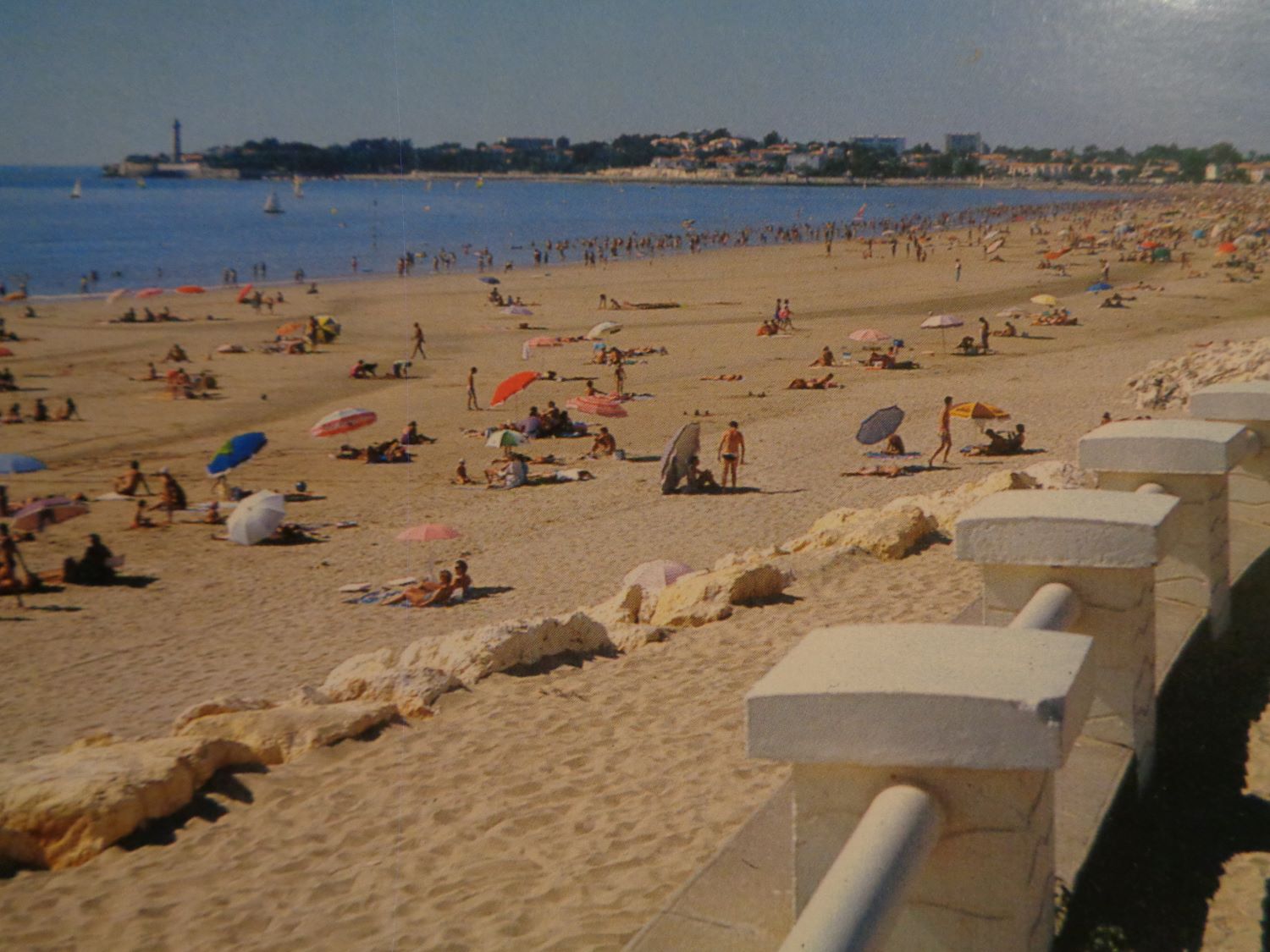
Once again looking back into my vault found me older paper pictures that should be in my blog, after all, this is my life’s history ! This is on beautiful Saint Georges de Didonne, a wonderful city to visit especially in summer. This is a coastal town ,very nice just south of us ,and off the beaten path area that should be visited more, Again, I take this opportunity to offer me and you this new post. Therefore, here is my take on this is Saint Georges de Didonne !!! Hope you enjoy the post as I.
The town of Saint-Georges-de-Didonne is located in the department of Charente-Maritime, no 17 in the Nouvelle Aquitaine region of my belle France, This is an important seaside and climatic station of the Royannais (Royan) and the Côte de Beauté, on the right bank of the mouth of the estuary of the Gironde river, and in the immediate vicinity of the Atlantic Ocean The town is 3 km from citycenter/downtown Royan 32 km from Saintes, 38 km from Rochefort, 63 km from La Rochelle , the departmental prefecture Bordeaux is 91 km away, and 370 km from my house (N165/D137/D733 dir La Rochelle/Rochefort) , The main road axes to reach it are the N150 and D733. The first does not directly cross the town (it comes to connect at the ring road), but drains a large number of vehicles from the A10 highwa (Paris, Tours, Poitiers, Bordeaux …) The second belongs to the network of departmental roads in the first category It is also the main way of communication to join Mirambeau, Blaye and Bordeaux. The Rocade of Royan or road D25 goes into the heart of the agglomeration (Saint-Palais-sur-Mer, Vaux-sur-Mer, Royan and Saint-Georges-de-Didonne) It is also the starting point of the D145, or “green road”, a tourist route to reach Blaye and Bordeaux by following the Gironde estuary as close as possible, via major tourist sites of the department, For parking in town never a problem by the beach but in the center see the rue de la République, rue Carnot, rue du Maréchal Foch, and rue du Marché which are in “blue zone” with parking period limited to 1h30 and conditioned on the demonstration of a parking disc, bought in the tobacco store or tourist office, The parking lot on the rue d’Algiers, backed by the church, is free, the same that those on rue du Stade, rue du Professor Langevin, and avenue Mocqueris, opposite the temple. The main parking spaces, however, are concentrated along the seafront, from the rond-point des oliviers trafic circle, and the boulevard de la Côte de Beauté to Roches Blanches, Free out of season, they become paid in summer (from July 1 to August 31).
For general info ,never taken these, By train, the Royan train station links the agglomeration to the other cities of France, including Paris and Bordeaux, via the stations of Saintes for the TER Nouvelle Aquitaine and Angoulême for the links by TGV. The city is served by the Cara’Bus urban transport network which connects it to the other towns in the Royan agglomeration The nearest airport is that of Rochefort-Saint-Agnant, about 35 km. La Rochelle-Île de Ré airport, 65 km, makes it possible to connect some big French cities, such as Paris or Lyon, as well as the British islands or northern Europe. 90 km south the Bordeaux – Mérignac airport is an international airport allowing connections to many countries (this have come once).
Things to see and enjoy here are : Its full boom in the 19C, thanks to the fashion of sea baths imported from England. From a small port of pilots-lameurs, Saint-Georges-de-Didonne becomes a vacation location prized by writers like Jules Michelet, artists Odilon Redon, Fernand Pinal, and Léonce Chabry), but also political figures such as Édouard Herriot, even crowned heads like King Alfonso XIII of Spain. . It retains its old center, now semi-pedestrian, and some historic monuments. Saint-Georges-de-Didonne highlights its fine sand conch, the largest intramural beach in Charente-Maritime Well, the beach if for anything worth the detour me think, Others are the Motte Castral of the Château des Lords de Didonne located in the district of the same name, a little behind the city center. Dating from the 11C, it is the only vestige of a fortified castle destroyed by the English in the 15C without ever being rebuilt. Another testimony of the medieval era, the Saint-Georges Church was raised in the course of the 12C, but was reworked several times later. Its atypical neo-Roman bell tower, raised in 1877, A true village at the edge of the 20C, the port has a major stone lighthouse between 1898 and 1902, the Vallières lighthouse, more opulent houses appeared. One of the first to be made is Villa Musso, a brick stone chalet rising on three levels. A short distance away, the Villa Castel-Bourg unveils a facade inspired by the flamboyant Gothic style. Finally, on the sidelines of the seafront, the Nelly house is characterized by a neo-Renaissance facade with mullion and mask windows.

A bit of history I like tell us that the town of Saint-Georges de Didonne was organized around its Clunisian priory, dependence of Saint-Eutrope de Saintes, mentioned in 1075 in a bubble of Pope Grégoire VII, and of its small Romanesque church, which serves as a stopover to pilgrims en route to Saint-James of Compostela, The marriage of Aliénor d’Aquitaine with Henri Plantagenêt and the accession to the throne of England of the latter passed Saint-Georges-de-Didonne in the Plantagenêt Empire, A vast area under English influence ranging from Scotland to the steps of the Pyrenees. When the Hundred Years War broke out in 1337, the town remained essentially faithful to the King , but his castle was taken for the first time by the armies of the King of France in 1350 (Philippe VI then his son Jean Le Bon) ;the town is then given to Foulques de Matha, whose descendants in particular, by marriage, the Montbron have it until 1446 ; finally it passes to the Trémoïlle who kept it until the 18C, The great fashion of the sea baths , imported from England, radically changed the face of the region in the course of the 19C. An Arena was built in 1902, where bullfights and Landes races were given.
The Great War or WWI had direct repercussions in the town. Several buildings are requisitioned in order to serve as hospitals or convalescent houses for the “poilus” , The next war or WWII brutally puts a brake on seaside pleasures. On June 24, 1940, after the disastrous campaign of France, two detachments of the “heer” (Army) of the 44th Wehrmacht division took possession of the town. The Kommandantur was installed in the Villa Le Rafale, on Boulevard Garnier (today, boulevard de Lattre de Tassigny) In 1944, while the Allies landed in Normandy and the FFI gradually frees the main cities of the southwest , In summer, the nazis received Hitler’s order to lock themselves in pockets of resistance. Saint-Georges-de-Didonne is integrated into one of them, Royan’s pocket.The reconquest of Royan’s pocket is pushed back in the spring. Meanwhile, sporadic bombings reach the town, between rue de la République, rue du Coca and rue du Docteur Larroque, nearly 300 houses are destroyed and 700 damaged. On the morning of April 15, the “venerable” operation marks the start of the release of Royan’s pocket. The center town was taken a few hours later by a unit of the West Indian Battalion No 5 (BMA5) placed under the command of Lieutenant-Colonel Henri Tourtet. Further north, the hamlet of Boube, then the Quarter of Didonne are taken by the fifth company of the French Equatorial Africa Battalion (“Oubangui-Chari” or BM2 walking battalion), placed under the command of Lieutenant François Valli , On April 17, rear-admiral Hans Michahelles, commander of the Royan fortress signed the surrender of the nazis forces,
As in most beautiful picturesques towns of my belle France, the artists flocked here ; some of my favorites are the painter Odilon Redon, who comes to Saint-Georges-de-Didonne from 1898 ,rents the villa Goa, and painted several canvases, representing the young seaside resort and its landscapes. The best known are “Rochers de Vallières”, « Magnifique moulin de Saint-Georges-de-Didonne » or “Rue de Saint-Georges-de-Didonne” (exhibited at the Museum of Fine Arts in Bordeaux). Also, Gustave Courbet painted in 1862 a « Roche isolée » (visible at the Brooklyn Museum of Art) , it is actually what is called today l’île aux Mouettes, à Vallières , and a « Marine au bord de mer ». Louis-Alexandre Cabié, naturalist painter, painted in 1902 a « Clair de lune au bord de mer », an oil on canvas called “La Corniche à Saint Georges de Didonne”, a “Saint Georges de Didonne, prés de Royan”, a « Vue de Royan depuis Suzac », a « Bord de mer » , and a « Sous les chênes verts » , In literature, we have Eugène Pelletan who evoked the young seaside resort in his book « La naissance d’une ville » or the birth of a city, released in 1876. Also, Jules Michelet stayed during an equinox storm in Saint-Georges-de-Didonne, and here he wrote “La Femme” in 1859. The Saintongeaise language presents many common features with languages such as the Cadia or the Acadian, which is explained by the Saintongeai origins of part of emigrants to New France (Canada and USA) in the 17C.
The town of Saint Georges de Didonne on its heritage : https://www.saintgeorgesdedidonne.fr/transitions/decouvrir/
The local Royan Atlantique tourist office on Saint Georges de Didonne : https://www.royanatlantique.fr/en/destination-royan-atlantique/balneaire-et-sauvage/saint-georges-de-didonne/
The Charente Maritime dept 17 tourist office on others : https://www.infiniment-charentes.com/
There you go folks, a nice walk to be able to see some wonderful coastal towns of my belle France with stunning views and leisure living at its best, you will love Saint Georges de Didonne. Enjoy the walk, the best way to see a place, no different here. Again, hope you enjoy the post on this is Saint Georges de Didonne !!! as I.
And remember, happy travels, good health, andn many cheers to all !!!

 Paris1972-Versailles2003