
 In the 17C, people came from all around Charné, to give worship of the imposing statue of Notre Dame, very old, but of which we know neither the date nor the craftsman. It is in oak, measures 1m30 and, according to the attitude of the Virgin, the rusticity of the presentation, the drapery of the clothes, it seems to be from the 13C. Mary holds in her hand the scepter, symbol of power, and Jesus, the cross on the terrestrial globe, symbol of royalty and redemption. In 1793, during the French revolution and in the context of the anti-religious struggle, the chapel was closed and the entrance guarded to prevent access. It was sold as national property, but a certain Le Nicolais, although a member of the revolutionary committee, hided the statue in a barrel in his cellar where it remained until 1800. Marie had regard to this gesture of piety; he died christianly. However the Chapelle Notre Dame de Charné threatened ruin and its disappearance seemed inexorable when it was put up for sale a third time in 1807. It was then a humble servant, Anne Vauloup, who offered all her savings, obtained a deposit on her wages, begged to Ernée and surroundings, which, on January 18, 1808, had the joy of being awarded the chapel and cemetery. She immediately donated it to the Charity Office of the city on the express condition that the chapel remained for the use of Catholic worship. She reserved for her only one place in the cemetery. She rests there, a little to the right, opposite the west entrance to the chapel. A city street now bears her name.
Some other things to see here are : The Notre-Dame-de-l’Assomption Church which dominates the town with its high bell tower. It was consecrated in 1697. Also, Roman Antiquities. The Château de Pannard 16C of Renaissance style. The local museum of prehistory. The Louis-Derbré cultural space: foundry workshop, sculpture garden and open-air theater. The Dolmen of Contrie. . And The Covered Alley of the Tardivière.
A bit of history I like tell us that in 1231, after the truce concluded in Saint-Aubin-du-Cormier, on July 4, between Queen Blanche of Castile, Spanish queen daughter of King Alphonse VIII of Castile and Aliénor of England, (mother of Saint Louis or king Louis IX) regent, and Pierre Mauclerc, Duke of Brittany, the city of Ernée is the place of the meeting between Pierre Mauclerc and Philippe Hurepel, the king’s uncle. This meeting ended with a solemn exchange of oaths.
The town of Ernée on the Chapelle ND de Charné : https://www.ville-ernee.fr/decouvrir-ernee/tourisme/la-chapelle-de-charne/
The local Atlantic Loire Valley tourist office on the Chapelle ND de Charné : https://www.atlantic-loire-valley.com/visits/religious-heritage/chapelle-de-charne-a-ernee
There you go folks, a nice ride by and rest stop with a nice monument to boot, this is my belle France. A quant chapel to see in off the beaten path Ernée, Again, hope you enjoy the post on the Chapelle Notre Dame de Charné of Ernée !! as I
And remember, happy travels, good health, and many cheers to all !!!
In the 17C, people came from all around Charné, to give worship of the imposing statue of Notre Dame, very old, but of which we know neither the date nor the craftsman. It is in oak, measures 1m30 and, according to the attitude of the Virgin, the rusticity of the presentation, the drapery of the clothes, it seems to be from the 13C. Mary holds in her hand the scepter, symbol of power, and Jesus, the cross on the terrestrial globe, symbol of royalty and redemption. In 1793, during the French revolution and in the context of the anti-religious struggle, the chapel was closed and the entrance guarded to prevent access. It was sold as national property, but a certain Le Nicolais, although a member of the revolutionary committee, hided the statue in a barrel in his cellar where it remained until 1800. Marie had regard to this gesture of piety; he died christianly. However the Chapelle Notre Dame de Charné threatened ruin and its disappearance seemed inexorable when it was put up for sale a third time in 1807. It was then a humble servant, Anne Vauloup, who offered all her savings, obtained a deposit on her wages, begged to Ernée and surroundings, which, on January 18, 1808, had the joy of being awarded the chapel and cemetery. She immediately donated it to the Charity Office of the city on the express condition that the chapel remained for the use of Catholic worship. She reserved for her only one place in the cemetery. She rests there, a little to the right, opposite the west entrance to the chapel. A city street now bears her name.
Some other things to see here are : The Notre-Dame-de-l’Assomption Church which dominates the town with its high bell tower. It was consecrated in 1697. Also, Roman Antiquities. The Château de Pannard 16C of Renaissance style. The local museum of prehistory. The Louis-Derbré cultural space: foundry workshop, sculpture garden and open-air theater. The Dolmen of Contrie. . And The Covered Alley of the Tardivière.
A bit of history I like tell us that in 1231, after the truce concluded in Saint-Aubin-du-Cormier, on July 4, between Queen Blanche of Castile, Spanish queen daughter of King Alphonse VIII of Castile and Aliénor of England, (mother of Saint Louis or king Louis IX) regent, and Pierre Mauclerc, Duke of Brittany, the city of Ernée is the place of the meeting between Pierre Mauclerc and Philippe Hurepel, the king’s uncle. This meeting ended with a solemn exchange of oaths.
The town of Ernée on the Chapelle ND de Charné : https://www.ville-ernee.fr/decouvrir-ernee/tourisme/la-chapelle-de-charne/
The local Atlantic Loire Valley tourist office on the Chapelle ND de Charné : https://www.atlantic-loire-valley.com/visits/religious-heritage/chapelle-de-charne-a-ernee
There you go folks, a nice ride by and rest stop with a nice monument to boot, this is my belle France. A quant chapel to see in off the beaten path Ernée, Again, hope you enjoy the post on the Chapelle Notre Dame de Charné of Ernée !! as I
And remember, happy travels, good health, and many cheers to all !!! The Chapelle Notre Dame de Charné of Ernée !!
In my road warrior mode, this is another off the beaten path spots of my belle France. I am on the road a lot in this beautiful country and passed by many wonders, usually no time to stop and just marked it for later returns and in depth views. Or bring the family over for a nice day out or weekend or more. One of these small towns I passed by and brings good souvenirs of passing on the job and then bringing the family over on a non toll ride to Paris/Versailles area. The little town is Ernée in the department of the Mayenne no. 53 in the Pays de la Loire region. And the little Chapel is right there on the road N12 each time so let me update this older post with new text and links for you and me, Therefore, here is my new take on the Chapelle Notre Dame de Charné of Ernée !! Hope you enjoy the post as I.
The town of Ernée is cut by the river that flows through the town, of the same name. This river creates the Ernée valley and leads to a body of water integrated into the city. Ernée has no train station, however, the TGV train station in Laval located less than 30 km away, takes you /from Paris Montparnasse in about 1.5 hours away . The town is also served by bus lines 104, 105 of the Pégase network in the Mayenne dept 53, connecting the city of Mayenne and Laval passing by Ernée. You can look up bus line 116 as well. This is for reference only as never taken these, Of course, we go by car on the N12 long trip without tolls or taxes to Paris/Versailles and the round trip is done by here. We gas up and have a snack on our way , especially at the Au Ptit Bistro, a nice rest area and picturesque little town.
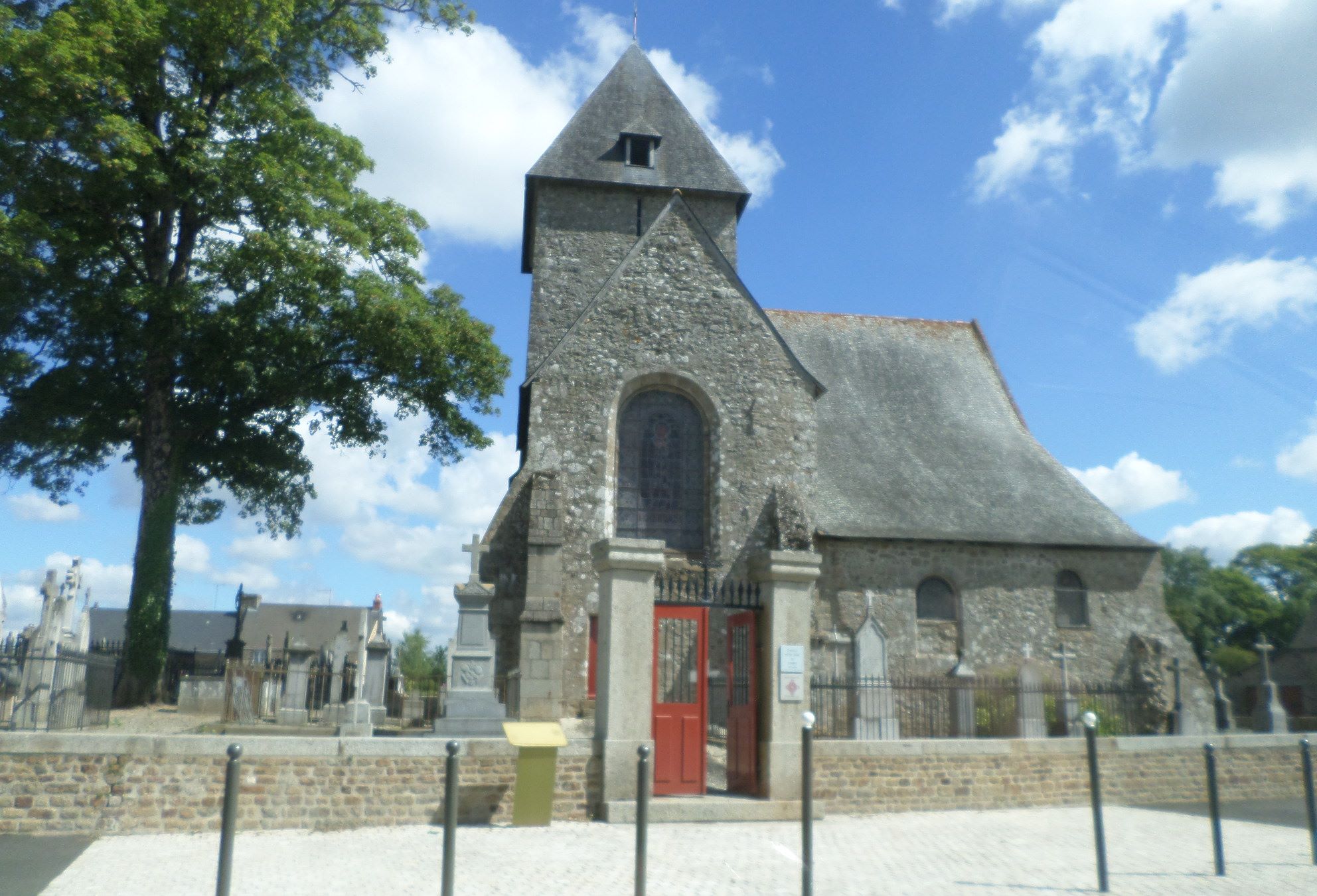
The Chapelle Notre Dame de Charné is the old parish church of Ernée. The chapel is on the edge of the N 12 road, called route de Paris exactly at local 32 Avenue de Paris. The existence of the Church of Charné is attested for the first time around 1150. The church was dedicated to the Blessed Virgin, whose Assumption was especially honored.The Chapelle Notre Dame de Charné, with its Romanesque tower, is the remains of an old church which was demolished at the end of the 17C. It is surrounded by its classified cemetery where there are very ancient tombs. The construction of the central part and the choir can be dated to the beginning of the 13C. The nave was destroyed around 1690, during the construction of the ND Church of Ernée. Consecrated on June 29, 1697, the ND Church of Ernée replaces the Charné as a parish church.
In the 17C, people came from all around Charné, to give worship of the imposing statue of Notre Dame, very old, but of which we know neither the date nor the craftsman. It is in oak, measures 1m30 and, according to the attitude of the Virgin, the rusticity of the presentation, the drapery of the clothes, it seems to be from the 13C. Mary holds in her hand the scepter, symbol of power, and Jesus, the cross on the terrestrial globe, symbol of royalty and redemption. In 1793, during the French revolution and in the context of the anti-religious struggle, the chapel was closed and the entrance guarded to prevent access. It was sold as national property, but a certain Le Nicolais, although a member of the revolutionary committee, hided the statue in a barrel in his cellar where it remained until 1800. Marie had regard to this gesture of piety; he died christianly. However the Chapelle Notre Dame de Charné threatened ruin and its disappearance seemed inexorable when it was put up for sale a third time in 1807. It was then a humble servant, Anne Vauloup, who offered all her savings, obtained a deposit on her wages, begged to Ernée and surroundings, which, on January 18, 1808, had the joy of being awarded the chapel and cemetery. She immediately donated it to the Charity Office of the city on the express condition that the chapel remained for the use of Catholic worship. She reserved for her only one place in the cemetery. She rests there, a little to the right, opposite the west entrance to the chapel. A city street now bears her name.
Some other things to see here are : The Notre-Dame-de-l’Assomption Church which dominates the town with its high bell tower. It was consecrated in 1697. Also, Roman Antiquities. The Château de Pannard 16C of Renaissance style. The local museum of prehistory. The Louis-Derbré cultural space: foundry workshop, sculpture garden and open-air theater. The Dolmen of Contrie. . And The Covered Alley of the Tardivière.
A bit of history I like tell us that in 1231, after the truce concluded in Saint-Aubin-du-Cormier, on July 4, between Queen Blanche of Castile, Spanish queen daughter of King Alphonse VIII of Castile and Aliénor of England, (mother of Saint Louis or king Louis IX) regent, and Pierre Mauclerc, Duke of Brittany, the city of Ernée is the place of the meeting between Pierre Mauclerc and Philippe Hurepel, the king’s uncle. This meeting ended with a solemn exchange of oaths.
The town of Ernée on the Chapelle ND de Charné : https://www.ville-ernee.fr/decouvrir-ernee/tourisme/la-chapelle-de-charne/
The local Atlantic Loire Valley tourist office on the Chapelle ND de Charné : https://www.atlantic-loire-valley.com/visits/religious-heritage/chapelle-de-charne-a-ernee
There you go folks, a nice ride by and rest stop with a nice monument to boot, this is my belle France. A quant chapel to see in off the beaten path Ernée, Again, hope you enjoy the post on the Chapelle Notre Dame de Charné of Ernée !! as I
And remember, happy travels, good health, and many cheers to all !!!
In the 17C, people came from all around Charné, to give worship of the imposing statue of Notre Dame, very old, but of which we know neither the date nor the craftsman. It is in oak, measures 1m30 and, according to the attitude of the Virgin, the rusticity of the presentation, the drapery of the clothes, it seems to be from the 13C. Mary holds in her hand the scepter, symbol of power, and Jesus, the cross on the terrestrial globe, symbol of royalty and redemption. In 1793, during the French revolution and in the context of the anti-religious struggle, the chapel was closed and the entrance guarded to prevent access. It was sold as national property, but a certain Le Nicolais, although a member of the revolutionary committee, hided the statue in a barrel in his cellar where it remained until 1800. Marie had regard to this gesture of piety; he died christianly. However the Chapelle Notre Dame de Charné threatened ruin and its disappearance seemed inexorable when it was put up for sale a third time in 1807. It was then a humble servant, Anne Vauloup, who offered all her savings, obtained a deposit on her wages, begged to Ernée and surroundings, which, on January 18, 1808, had the joy of being awarded the chapel and cemetery. She immediately donated it to the Charity Office of the city on the express condition that the chapel remained for the use of Catholic worship. She reserved for her only one place in the cemetery. She rests there, a little to the right, opposite the west entrance to the chapel. A city street now bears her name.
Some other things to see here are : The Notre-Dame-de-l’Assomption Church which dominates the town with its high bell tower. It was consecrated in 1697. Also, Roman Antiquities. The Château de Pannard 16C of Renaissance style. The local museum of prehistory. The Louis-Derbré cultural space: foundry workshop, sculpture garden and open-air theater. The Dolmen of Contrie. . And The Covered Alley of the Tardivière.
A bit of history I like tell us that in 1231, after the truce concluded in Saint-Aubin-du-Cormier, on July 4, between Queen Blanche of Castile, Spanish queen daughter of King Alphonse VIII of Castile and Aliénor of England, (mother of Saint Louis or king Louis IX) regent, and Pierre Mauclerc, Duke of Brittany, the city of Ernée is the place of the meeting between Pierre Mauclerc and Philippe Hurepel, the king’s uncle. This meeting ended with a solemn exchange of oaths.
The town of Ernée on the Chapelle ND de Charné : https://www.ville-ernee.fr/decouvrir-ernee/tourisme/la-chapelle-de-charne/
The local Atlantic Loire Valley tourist office on the Chapelle ND de Charné : https://www.atlantic-loire-valley.com/visits/religious-heritage/chapelle-de-charne-a-ernee
There you go folks, a nice ride by and rest stop with a nice monument to boot, this is my belle France. A quant chapel to see in off the beaten path Ernée, Again, hope you enjoy the post on the Chapelle Notre Dame de Charné of Ernée !! as I
And remember, happy travels, good health, and many cheers to all !!! 
 Paris1972-Versailles2003