
This is a memorable City for my family and this is an update post with new text and links for you and me, A simple tower with history that I think merits stopping by while in Rouen. Therefore, here is my take on the Donjon of Rouen !! Hope you enjoy it as I.
The City of Rouen is in the Seine Maritime dept 76 of Normandie in my belle France, The Donjon tower or Chateau de Rouen where Jeanne d’Arc was kept prisioner still is well preserved. The original castle was built by king Philippe Auguste.
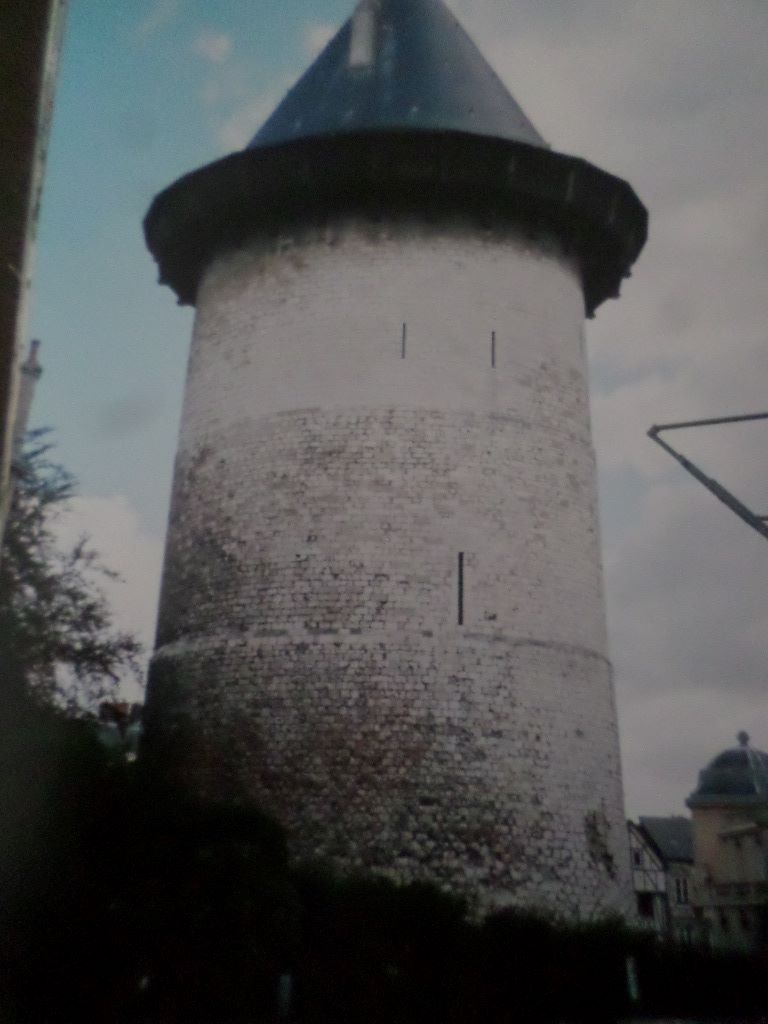
Some of its former details tell us that it is without doubt one of the largest castles built under king Philippe Auguste, the Château de Rouen is also remarkable for its history throughout the Hundred Years War. The Jeanne-d’Arc tower, which constitutes her former prison. The Tour de la Pucelle or Maid’s Tower where Joan of Arc was locked up. The castle-fortress enclosure was flanked by ten towers including three half-turns linked by a covered way at the top of the curtain walls in which two gates open towards the city and towards the fields. The Grosse tour or Donjon, detached from the enclosure by the rue du Donjon, current Joan of Arc tower, its inner gate to the castle courtyard and its outer door ,and current access to the dungeon walled by the English. The Crowned tower, current tower of the Maid or pucelle at 102 rue Jeanne-d’Arc, in the interior courtyard, surmounted by a floor by the English. The skylight of the current tower occupies the volume of it without its pepper shaker roof. The base is kept in the basement for more than six meters in height.
At the beginning of the 20C, the Donjon and the Tour de la Pucelle still remain. The latter, in very poor condition, was destroyed to allow the expansion of the Ursuline boarding school. The planned destruction of the donjon in 1840 is interrupted by the Historic Monuments of France; its purchase and restoration from 1868-1884 were finally carried out thanks to a national underwriting committee. Napoleon III, an emperor passionate about history, is in the second rank of subscribers. The monument is then donated to the Seine-Inférieur department then Seine Maritime as of today. In the 19C and the beginning of the 20C, three streets were created on the castle’s right-of-way, on the site of the Ursulines boarding school: rue Jeanne-d’Arc, rue du Donjon and rue Philippe-Auguste. During WWII, the Donjon, now known as the Tour Jeanne d’Arc, was transformed into a bunker by the Nazi occupation forces.
Currently what is seen are the Circular donjon , known as the Grosse Tour or tour de Jeanne d’Arc (photo) at about 35 meters high with a diameter of about 14 meters and with walls 4 meters thick, it has been rebuilt from the first floor in the 19C. including the hourds that we can see today. The tower, formerly owned by the Seine-Maritime departmental council, has been a Rouen Normandy metropolitan museum since January 1, 2016, hosting an escape game since April 2017. Defensive and residential, the tower is fitted with a well from the Gaalor spring and a spiral staircase caught in the thickness of the wall. A model of the castle made in 1983 and completed in 2004 is presented in the museum. The circular tower known as the Tour de la Pucelle, where Jeanne d’Arc, known as the Pucelle d’Orléans or Maid of Orleans, was imprisoned. You can see the foundations visible in the interior courtyard of the building located at 102 rue Jeanne-d’Arc.
A bit of history I like tell us that the Château de Rouen was built from 1204 to 1210 on the Bouvreuil hill in Rouen, capital of the Duchy of Normandy, by Philippe Auguste, King of France, following the conquest in 1204 of the Duchy of John Landless, Duke of Normandy and King of England, and to replace the Ducal Palace of Rouen erected by Duke Richard I. The first reports of royal stays date from the middle of the 14C, the castle then served as a royal residence until king Charles VII. The fortified castle played a military role during the Hundred Years War (1337-1453) and during the Wars of Religion (1562-1598). The castle of Rouen is especially the seat of an important administrative and political function: bailiwick and viscounty of the king of France, government of the king of England during the English domination (1418-1449), Exchequer of Normandy (which will become the Parliament of Normandy). It was also at the Château de Rouen that Jeanne d’Arc was imprisoned from December 23, 1430 and tried from February 21 to her execution on May 30, 1431.
The City of Rouen on the Donjon Jeanne d’Arc tower : https://rouen.fr/tour-jeanne-darc
The Rouen tourist office on the Donjon : https://en.visiterouen.com/offres/le-donjon-de-rouen-rouen-en-3940949/
The official Rouen Normandie Sites and Monuments on the Donjon of Rouen : https://www.donjonderouen.com/en/accueil/
A private site Sainte Jeanne d’Arc on the tower and the pucelle : http://www.stejeannedarc.net/dossiers/jeanne_a_rouen.php
There you go folks, one of my memorable towns in France, came here early on my visits and then living closer came often even for lunch with the family. It is a city to marvel on foot, great architecture and history;see my other posts on Rouen ,nice and the sights are of architecture and historical values second to none in my belle France. Again, hope you enjoy this post on the Donjon of Rouen as I.
And remember, happy travels, good health, and many cheers to all !!!

 Paris1972-Versailles2003