
I bring you back to the Mayenne,dept 53 and Pays de la Loire, and the historical town of Laval. As always been rushing wiht all these beauties and so much to tell the world about my belle France. There is always something by passed and hidden in small mentions in previous posts. This is one of them and would like to give credit to a wonderful monument, the Porte Beucheresse of Laval ! Hope you enjoy the post as I.
The Porte Beucheresse is a city gate in Laval,,and is the only surviving gate of the city, as well as one of the best preserved vestiges of the ramparts of Laval. It stands on the edge of Place Hardy-de-Lévaré, in the city center, and connects with Rue des Serruriers. The Porte Beucheresse was on the way to the Concise forest, and the woodcutters, when they brought the wood to Laval, took the current rue du Lycée, then passed under the gate. Its name therefore means “door of the Lumberjacks”. The naive painter Henri Rousseau was born in the right tower in 1844 and lived there during his childhood. His father had a tinsmith on the ground floor. On the rue des Serruriers side, a niche in the gate wall shelters a Pietà from the end of the 15C. It is one of the many religious statuettes found in the old center of Laval.
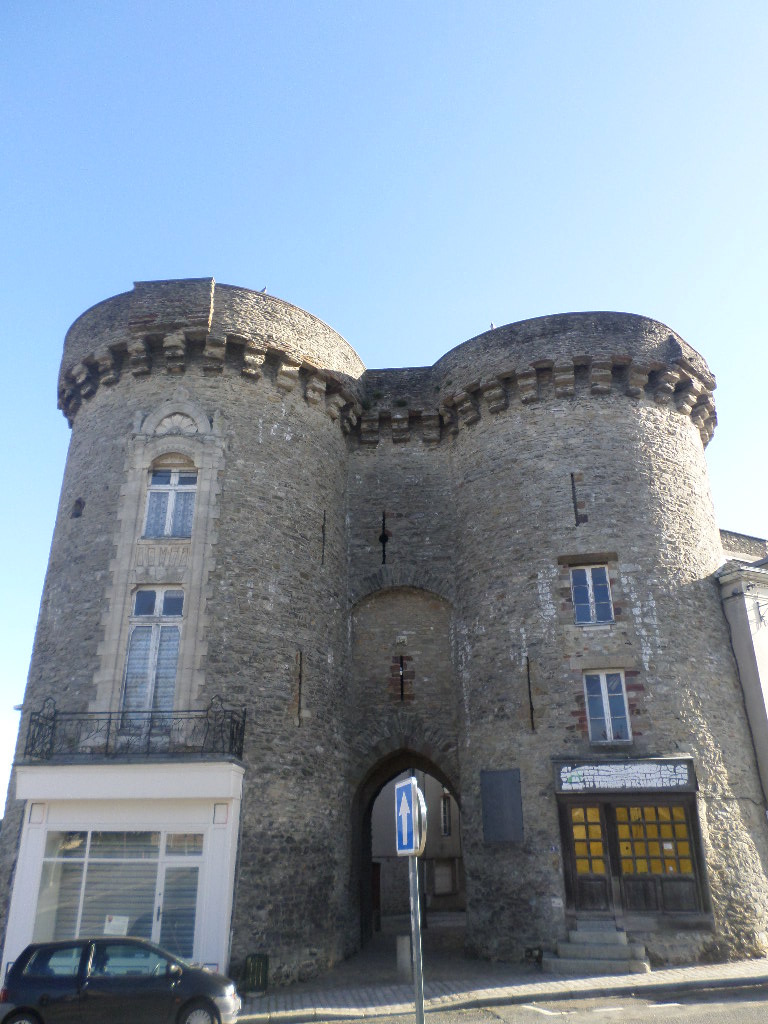
The porte Beucheresse is made up of two circular and symmetrical towers. The opening is in a rib vault. It was originally fitted with a harrow. These opening is surmounted by loopholes, while the towers are capped with a rest of covered way on machicolation. The whole is built of rubble. The openings made in modern times are located on the towers. They are grouped into two spans, one on each tower. Those on the left have neo-Renaissance decorations including pinnacles, pilasters, a pediment, a shell and geometric reliefs. These neo-Renaissance windows are made of limestone ashlar.
The city of Laval appeared in the 11C, around the castle (see post). Originally, this castle had a large earthen wall which encompassed land leading to the current cathedral (see post). In the 13C, the castle was rebuilt in stone and it folded around the keep. The city is therefore no longer protected and has its own fortifications, also built of stone. The ramparts built in the 13C included several gates, including four main ones: the Porte Renaise , the Porte Belot-Oisel ; the Porte Peinte on the Mayenne river side, and the Porte Beucheresse. The entire enclosure was altered in the 15C, during the Hundred Years War. The gate is then topped with machicolations, integrated into a covered way which made it possible to go around the fortifications. After the war, the gate was protected by a bastion, which disappeared during the development of Place Hardy-de-Lévaré in the 18C. This work also removed the moat. Openings were drilled in the towers in the 18C or early 19C.
The City of Laval on the Porte Beucheresse: https://www.laval.fr/decouvrir-sortir/musees-lieux-dexposition/porte-beucheresse
The Laval tourist office on the ramparts and porte Beucheresse : https://www.laval-tourisme.com/activites/patrimoine-culture/monuments-historiques-de-laval/les-remparts-et-la-porte-beucheresse-243781
A heritage site of the City of Laval on the porte Beucheresse : https://patrimoine.laval.fr/lavalpatrimoine/porte-beucheresse-13eme-15eme-siecles/
There you go folks, another nice architecturally stunning and historical gate in Laval; worth the detour me think. Again, hope you enjoy the post on the Porte Beucheresse of Laval ! as I
And remember, happy travels, good health, and many cheers all !!!

 Paris1972-Versailles2003