
I have several posts on Chantilly and as most concentrate on the castle.However, we go into the town and walked all over as usual for us ; see the wonderful architecture and history of this town. And I do not mention much but I am very involve in France on the restoration of national monuments and friends of many, of course, including Chantilly. I like to update this older post on a wonderful monument of this City, The Church Notre-Dame de l’Assomption is of course also in the Oise dept, no 60 in the Hauts-de-France region. It is the first church in Chantilly. Therefore, here is my take on the Church Notre Dame de l’Assomption of Chantilly !!! Hope you enjoy the post as I
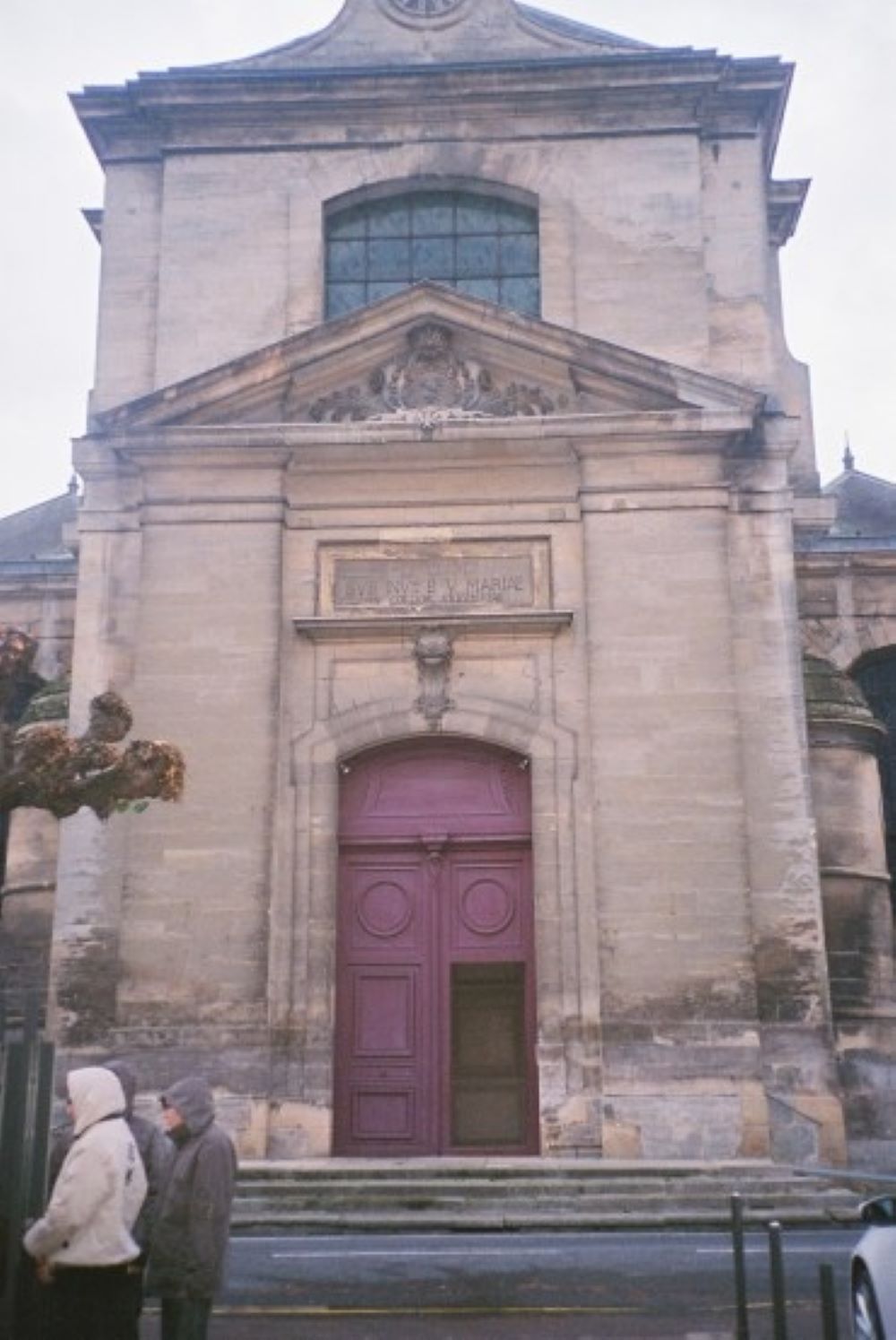
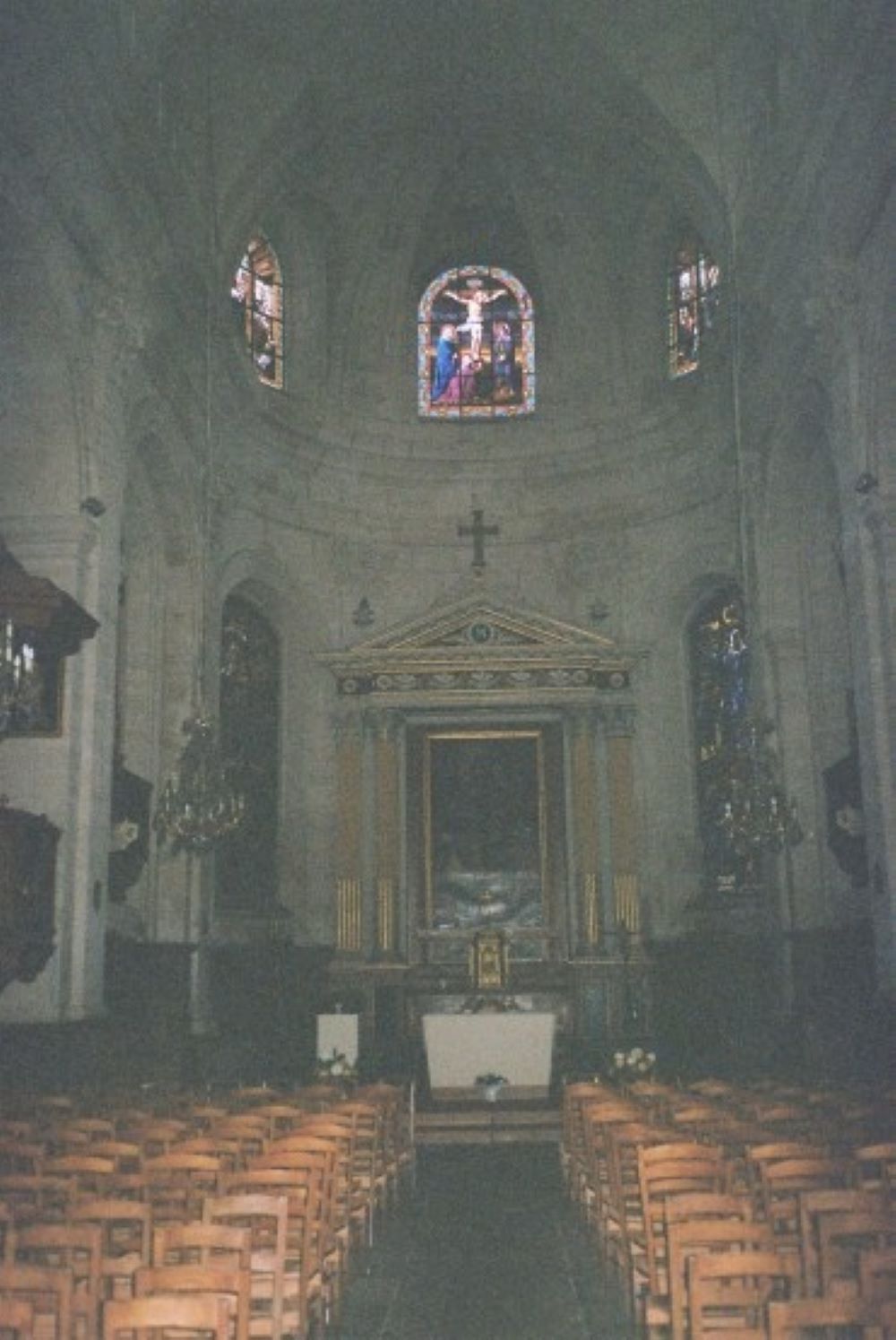
The exterior of the Church of Notre Dame de l’Assomption responds to a fairly simple plan without transept or ambulatory. The central vessel is preceded by a narthex delimited by two staircase turrets, which serve in particular the organ gallery that hosts this part of the building. The central nave and the apse have an elevation on two levels, with the upper arches and the upper windows. Only the right span of the choir has a gallery, and therefore has an elevation on three levels. The apse is the only one to have two levels of windows. According to the precepts of classical architecture, the large arches are semicircular, and the central vessel is covered with a barrel dome. In its current form, the nave evokes that of the Dôme of Saint-Louis des Invalides in Paris, whose large arcades, however, have two floors, and whose entablature has a cornice. In the Oise department , the Church Notre-Dame-de-l’Assomption is the only parish church of a clearly stated classical style, quite remarkable for the quality of its architecture. Below pic my sons!
While the Church Notre Dame de l’Assomption was still under construction, Henri-Jules de Bourbon-Condé commissioned five paintings from the painter Louis de Boullogne: three were used as altarpieces, and two were originally intended as pedalled for the primitive altars of the chapels of the Virgin and Saint-Hubert. The table for the altarpiece of the high altar represents the Adoration of the Shepherds and measures unit 390 cm high by 230 cm wide. The altarpiece in the Chapel of the Virgin is about the Education of the Virgin by Saint Anne. The painting that served as a pedalled is now hanging on the wall. It represents the Presentation of Mary in the Temple, according to the evangile of James (6-10). The altarpiece of the Saint-Hubert chapel is dedicated to the most famous episode of his life, which motivates his conversion to a Christian life; this is the vision he has of a deer carrying a luminous cross between his antlers. On the wall to the right of the altar, the old altarpiece table has been hung. These are the Charity of Saint Hubert, and the Baptism of Saint Hubert.
A bit of history tell us that its construction was launched in 1687 by Prince Henri-Jules de Bourbon-Condé in accordance with a wish expressed by the will of his father the Grand Condé, which also stipulates that the necessary funds must be taken from his fortune. The plans are drawn by architect Jules Hardouin-Mansart, and the church was completed at the beginning of 1692. It is a church of a fairly sober classical style, which quickly turns out to be too small: to meet the increase in population, an expansion was undertaken between 1724 and 1734. To find a parish priest, the Prince de Condé contacted Mgr Jacques-Bénigne Bossuet, bishop of Meaux (my Martine native town and the bishop was the personal advisor/confessor of Louis XIV), who recommended his own nephew,of the same name , then in ministry in the diocese of Poitiers.
The story of the hearts that needs to be understood by many visitors. Here it is the same. Two ebony caskets arrive at the castle. They contain remains of Saint Adrien, Saint Aurélie de Ratisbonne, Saint Eusèbe, Saint Faustin, Saint Julien, Saint Valentine and Saint Victoire, accompanied by their certificates of authenticity. Often there are several saints of the same name, and it is not specified which ones it is. The current caskets were offered by Louis VI Henri de Bourbon-Condé. During the main religious festivals, the Prince of Condé and his family attend Mass in the parish church: Christmas, Easter, Pentecost and the Assumption, patronal feast of Chantilly. Due to the French revolution in July 17, 1789, the Prince of Condé took the road to exile. From his exile in Turin, he learned that religious establishments and their churches would be sold as national property. In September 1793, Catholic worship was banned in Chantilly, and the church was immediately transformed into a temple of reason.
It turns out that since the Grand Condé which revived the medieval custom of keeping the hearts or soul of persons apart, the hearts of his family were buried in the Saint-Paul-Saint-Louis Church in Paris, which belongs to the Jesuit religious. He gives the order that the hearts are transferred to the Church Notre-Dame de L’Assomption in Chantilly, and this transfer takes place on February 4, 1791. At the time of the French Restoration (monarchy back 1814), the Prince of Condé and his son returned to Chantilly. The hearts of their ancestors were given back such as Louis V Joseph de Bourbon-Condé died in 1818 and his son Louis VI Henri de Bourbon-Condé in 1830. It was asked King Louis-Philippe I that the hearts of the last Prince of Condé be reunited with the others: this favor was granted to them, and the heart arrives at Chantilly on September 9, 1830. It is temporarily deposited in the sacristy with the others. The Duke of Aumale, Henri d’Orléans, wants to create a funeral chapel for the hearts and order a new monument. The heart of his son Louis d’Orléans, who died in 1866, joined the monument on June 25, 1876. After the completion of the new chapel of the castle, the hearts are transferred towards this one on September 18, 1883 and deposited in the old monument sculpted by Jacques Sarrazin and coming from the Saint-Paul-Saint-Louis Church.
The monument of the hearts of the princes of Condé is located opposite, in the middle of the right aisle, where it replaced a window. This monument funded by the Duke of Aumale and erected during his first exile was inaugurated on May 13, 1854, and has only been a cenotaph since September 18, 1883. As the real hearts are now in the Chapel of the Castle of Chantilly (see post).
The parish of the Holy Family of Chantilly : https://www.paroisse-ste-famille-chantilly.fr/lieux-de-culte/
The Oise dept 60 tourist office on things to see in Chantilly: https://www.oisetourisme.com/itineraire/circuit-touristique-au-coeur-de-chantilly/
The local Chantilly-Senlis tourist office on the Church Notre Dame : https://www.chantilly-senlis-tourisme.com/en/patrimoine/church-our-lady-of-assumption/
There you go folks, another off the beaten path monument to visit in pretty Chantilly. An off the beaten path site that is worth the detour, me think, The history of Chantilly is in it too as well as France, Again, hope you have enjoy this post on the Church Notre Dame de l’Assomption of Chantilly as I
And remember,happy travels, good health, and many cheers to all !!!

 Paris1972-Versailles2003