
And I went to Vietnam , really all over by plane and car and even boat on the Mekong river, Most visits were to Ho Chi Minh City, the fabled Saigon. I finally arrived , after many years hearing about it. Many friends and some still in touch. For now, let me tell you more of the curiosities of Ho Chi Minh City,part V !!! Hope you enjoy the post as I
Ho Chi Minh City, commonly called Saigon, which was the official name until 1975, or formerly Prey Nokor when it belonged to the Khmer Empire. Ho Chi Minh City, whose status corresponds to that of a Vietnamese province, is divided in 19 boroughs and 5 districts,and it is located on the banks of the Saigon River The name Saigon refers to the district of Cholon (Big Market), while the mandarins use various appellations, Dong Nai, Phan Yen, Gia Dinh and, by local traders, Ben Nghe and Ben Thanh. The French, for their part, perpetuate the name Sài Gòn,
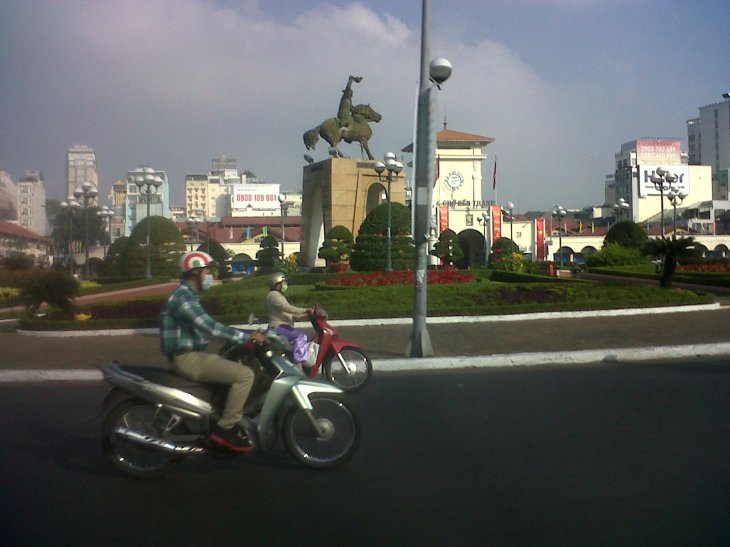
As was driven around was impressed by the wonderful equestrian statue of General Tran Nguyen Han, Built by the government of the Southern Republic of Vietnam , the statue commemorates General Nguyen Han who helped Emperor Le Loi repel three Mongol invasions and establish the Le Dynasty. The statue is located at the center of the roundabout that serves as a kind of joint between the top of September 23rd Park and connects the following streets: Le Loi, Le Lai, Tran Hung Dao, Huynh Thuc Khang and Phan Chu Trinh. The roundabout was named after Quach Thi Trang after the Vietnam War ended in 1975, As for the Tran Nguyen Han statue, after being moved from the roundabout in front of Ben Thanh market, District 1, to Phu Lam park in 2014, the statue was still there when last saw but they are planning to moved it as a metro transport line is been constructed, The old version will be kept and stored once completed. In addition, the statue will be molded and a negative copy will be created to serve as a new statue at the request of the city government.
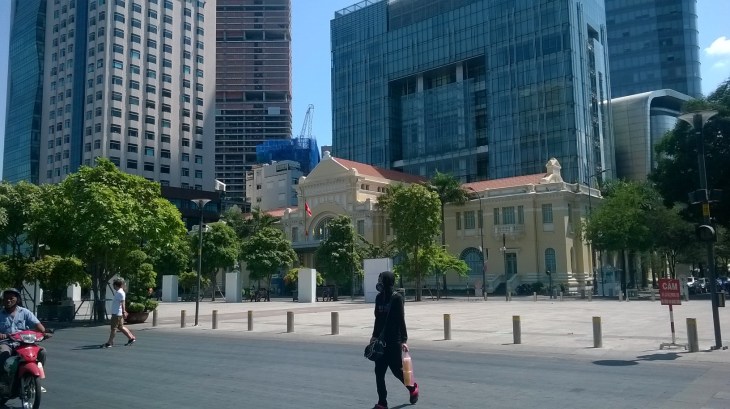
Very close to the Notre-Dame Cathedral (see post), the Saigon Central Post Office at 125 Hai Ba Trung, District 1, Ho Chi Minh City was built in 1886~1891. This unique construction was inspired by European architectural style combined with the Asian decoration trend. The building was constructed when Vietnam was part of French Indochina in the late 19C. It counts with Gothic, Renaissance and French influences. It was designed by Alfred Foulhoux, but is often erroneously credited as being the work of Gustave Eiffel or a collaboration between Foulhoux and Hanoi-based Auguste Henri Vildieu , On the outside wall of the post office there are several plaques commemorating important scientists and engineers, who contributed to the development of the communication technologies of the time. These include Morse, Ampere, Volta, Ohm, and Faraday.
The Vietnam post office in Ho Chi Minh City : http://hcmpost.vn/contact-us.htm
An unofficial Vietnam tourist site on Ho Chi Minh City : https://www.vietnamtourism.org.vn/travel-guide/list-of-cities-in-vietnam/ho-chi-minh-city.html
The official Vietnam tourist office on Ho Chi Minh City: https://vietnam.travel/places-to-go/southern-vietnam/ho-chi-minh-city
There you go folks, another dandy spot in my world map. This is worth the detour to visit Ho Chi Minh City and Vietnam ,Always looking forward to visit again, eventually, Again, hope you enjoy this post on the curiosities of Ho Chi Minh City, part V as I.
And remember, happy travels , good health, and many cheers to all !!!

 Paris1972-Versailles2003