
And I came to wonderful Koblenz ! ,I made a family vacation to Germany after many business trips and base in the south by Trier where we had rented a house in wine country! (see posts), I decided to take my family on a road warrior tour of western Germany and why not, Koblenz was/is a must, It is a very old post in my blog so will update with new text and links, Therefore, let me give you my take on the nice Saint Florin’s Church of Koblenz !! Hope you enjoy it as I

The town of Koblenz is a pretty 2,000-year-old German town located in the UNESCO World Heritage Upper Middle Rhine area with much to see. The Saint-Florin’s Church was the church of the canons of the abbey of Saint-Florin today dissolved, it is now a church of the evangelical community in the city center, which dominates the old city. It is located near the Moselle river on the Florin’s market. The church was built around 1100 and dominating the city with its dominant silhouette, belonged to the St. Florin canons, which was secularized in 1802. Then it came in 1820 as the first evangelical church from Koblenz to the Evangelical Church in the Rhineland. The early medieval church is a prime example of Romanesque religious architecture on the Middle Rhine. The Florinskirche (German) is one of four historical buildings on the Florinsmarkt (Florin’s market). It is owned in equal parts by the State of Rhineland-Palatinate, and the Evangelical parish of Koblenz-Mitte.

A bit of history I like, tell us that originally a Saint Mary’s Church with an associated monastery, the Florinskirche or Saint Florin’s Church may have emerged from the chapel of the neighboring Franconian royal court. King Childebert of Austrasia supposedly held court in 586 . Around 938 to 948, after the relics of Saint Florin had been transferred from Remüs (Switzerland), the then church was dedicated to this Saint alone. Around 1100 there was a new church as a Romanesque three-aisled church. The pillar basilica, which was flat at the time, included parts of the Roman-Franconian city wall on the east side. In the middle of the 14C, the Romanesque apse of the church was replaced by a Gothic one. In the years 1582 to 1614 the vaulting of the eastern nave followed. The bell towers were renewed at the beginning of the 17C. During the siege of Koblenz in 1688 during the Palatinate War of Succession ,the Florinskirche was badly damaged and the central nave vault was destroyed, but this could already be renewed between 1708 and 1711. Around 1710 the church received a new south portal with the figure of Saint Florin. After the southern tower was destroyed by lightning and fire in 1791, the decision was made to built a new lower tower.
In 1794, French revolutionary troops occupied Koblenz during the First Coalition War (against the French revolution). The Saint Florin’s Church was secularized by the French in 1802 and thus abolished. After that, the church was used as a military magazine. Between 1807 and 1811 the church inventory was sold, the school house, the adjoining abbey and the cloister were demolished. Napoleon arranged in 1807 that the church should be converted into an urban slaughterhouse with sales stands. However, this did not happen since Koblenz fell to Prussia in 1815. King Friedrich Wilhelm III transferred Saint Florin’s Church to the evangelical military and civil parish in 1818. The subsequent restoration of the church and the furnishings took place and the church was consecrated in 1820 as a Protestant parish church and thus the first Protestant church in Koblenz. From 1929 to 1930, the foundation of a Roman city wall tower was found in the course of interior restoration work during archaeological excavations under the Gothic apse. The roofs of the three-aisled pillar basilica burned out in an air raid in 1944, and the vault of the former monastery choir was also destroyed. The reconstruction took place in 1951. The outside of the church was last restored in 1970.
A bit on the construction and architecture styles I like, tell us that the Romanesque Saint Florin Church is dominated by the fortified west side on Florinsmarkt (Florins’s market) with its towering two towers. The bell towers’s floors have characteristic Romanesque biforias. The triangular gable above it dates from the 13C, the pointed spirals are from 1899. The large post-Gothic tracery window on the west building dates from the 17C. The west side of Saint Florin Church is integrated into the nave. The nave incorporates the originally barrel-vaulted, now post-Gothic cross-rib vaulted ground floor hall and the tower ground floors and is thus fully open to the nave. The three-aisled pillar basilica is divided by five narrow, circular arch pillar arcades. The choir connects to the east of the nave and is a few steps higher; it is set off by a powerful choir arch. To the east is the transept with three rooms or chapter house. A part of the cloister has been preserved . Originally this chapter house, built around 1200 was probably used as a sacristy, the upper floor as a treasure house.
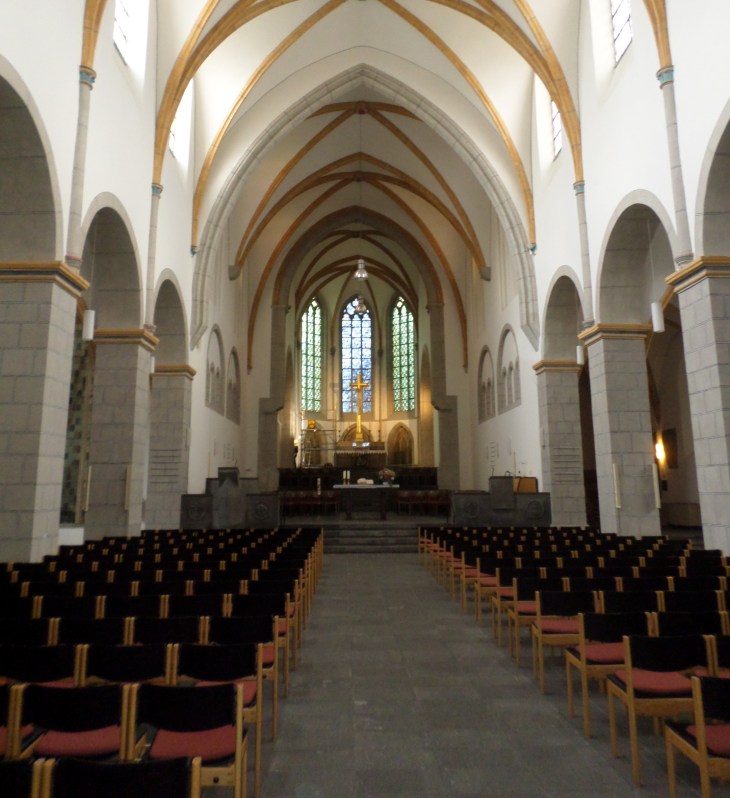
The medieval and baroque furnishings of the Saint Florin Church were almost completely destroyed in the early 19C. Apart from a few fragments in museum possession, only remnants of wall paintings from the 14-15C are left in the church. In the choir there are also wall paintings, but they have been restored several times and therefore have hardly any original substance. Two of the stained glass windows each contain four round panes from the early 14C, about 24 cm in diameter, which were donated to the church on the occasion of the reopening of 1819/20. The images on the panels show the proclamation and birth of Jesus, the adoration of the kings and the capture of Jesus, as well as flagellation, crucifixion, burial and resurrection. In the vault of the north tower there are two Franconian stone coffins that were found during excavations in the church garden. There is a cannon ball in the vaulted ceiling of the baptistery, which is supposed to commemorate the bombardment of the church by French troops in 1688. Several Archbishops of Trier were laid to rest in the church. The organ of the Florinskirche or Saint Florin Church was built in 2010 by Förster & Nicolaus. Five bells hang in the south tower. The oldest bell dates from 1511. The Rincker foundry completed the ringing by adding four bells in 1960.

The Romanesque site on the Saint Florin’s Church : https://www.romantischer-rhein.de/en/a-florinskirche
The official Evangelical Parish of Koblenz-Mitte on the Saint Florin’s Church (German) : https://koblenz-mitte.ekir.de/inhalt/die-florinskirche-in-koblenz
The Koblenz tourist office on the Saint Florin’s Church : https://www.visit-koblenz.de/en/sights/florins-church
There you go folks, another nice monument of pretty Koblenz by the Moselle and Rhine rivers, much to see here. Again, hope you enjoy the post on the Saint Florin’s Church of Koblenz as I.
And remember, happy travels, good health, and many cheers to all !!!

 Paris1972-Versailles2003