
I am back at you with the city of Tours with its wonderful fine arts museum in a historical building. I need to update the post on the museum; granted I love history and all related to museums are part of it, even if do not go to as many as I should. The museum is excellent. Gladly, I will update this post for you and me. Therefore, here is my new take on the Fine Arts Museum of Tours, part I !! Hope you enjoy it as I.

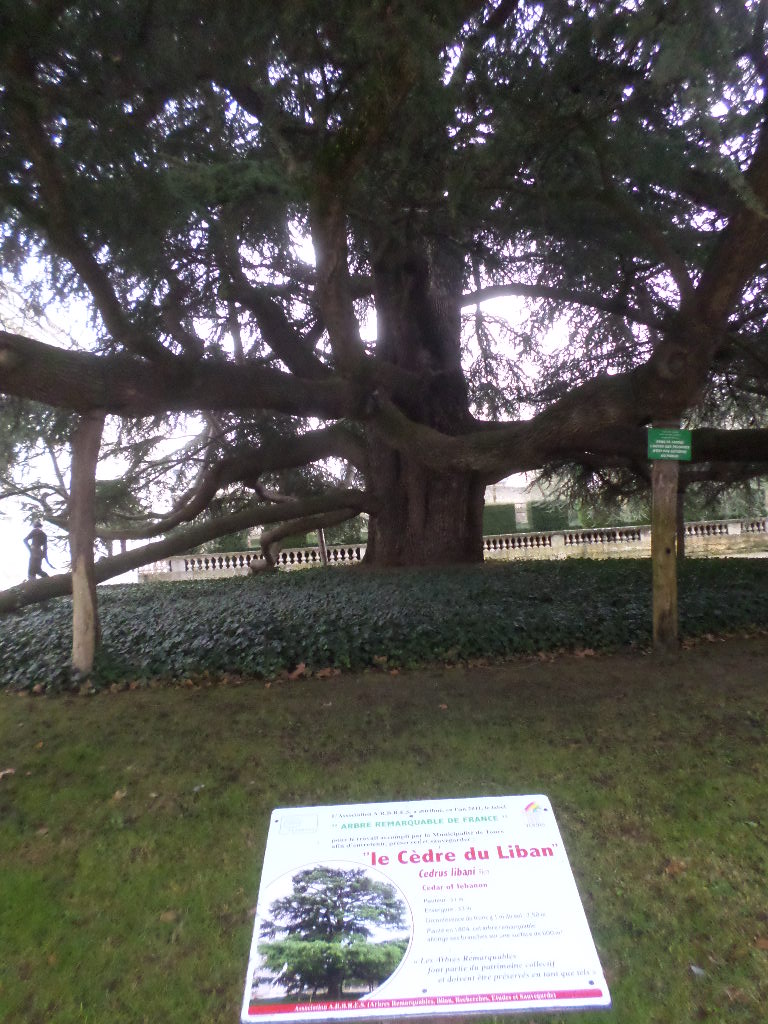
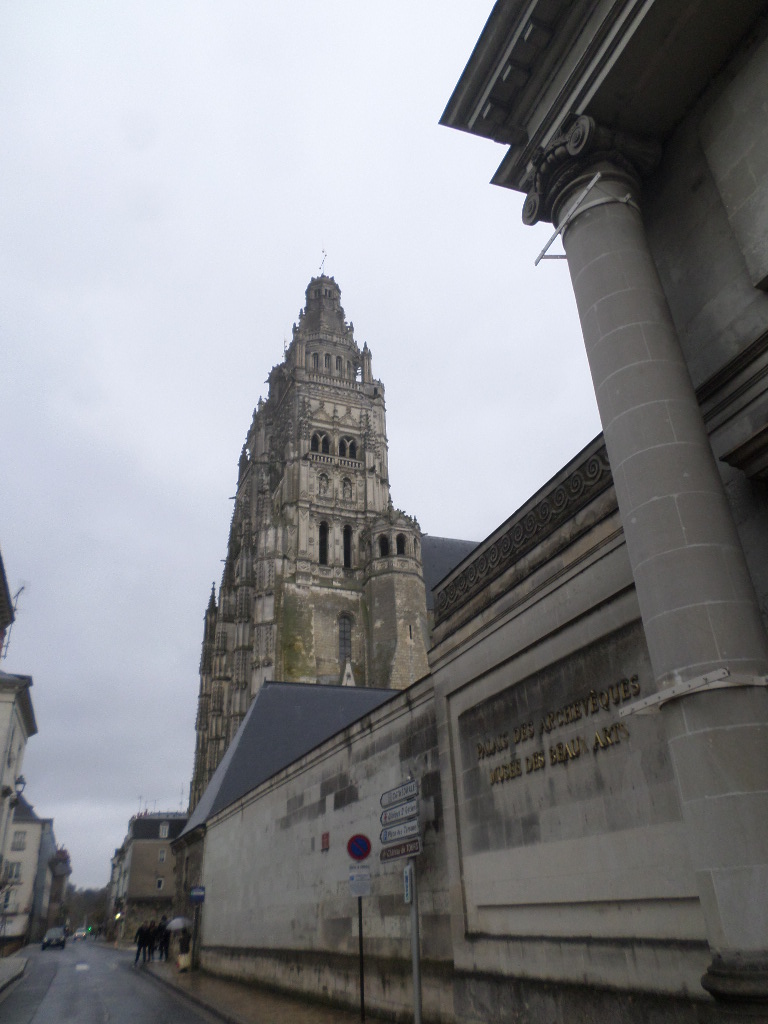
The Fine Arts Museum is in the old Episcopal palace of the bishops near the Cathedral, since 1910. It has a beautiful collection of French paintings and the primitive Italian or old Italian masters painter such as Mantegna, as well as sculpture by Rodin, Houdon and others. A French-style garden extends past the episcopal palace of the 18C, which has retained part of its original decor. A cedar of lebanon, tree can be seen in this same courtyard, in a building in front of the palace, Fritz, a stuffed Asian elephant, slaughtered because he became uncontrollable during a parade of the circus Barnum & Bailey in the streets of Tours on June 10, 1902. Access to the elephant and the large cedar tree is free inside the park.

The Fine Arts Museum’s oldest fund consists of works seized in 1794 (during the French revolution) from the houses of emigrants, churches and convents, in particular the large abbeys of Marmoutier, Bourgueil and La Riche, as well as paintings and furniture from the Château de Chanteloup and the Château de Richelieu.
The Fine Arts Museum maintains an important and fairly homogeneous collection of paintings punctuated by several masterpieces, including the two paintings by Andrea Mantegna coming from the San Zeno Altarpiece (the Last of the three elements of the predelle, the Crucifixion, being preserved at the Louvre museum): the ancient French painting is represented abundantly for the 17C and 18C. The French painting of the 19C is also amply represented, the collection of Flemish and Dutch paintings presents works by major artists such as Rubens and Rembrandt. The 20C is illustrated above all by a beautiful set of abstract paintings. Among the most famous are Gabriel Blanchard, François Boucher, Louis de Boulogne, Jean-Pierre Louis Laurent Houël, Charles de La Fosse, Charles Lamy, Eustache Le Sueur, Joseph Parrocel, Jean Restout. Gaëtan Cathelineau , student and friend of David, Professor of drawing at the Royal College of Tours, bequeathed about fifty paintings of ancient painters, including the only undeniable Hubert Robert of the collection, “Cascade under a ruined bridge”, and an astonishing Louis Cretey, “Tobie and the Angel”. In 1963 the museum received the collection of the painter and collector Octave Linet, constituting one of the largest collections of Italian primitives after the Louvre Museum and the Museum of the Petit Palais d’Avignon.
For the sculpture, you will find notably the imposing Diane huntress (Diane chasseresse) , bronze of Jean-Antoine Houdon, one of the very rare original prints of the work in marble executed from 1776, as well as works by Antoine Coysevox (bust of Louis XIV), Auguste Rodin (Balzac drape, bronze, 1898), Antoine Bourdelle, Alexander Calder (Mobile, painted metal, circa 1957) and Olivier Debré.
A bit of history I like tell us that the museum houses in its underground the most beautiful lapidary inscription to the glory of the Turons (original inhabitants of Tours). The first bishops had chosen to settle in the vicinity of the Cathedral, in a palace built on the rampart of the 4C which still remains today of beautiful traces including the corner tower. Another vestige of this period was a chapel backed by the Archbishop’s palace dating back to the 4C and rebuilt in 591AD on the orders of Gregory of Tours. This building was transformed in the 12C and partly destroyed in the 17C during the development of the new Archbishop Palace. In the 12C the so-called synod wing was built. Constantly transformed over the centuries, this immense hall where two meetings (1468 and 1484) were gathered the States General of the Kingdom of France is one of the most evocative historical places in the history of Touraine. After 1789, French revolution, the Archbishop’s Palace became a theater, a central school, a library ,then by 1792 became the deposit of the works seized (nationalisation) at the French Revolution. A first museum opens to the public in 1795.
Under the Empires and throughout the 19C, the buildings were again assigned to the Archdiocese. The works thus leave this place and move to temporary premises, in the former convent of the Visitation, then in the old stewardship, before the inauguration in 1828 a building created specifically to welcome the museum on the Place des Arts along the Loire river. It was only in 1910, when the city became the owner of the premises, that the collections reintegrated the old Archbishop Palace as of today.
Like I said, the Fine Arts Museum is simply a must to visit while in the area or in Tours.
The museums of Tours on the Fine Arts museum : https://musees.tours.fr/visiter/musees-et-sites-patrimoniaux/musee-des-beaux-arts/
The local Loire Valley tourist office on the Fine Arts Museum: https://www.loirevalley-france.co.uk/cultural-sites/museum-of-fine-arts-and-its-garden/
The Touraine Loire Valley tourist office on the fine arts museum of Tours: https://www.tourainevaldeloire.com/en/offers/musee-des-beaux-arts-de-tours-et-son-jardin-tours-en-5153225/
There you go folks, Tours is wonderful ,and with the Fine Arts Museum is a winner, a must to visit, Again, hope you have enjoy the post on the Fine Arts Museum of Tours, part I !!! as I
And remember, happy travels, good health, and many cheers to all !!!

 Paris1972-Versailles2003
I stayed overnight in Tours in 1985 and had a curious meal somewhere that I cannot remember. I need to go back.
LikeLiked by 1 person
Yes you should! Thanks for stopping by Cheers
LikeLike
Apparently it’s a very pretty town. Maybe I should go and visit some day…
LikeLiked by 1 person
Yes indeed you should. Thanks for stopping by Cheers
LikeLiked by 1 person