
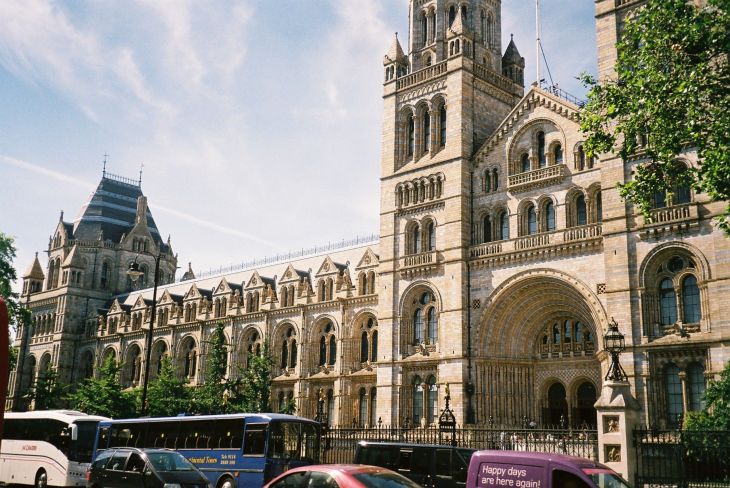
Of course, we walked all over London and use the underground and double decker buses to boot, all glorious as was able to come with the family and not just my business trips. We enjoyed the trip here with the family, and now it brings lots of good memories for me. I have written many posts on the City before, but found me again older pictures not in my blog yet and they should be, Therefore, here is my take on the Natural History Museum of London !!! Hope you enjoy it as I.
The Natural History Museum of London is one of three large museums along Exhibition Road in the Kensington district of London. It houses life and earth science collections. Filled with finds from the former colonial empire, it notably includes collections brought by the explorer James Cook and the naturalist Charles Darwin, The Natural History Museum is particularly known for its entrance central hall dominated by the skeleton of a diplodocus because this was replaced by the skeleton of a whale. The architect made extensive use of terracotta bricks for the interior and exterior parts to resist the sooty London atmosphere of the Victorian era. Bas-reliefs of plants, animals and fossils decorate these bricks. The central axis of the museum is aligned with the tower of Imperial College, the Royal Albert Hall and the Albert Memorial further north, which are part of the complex called “Albertopolis”. This museum houses five major collections in the following fields: botany; entomology; mineralogy; paleontology; and zoology.
If short on time, me as many others recommend seeing the Dinosaurs: Several halls of this museum are dedicated to the Mesozoic era. Here, visitors will be able to observe dinosaur fossils and skeletons, including some life-size models of dinosaurs. This collection is usually the children’s favorite. Mammals: In the Large Mammals Hall there are dissected mammals, as the name suggests, fossils, and an impressive life-size model of a blue whale. The Power Within: An interactive experience aiming to show the reasons why volcanoes and earthquakes occur.
A bit of history I like tell us that after acquiring land, construction lasted from 1873 to 1880. The new museum opened in 1881, but the relocation of the old museum lasted until 1883. In 1963, the museum became independent with its own board of directors. In 1986 it absorbed the Geological Museum from the British Geological Survey. However, it was not until the 1992 law (Museums and Galleries Act) that the name “Natural History Museum” replaced the British Museum, In 1917 the mineralogy rooms from the Geological Museum were completely redeveloped in the form of a multimedia exhibition called “Earth Galleries” while the other departments were renamed “Life Galleries”. The mineralogy rooms from the Natural History Museum remained unchanged as witnesses of the 19C. The new Darwin Center contains a collection of several million specimens, interactive equipment and dedicated work spaces to scientific staff.
The official Natural History Museum of London : https://www.nhm.ac.uk/visit.html
The London tourist office on the National History Museum: https://www.visitlondon.com/things-to-do/place/427179-natural-history-museum
There you go folks, do come to the Natural History Museum and see many nice things good for the whole family in London. We enjoyed the walks around here and the architecture/history surrounding it, Again, hope you enjoy the post on the Natural History Museum of London as I
And remember, happy travels, good health, and many cheers to all !!!

 Paris1972-Versailles2003