
Of course, we walked all over London and use the underground and double decker buses to boot, all glorious as was able to come with the family and not just my business trips. We enjoyed the trip here with the family, and now it brings lots of good memories for me. I have written many posts on the City before, but found me again older pictures not in my blog yet and they should be, Therefore, here is my take on the Hyde Park Corner of London !!! Hope you enjoy it as I.
Hyde Park Corner primarily refers to a major road junction at the corner of Hyde Park (see post). Hyde Park and its main entrance, from which it takes its name. It is a major road junction, where the avenues of Park Lane, Knightsbridge, Piccadilly, Grosvenor Place and Constitution Hill converge. There is also a road tunnel under the square, connecting Knightsbridge and Piccadilly Circus. In Hyde Park Corner, in which stands Wellington Arch, a triumphal arch erected in memory of the winner of the Battle of Waterloo. It was commissioned by King George IV in 1825 to commemorate British victories during the Napoleonic Wars. and therefore close to Apsley House, the London residence of Sir Arthur Wellesley, 1st Duke of Wellington, soldier, victor of the Battle of Waterloo, and Prime Minister. In 1846 the monument was chosen to house an equestrian statue of the Duke, 8.5 meters high, the largest ever made up to that time.
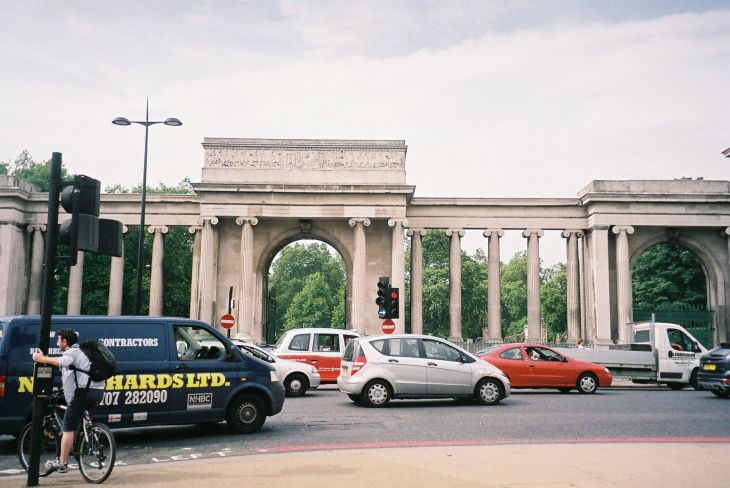
Today it is at the center of the large tree-lined roundabout that is Hyde Park Corner. At the time of its removal, the Duke’s statue was moved to Aldershot and replaced in 1912 by a grandiose bronze quadriga. The statue depicts the goddess of victory Nike descending on her war chariot. The face of this statue which guides the quadriga is a young boy (said to be the son of Lord Michelhan, the person who financed the work). This is the largest bronze statue in Europe. Inside the triumphal arch, the second smallest police station in London was located until 1992. In 1999, English Heritage set up a museum there, displaying the history of this building on three floors.
Other military memorials can also be seen: the New Zealand War Memorial, the Australian War Memorial (in memory of New Zealand and Australian soldiers who fought in the two world wars) and the Royal Artillery Memorial, dedicated to the Royal Artillery who fought in the Great War. Hyde Park Corner was used as a code to announce the death of King George VI, father of Queen Elizabeth II, on February 6, 1952.
The London tourist office on Hyde Park Corner Wellington Arch : https://www.visitlondon.com/things-to-do/place/181523-english-heritage-wellington-arch
There you go folks, do come to Hyde Park Corner and see many nice monuments of London. We enjoyed the walks around here and the architecture/history surrounding it, Again, hope you enjoy the post on the Hyde Park Corner of London as I
And remember, happy travels, good health, and many cheers to all !!!

 Paris1972-Versailles2003