
I was able to bring the family over to Rome, after many business trips : we had a blast!!They were happy to finally be in the eternal Rome with monuments all over and one particular one was the Foro Romano, I have written many posts on Rome and this one will be an updated one as new text and links. Therefore, here is my new take on the Foro Romano of Rome !!! Hope you enjoy it as I
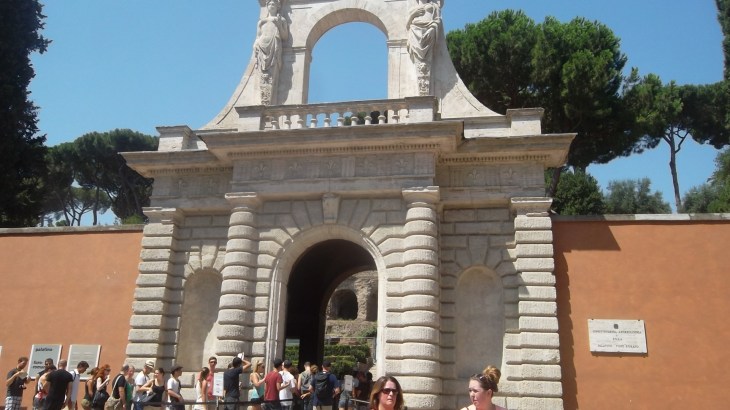
The Roman Forum , also called Forum Magnum or Forum Vetus (old forum), is located in the most important archaeological site of Rome, between the Capitol hills, and the Palatine Hill. The Forum was the main square of ancient Rome. The place of the Forum was first arranged in 616 BC or shortly thereafter, simply covered with clay. From this time onwards, the Forum is no longer a peripheral zone to the villages but becomes the central place of the surrounding villages. The part of the Forum closer to the Capitol, the public part, is first divided into two distinct sections: to the north, at the foot of the Arx, the Comitium becomes the political and judicial center of the city, while the commercial activities are concentrated in the south, on the Forum itself. A third section appears with the construction of the regia, near the Temple of Vesta, which constitutes the religious area.

As anything in Rome, the history goes deep, so will just condense a bit here on the history I like, and description of this huge area, hope it helps,
At the beginning of the 1C BC.,Sylla closed the prospect to the west by constructing on the slopes of the Capitol the great façade of the Tabularium. With the Sempronia and Aemilia basilicas on the sides, the Forum becomes a closed place. Under the Empire, on both sides of the temple are elevated triumphal arches that serve as monumental entrances for who accesses the Forum from Via Sacra or the Vicus Vestae. The Forum then adopts its definitive form, that of a closed quadrilateral on its four sides, surrounded on two sides by porting ,those of the basilicas of Julia and Aemilia, and closed on the other two by a temple. During the early Middle Ages, the Forum was progressively abandoned from the 7C onwards. The return of Pope Urban V to Rome from Avignon in 1367 leads to a revival of interest in the ruins of the Forum. The Roman Forum, which has long been invaded by grass and where cattle herds are allowed to graze, is now known under the name of Campo Vaccino (Bovine field) , until the excavations conducted under Napoleon III. The Roman Forum gradually developed throughout almost a Millennium !
As of the end of the Empire, arriving from Via Sacra, one follows first the great Basilica of Maxentius and Constantine then the Temple of Romulus and the Temple of Antonin and Faustina that faces the Regia. We then pass under one of the two arches of Augustus which covers the narrow passage between the Temple of Caesar on the left and the Basilica Aemilia on the right. At the end of the portico of the Basilica Aemilia starts to the right the Argiletum which crosses first the Transitorium forum before sinking into Subure. The way is bounded on the other side of the Basilica by the Julia Curia, whose orientation is slightly different. Further on, the Mamertine prison is built on the slopes of the Arx Hill at the top of which is accessed by a long staircase that starts between the prison and the Temple of Concord. In front is the three arches of Septime Severa. Turning left behind the arches, we follow the Clivus Capitolinus which allows access to the terrace of the Capitol. On the right, the slope of the Hill is occupied by the Temple of Concord and the Temple of Vespasian which hides the basement of the large façade of the Tabularium. The Clivus Capitolinus shrinks to pass between the Temple of Vespasian then the portico of the gods counselors and the Temple of Saturn.Arriving at the height of the high podium of the Temple of Saturn, turn left to pass between the Rostres and the Basilica Julia. The path is bounded on one side by the portico of the Basilica and on the other by the succession of seven great honorary columns. Arriving at the end of the portico, a street, the Vicus Tuscus opens to the right and descends towards the Tiber river passing through the Velabrum. In front, a second Arch of Augustus marks a second entrance to the Forum, between the grandstand preceding the Temple of the Dioscuri and the Temple of Caesar. After crossing this arch, we are located near the shrine of Vesta, at the foot of the Palatine.
This is a long walk but worth it, you see the wonders of the power of Rome and history and architecture abound all over, Worth the time me think, Some practical useful information, The closest public transport is the Colosseo Metro station , even if we came on foot after taking nearby bus 62 and walking Rome ! There are two entries by Via dei Fori Imperiali ,taking the small alley Largo Salara Vecchia (we took) ,and Via di San Gregorio, 30: this is also the entrance to the Palatine Hill, located on the Colosseum side. It is possible to visit the Roman Forum and the Palatine Hill with a combined ticket to also visit the Colosseum. Tickets are almost exclusively sold online. The chance of getting tickets at the box office is low. Always book your Roman Forum tickets online The Roman Forum is a must during your visit to Rome.
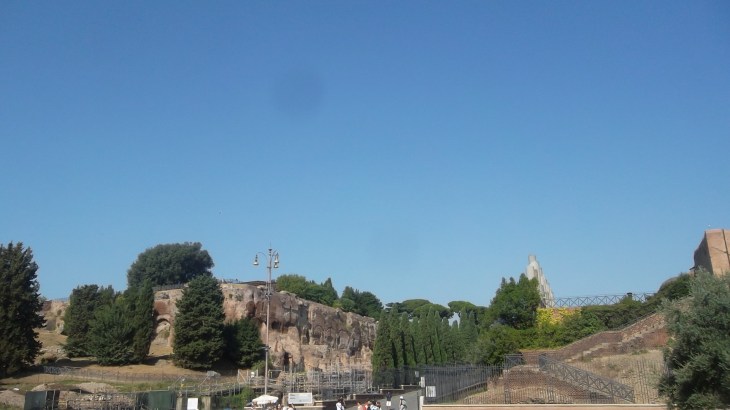
The Archeological park of the Colisseum on the Foro Romano : https://colosseo.it/en/area/the-roman-forum/
The Rome tourist office on the Foro Romano : https://www.turismoroma.it/en/places/roman-forum-and-palatine
There you go folks, another wonderful monument of Rome. The Foro Romano is a large area but worth the walk indeed. Again, hope you enjoy the post as I,
And remember, happy travels, good health, and many cheers to all !!!

 Paris1972-Versailles2003