
I arrived in Rome with the family, finally. It was a very nice family trip and we packed a lot of sights into it. However, one of the best if not the best was the visit to Villa Borgnese , this is follow up post with older new pictures to the blog, Let me tell you a bit more on the Villa Borghese of Rome, part II !!! Hope you enjoy it as I.
The Villa Borghèse is a municipal park of 80 hectares or about 198 acres in Rome. It has a large group of buildings on the cultural nature as well as museums i The gardens of Villa Borghese were done following the plans of Cardinal Scipione Borghese to enhance the town and to house his art collection. In 1605 he ordered transformed a vineyard into luxurious gardens fed by several fountainsL This is the most important park in Rome since the Antique period. The whole of the Villa Borghese was finished in 1633 . The current gardens dates from the 19C and done in the English style. The park was purchased by the Italian government in 1901 and given to the city of Rome in 1903 to be open to the public.
You see the wonderful Pincio Water clock , still going strong from 19C engineering. The Pincio is a hill on the north of the Quirinal that dominates the Campo di Martes with several villas including Villa Borghese where you have the clock. The clock has four quadrants ideally recalling the trunk of a tree and allowing it to show the time in four different directions, to note his hands in the shape of tree branches to make this structure an architectural element almost natural in perfect harmony with Villa Borghese.

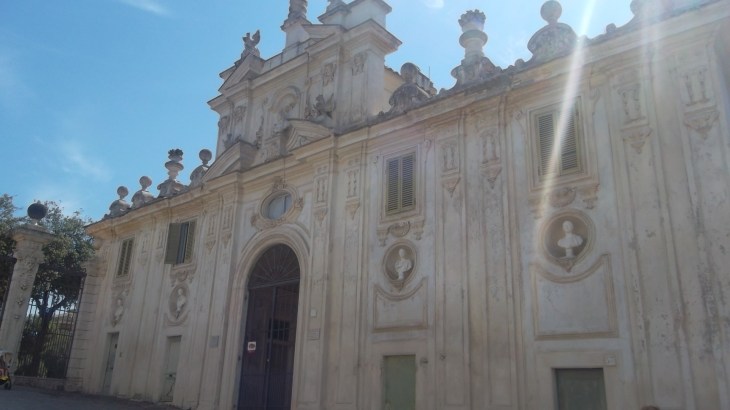
The Padiglione dell’Uccelliera or Aviary building is located in Viale dell’Uccelliera, which has three large bird cages as a roof. The Uccelliera pavilion was built in the 17C almost at the same time as the Casino nobile, as a prospective completion of the second secret garden. The building has a rectangular plan and is composed of two symmetrical buildings joined by a vaulted passageway decorated with frescoes. The façades present a rich architectural display with broken gables crowned by aviaries. The interiors are decorated with frescoes with rural motifs, pergolas, festoons and birds. Two circular fountains, which collected rainwater, were placed in the center of the two rooms, in correspondence with the cages, to quench the birds’ thirst. The two façades are richly decorated with stuccoes, ancient reliefs, festoons, oval niches with busts and heraldic motifs of the Borghese family. Today the casino houses the offices of the Capitoline Superintendence which takes care of the historic Roman villas.

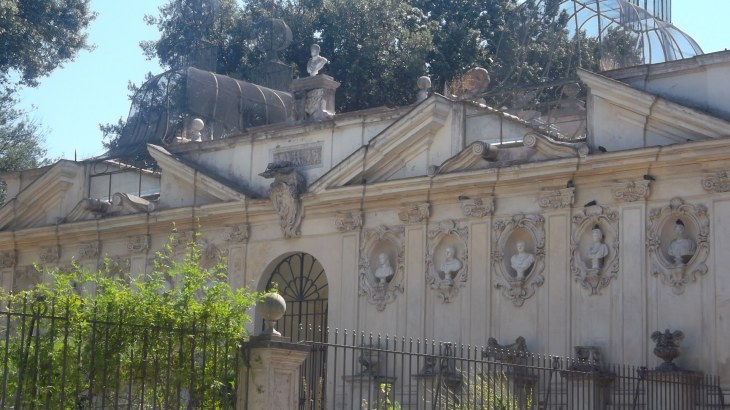
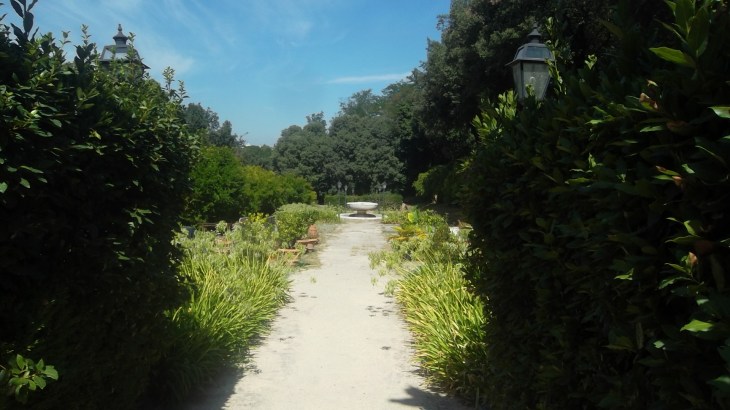
The Casino della Meridiana or Meridiana Pavilion is a second aviary , designed by Carlo Rainaldi in 1688; its name derives from the sundial placed at its center and is characterized by many marble and stucco decorations. Between the two pavilions there are the Secret Gardens, where the Cardinal Borghese used to admire rare and exotic flowers. The Secret Gardens were restored in 1999 and now recovered their bygone beauty and charm.
The Pincio elevator/lift, built at the old tram stop to allow citizens to go up to the Pincio. It was inaugurated in 1926, at the stop of lines 45 (Piazza Verbano – Trionfale district) and 46 (Piazza Indipendenza – Trionfale district), established in the same year along Viale del Muro Torto. The building contains the lower station on the avenue, the well for the cabins and the service stairs in the false tower and the upper station and the engine room in the upper building, on the Pincio level. The Pincio elevator/lift ceased service in 1959 when, for the 1960 Olympic Games, the Corso d’Italia – Piazzale Flaminio automobile axis was created, with the elimination of the tram line that ran along the walls of Viale del Muro Torto. In August 1960, for the Olympics, the service was reactivated on Saturdays, Sundays and holidays, before being definitively closed.

The Portale del Leone or Lion Portal is the access to the Deer Park in what is now Via Pietro Raimondi, built by Flaminio Ponzio in the 17C. Of the original decorations of the portal, only the lion-shaped protome remains above the keystone.
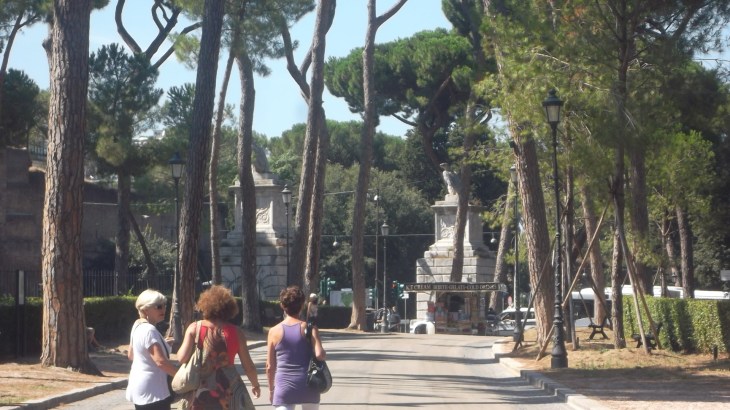
The Via Pinciana begins in Piazzale Brasile and ends where the road forks with Via Giovanni Paisiello on the left and Via Ruggero Giovannelli on the right. It runs alongside the oldest part of Villa Borghese which was the nucleus from which the subsequent expansions of the villa began.

The Rome Tourist Office on Villa Borghese park: https://www.turismoroma.it/en/places/villa-borghese-park
A private site on the Villa Borghese : https://borghese.gallery/villa-borghese-gardens/
A Rome tourist site on the park of Villa Borghese : https://www.060608.it/en/cultura-e-svago/verde/giardini-ville-e-parchi-urbani/villa-borghese-parco-di-culture.html
There you go folks as said a wonderful park in a huge historically renown city of Rome. I told you, it is huge we could not walked all and came back twice to it while there, so many monuments and buildings to see. Again, hope you enjoy the post on the beautiful Villa Borghese of Rome, part II as I.
And , remember for happy travels, good health, and many cheers to all !!!

 Paris1972-Versailles2003