
Well, well, I found me older new pictures to the blog and therefore, will do a post on the curiosities of Curitiba, part II ! These are new to the blog and glad found the pictures to write these wonderful posts, As said, had the opportunity to lived in Curitiba back in 2008 for 3 months, and it was superb! I have several posts on the city, so let me tell you about the beautiful City of Curitiba, ,Paranà State of Brazil, Hope you enjoy the post as I.
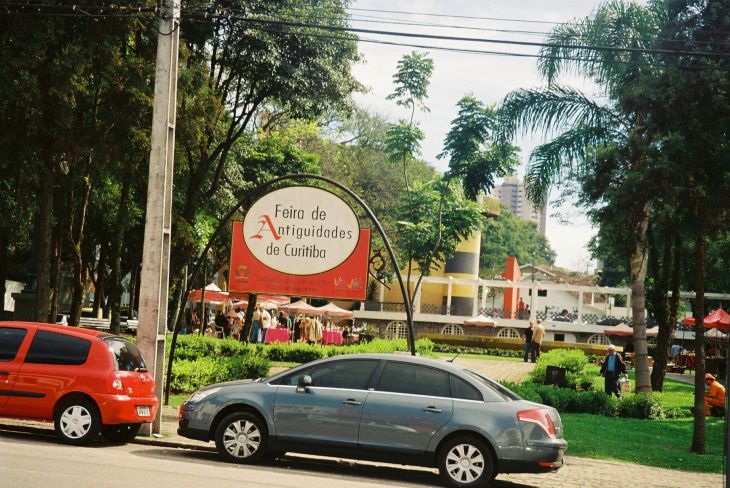
The Praça da Espanha or Spain square was opened in 1955, has an area of 6,500 m² and the name given to the square was a tribute to Spanish colonization. It is considered a cultural space that attracts people of all ages due to its events. Saturdays can be considered the busiest day, where the antiques fair takes place, where approximately 18 stalls come together to sell and exchange various objects for collectors, including stamps, coins, pennants, old telephone sets, crockery, jewelry, miniature cars, toys, household appliances from the 1960s to 1970s.There is also a car exhibition, held in the afternoon, which features approximately 30 cars from past decades. The yoga classes held on Saturday afternoons are free and anyone can participate. Another cool event is the live music performances with bands from Curitiba. At Casa da Leitura Miguel de Cervantes will also receive a Tourist Information Office. Landscaping works will be carried out in the square, as well as the installation of umbrellas that will be used during fairs on site.
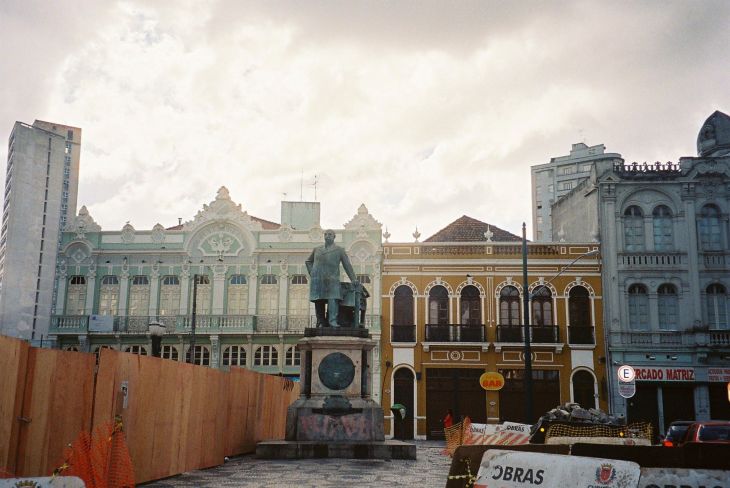
The Statue of the Baron of Rio Branco sits on the Rua Riachuelo next to the Praça Generoso Marques square, José Maria da Silva Paranhos Júnior , Baron of Rio Branco or Barão do Rio Branco was a Brazilian lawyer, historian, diplomat and politician, who was Minister of Foreign affairs between 1902 and 1912. The square is considered one of the largest historical-cultural collection in the city, home to mansions built at the end of the 19C until the beginning of the 20C that mark the beginnings of the population of Curitiba. On one side is Casa Edith, one of the oldest stores in the city, which boasts on its neoclassical-style facade a sign already worn out by time with the number 1879, the year the blue building was built. On the other, there is the sumptuous Palacete Tigre Royal, built in 1916, with eclectic architecture and a Parisian feel. Another notable building is the Palacete Joaquim Augusto de Andrade, on the corner of Rua Riachuelo. Built in 1915, in the center of the square, all paved with petit pavé, is its main attraction, the century-old Paço da Liberdade building., The place where the Paço da Liberdade stands today housed the city’s bustling public market until the beginning of the 20C. Installed there in 1874, the Municipal Market , also called Mercado Novo or new market gave life to the square, which until then was a sparsely inhabited and gloomy area known as Largo da Cadeia, as it was located at the back of the Public Prison building.
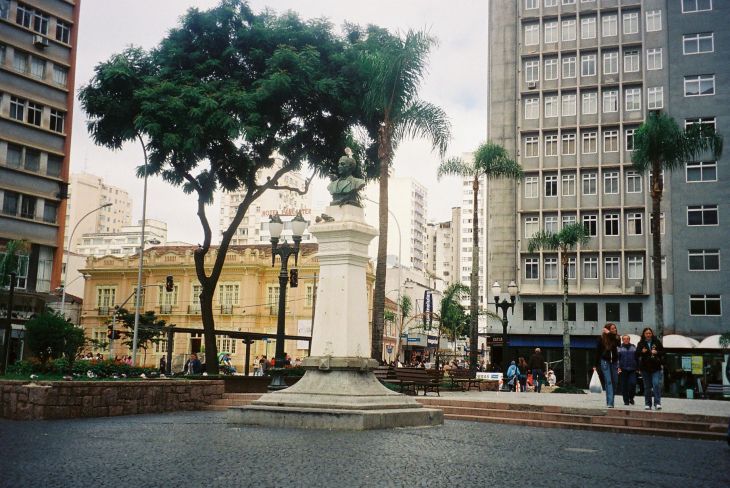
This beautiful square called Praça Zacarias in honor of the first President of the independent Province of Curitiba, Zacarias de Goes e Vasconcelos inaugurated on December 19, 1853, One of the elements of the square is the sculpture of an eagle with two heads. It was located at the top of the Masonic Lodge Fraternidade Paranaense, and symbolizes, in Freemasonry, the maximum degree of knowledge. The original building was demolished in the 1960s, but the eagle remained in the same location, in what is now the Acácia Building, In 1939, the square’s fountain was transferred from the square to the Paranaense Museum. Reports indicate that one of the possible reasons for the removal was the top part of the fountain which, for the church, represented a phallic symbol. In 1968, by order of the mayor, the fountain returned to the square, but without its top. The Zacarias Square was also a stopping point for trams and, later, for cars, as there was a fuel pump in the square.On December 19, 1915, the bust of Zacarias de Góes e Vasconcelos was inaugurated in Praça Zacarias.
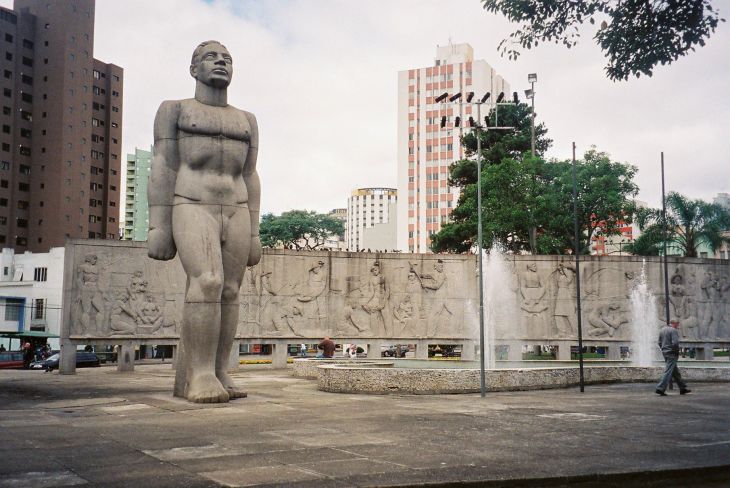
The Praça 19 de Dezembro or December 19 square, also known as Praça do Homem Nu,or Naked Men square is located in the center of the city of Curitiba. The square was inaugurated on December 19, 1953, in the wake of the public works program commemorating the centenary of the state’s political emancipation of , which took place on the same day, a century earlier. The square has a stone obelisk, containing words commemorating the centenary of the emancipation mentioned above and a large granite statue of a naked man, which gave the square its nickname, The square is It is also decorated with a sinuous water tank and a stone mural on two sides. One of them contains a granite panel in high relief by Erbo Stenzel and the other a panel of blue and white tiles by Poty Lazzarotto, both depicting important episodes in the history of Paraná. Later the square received another statue, this time of a nude woman , by the same authors
For reference, the Curitiba Tourist Office: https://turismo.curitiba.pr.gov.br/en/
There you go folks , a very nice time of many nice memories ; good for the soul and this road warrior in Curitiba. I had many opportunities to walked city , and do lots of sightseeing as had a company car in addition to my knowledge of the local language , and the fun was great, memories forever. The curiosities of Curitiba , part II was one happy moment in the City, and great architecture, good to walk the beat and enjoy the scenery, And for me, just another wonderful memory, always in my heart. I hope one day to be back toCuritiba, eventually. Again, hope you enjoy the post as I.
And remember, happy travels, good health, and many cheers to all !!!

 Paris1972-Versailles2003