
I am taking you back to neighbor Germany and the wonderful city of Koblenz. I found me again pictures not in my blog that they should be ,me think, I have written several posts on the City and you might want to see those too. Let me tell you about the curiosities of Koblenz, part II !!! , and hope you enjoy the post as I.
As said on previous posts, we came by chance here taking advantage were base in the south at Trier (see posts) and decided to take a road warrior trip to Koblenz, We like it a lot with so much history even combining both France and Germany we were pleasantly surprise and love it .We will be back, eventually.
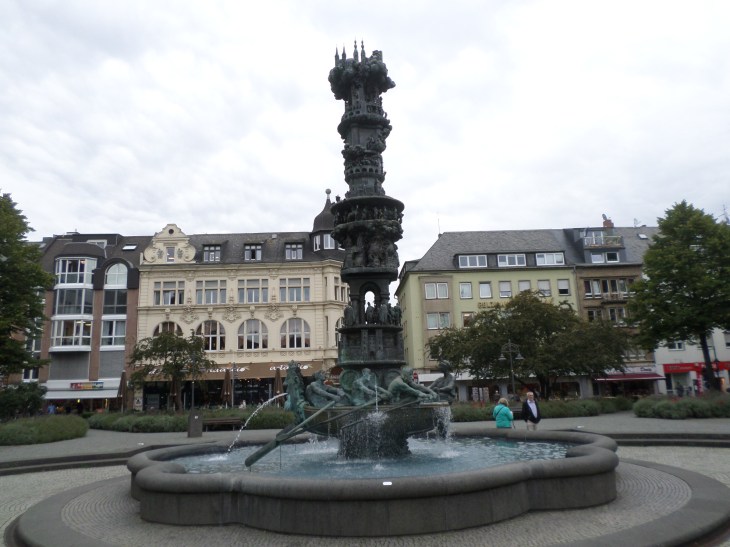
There is a wonderful column in Josef-Görres-Platz square, The history column in the middle of Görresplatz was donated to the city of Koblenz by the state government of Rhineland-Palatinate in 1992 for the 2000th anniversary celebrations ,Each of the ten steps depicts a transformative episode in the city’s history, starting with the Roman wine ship, through the warlike confrontations and phases of prosperity in the Electorate, to destruction and reconstruction in the 20C.
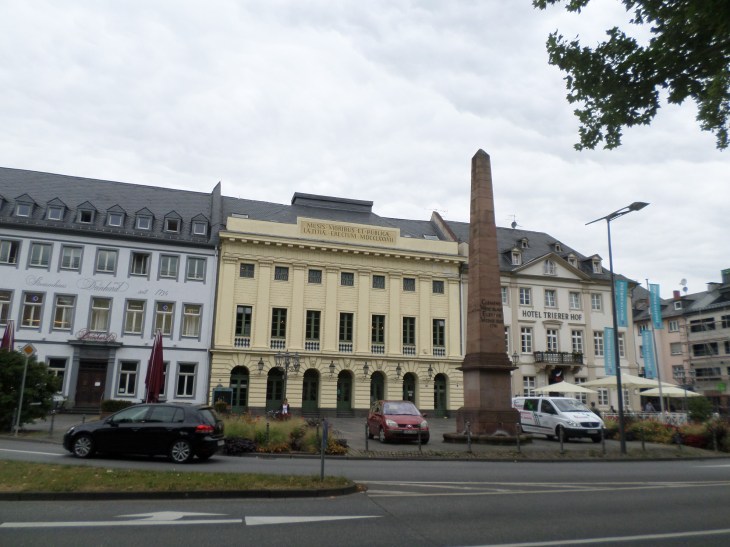
The Obelisk since 1970 in front of the theater has had its distractors as they said obstruct the view of the theater and less parking space, It is nine meters high, surrounded by four semicircular bowls and supports the square fountain obelisk on a sandstone pedestal and a square base with the following inscription: The western part of Clemensplatz was renamed Deinhardplatz in 1954 and still shows the obelisk belonging to the fountain, which reminds of its creator. The Municipal Theater is a performance hall with its own ensemble for drama, opera and ballet. The theater is a survivor of classical theater. The exterior of the theater is characterized by a neoclassical facade with pilasters. The blue, gray and white bring the viewer onto an annular plane, centered on the princely box decorated with optical illusions.
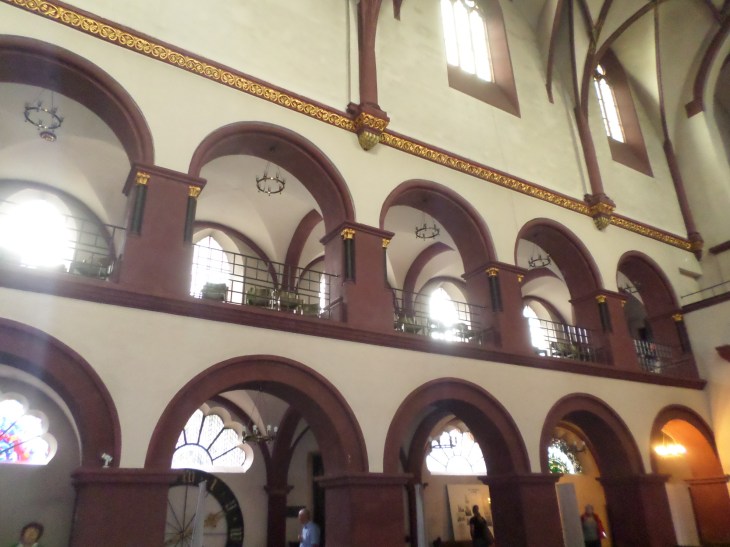
The Notre Dame Church or Liebfrauenkirche is the oldest church in Koblenz, and always been the parish church as well. The origins of the Notre Dame Church (Our Lady), go back to a Late Antique hall church from the time of the Roman Emperor Valerian approx. 350. Although what’s seen today dates from the 12C with later 15C additions, evidence concludes that a Roman 5C place of worship stood on this spot. Initial construction lasted from 1180 to approximately 1250 There you see one its wall richly done,
The Saint Castor Basilica is located behind the Deutsches Eck, the name of a headland in Koblenz, where the Moselle joins the Rhine rivers The St Castor’s Church or Kastorkirche was built between 817 and 836 by Hetto, the Archbishop of Trier with the support of Emperor Louis the Pious, just outside the city of Koblenz and dedicated on 12 November 836. In the 12C the Church was significantly enlarged, with the addition of the 2 spires, a choir and a miniature gallery, flanked by 2 smaller spires, all in the Romanesque style. On February 16, 1992, John Paul II elevated St. Castor to the status of a minor papal basilica, See the imposing stones or dalles in the patio outside,

Passing by the Rathaus or city/town hall where you can see the Schângel fountain,located in the courtyard on top a child smashing the water. The official City Hall or Rathaus of Koblenz : https://www.geoportal.koblenz.de/

The Jesuitenplatz or Jesuit square is in the heart of Koblenz’s old town ,and got its name from the religious order of the same name, which worked here from 1580 to 1773. The Jesuits took over a Cistercian monastery founded in the 13C and rebuilt it. The castle-like Jesuit high school with its towers and magnificent portals on the south side of the square was built between 1580 and 1701 and existed until 1773. The City/ town hall of the city of Koblenz has been housed here since 1895, The former Jesuit church (today the city church) is located in the southeast corner of Jesuitenplatz. It was built 1613-17. In the middle of the square, surrounded by beautifully decorated town houses, is the monument to the Koblenz physiologist and anatomist Johannes Müller, which dates back to 1899.

The Romantic Rhine region on things to do /see in Koblenz : https://www.romantischer-rhein.de/en/rhine-romanticism-and-the-region/historical-towns-and-villages
The Koblenz tourist office: https://www.visit-koblenz.de/en
There you go folks, something to expand our horizons and lucky to be at the crossroad of Europe and all these wonderful places to see easy. This is a City to come back,eventually, Again, hope you enjoy this post on the curiosities of Koblenz, part II !!! as I
And remember, happy travels , good health, and many cheers to all !!!

 Paris1972-Versailles2003