
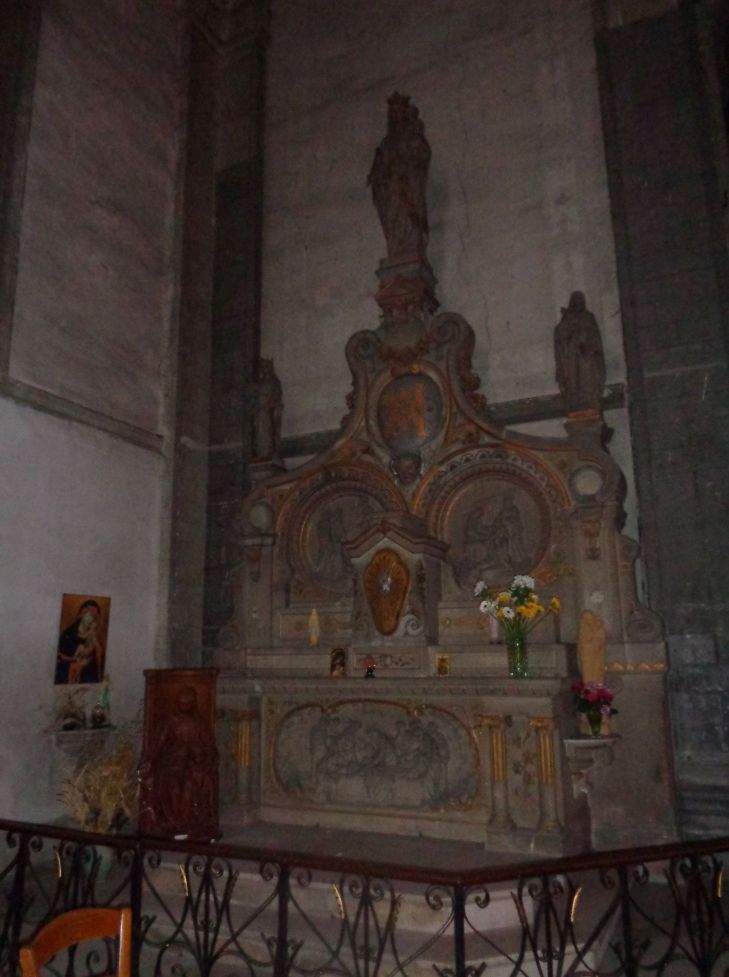
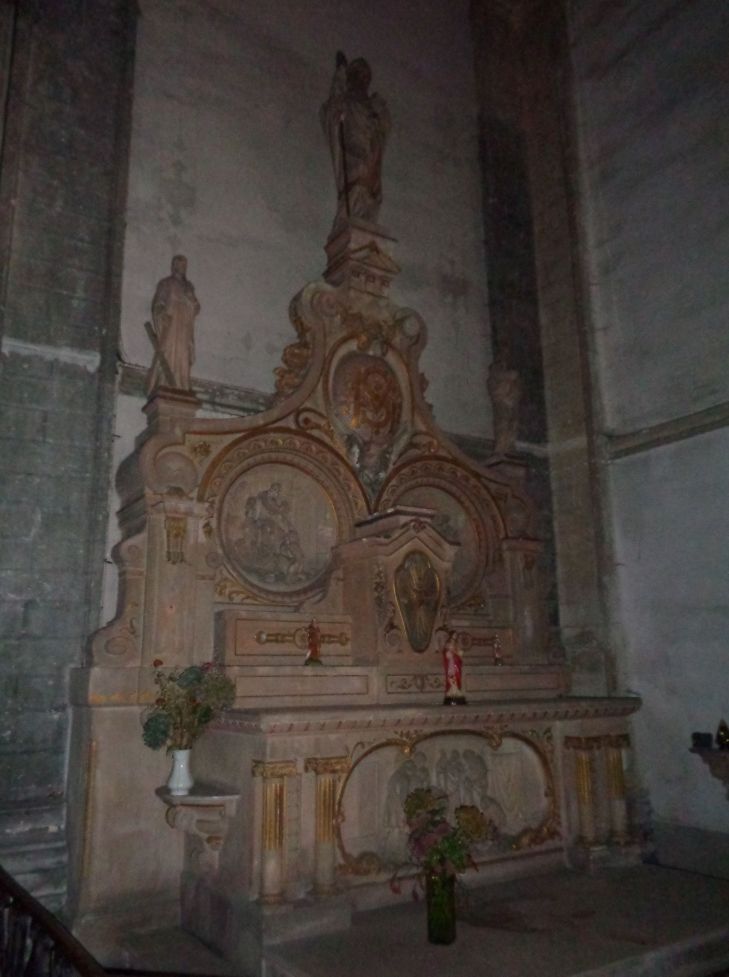
Again,now on more familiar territory but always new finds in my road warrior ways ! I have passed by here several times but never stop until now, I came over to see family again, my dear late wife Martine oldest brother and voilà a new older spot in my world map ! This is the continuation of wonderful sights in the dept 59 Nord of the region of Hauts de France, and in my belle France. For some reasons, the church was been renovated, and not enough light for the pictures…..Therefore, let me tell you about the Church Saint Martin of Le Cateau Cambrésis !! Hope you enjoy the post as I.
The town of Le Cateau-Cambrésis is located in the department 59 Nord in the Hauts-de-France region of my belle France. The town is 9.5 km from Caudry, 23 km from Cambrai, 28 km from Valenciennes and 34 km from Saint-Quentin. The regional capital, Lille, is 68 km away. The town is located right on the departmental road 643 (ex national route 43). The departmental road 932, also known as “Chaussée Brunehaut”, an old Roman road from Bavay to Vermand, passes to the east of the town.
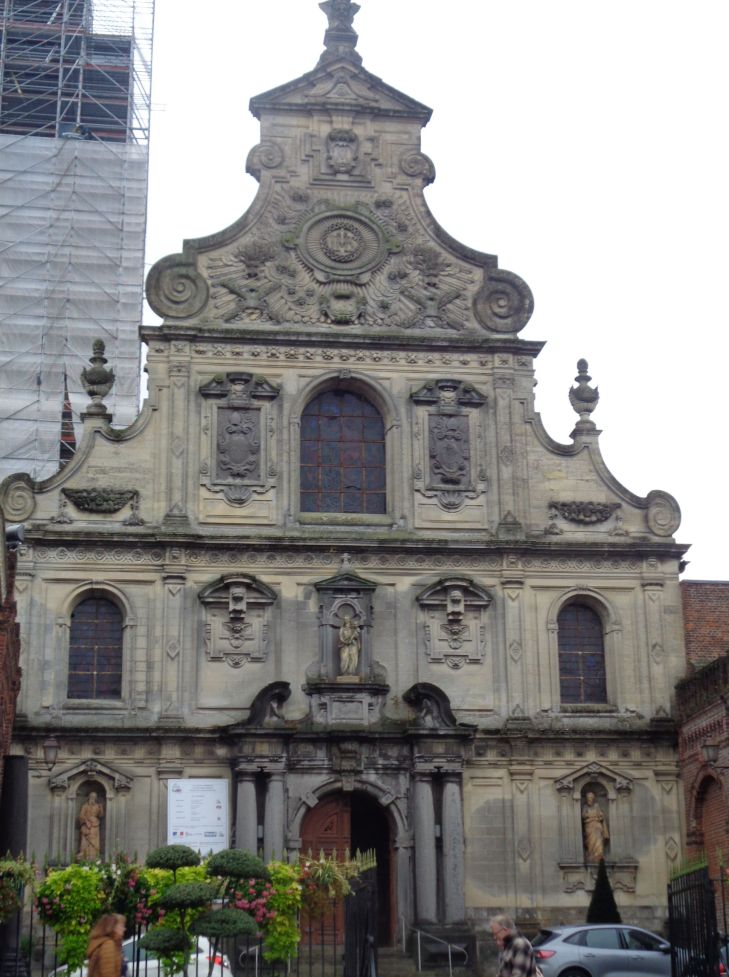
You can see the wonderful Saint-Martin Abbey Church. This church depends on the parish “Notre-Dame de la Fraternité en Cambrésis” attached to the diocese of Cambrai, The Collegiale Saint-Martin is built in the Manned Baroque style, begun in 1634-1635, and completed between the 17C and 18C. It is notable for its onion bell tower.

The Saint-Martin Church of Le Cateau-Cambrésis is the only remaining building of the former Saint-André Benedictine abbey. The church was built according to the plans of Brother Jean Du Blocq of the Company of Jesus during two campaigns: the first, concerning the facade and the nave, dates from the years 1634-1635, while the chancel and the transept were made at the turn of the 17C to 18C. The facade is characteristic of the mannerism of the northern regions. The play of curves and counter-curves, the use of volutes, the variety of decorative motifs make it a true masterpiece. Its onion bell tower dates from the 1680s. The abundance of decoration is found inside, where sculptures by Jaspard Marsy rub shoulders in the nave and the Froment brothers in the choir. The Saint Martin Church became the parish church of Le Cateau Cambrésis after the French revolution. It is a superb illustration of Mannerist art, imported from Italy, which flourished in the 17C. The facade is remarkable for its richness and quality ; it has three floors with sculptures of essentially secular inspiration where curves and volutes dominate. In the nave we find heads of angels, all different, and mascarons.
The vaults of the nave and the rest of the construction were completed from 1680 to the beginning of the 18C. The nave has large semi-circular vaults with pillars, of Romanesque inspiration, and the aisles are ribbed, of Gothic inspiration. In the choir, as long as the nave and which includes an ambulatory and an apse chapel dedicated to Sainte-Maxellende, the columns come together and the arches become mitred. This choir , where the monks of the abbey once stood is highlighted by the light from the large bays windows on the right are a 19C addition. There we also find the culmination of all the ornamentation with the divine lamb surmounted by a dove, figured in the background of the church. The very colorful stained glass windows, of Cubist inspiration dating from 1932-1934 replaced the original white glazing, because the church was very damaged by the bombings in October 1918 (WWI). In the nave, they evoke the main episodes of life of Saint-Martin. The church also has organs, restored after 1918 and more recently. The square bell tower, where you can see Saint Andrew’s crosses, is topped by a bulb which matches that of the belfry, and creates a pretty view of the center of the city.
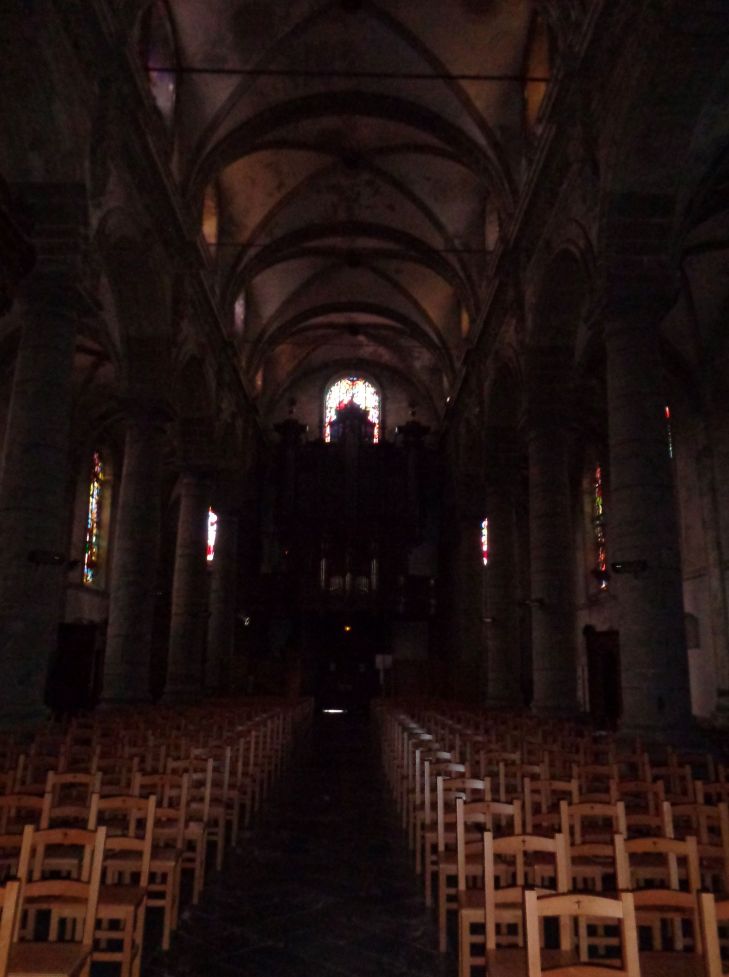
The original stained glass windows of the Saint-Martin Church were white and decorated with grisailles. The 18C, the time of construction of the church, is marked by the influence of the “school of French spirituality”. It is a movement of religious thought which wants to offer the Catholic faithful biblical knowledge and a constructed knowledge of theology. Bossuet, Saint Vincent de Paul or Saint François de Sales, are the animators of this movement of thought which is a heritage on intelligence. At this time, white stained glass windows were installed in churches which could expose the mystery in full light. Religious knowledge is transmitted through teaching. We therefore want to forget the dark stained glass windows of the Middle Ages, overloaded with biblical episodes, intended to provide the ignorant with a sort of comic strip catechism, Indeed a wonderful church to see,
I take this post to put up a bit of the history of Le Cateau Cambrésis, I like. In 1001, Emperor Otto III allowed the bishopric of Cambrai to strengthen the defenses of Château Sainte-Marie and make it a fortified town, to hold a market there and to mint money, in order to ensure the security in this part of Cambrésis county. In doing so, its name then changed to Chastel en Cambrésis, which then transformed into its current name, Le Cateau Cambrésis. The English conquered the city in the 15C, and kept it until 1449, when the Dunois took it back. Francis I stayed there in 1521 and then in 1543. In 1555, the French plundered it to take revenge for the good reception that Charles Quint had received there. In 1559, France and Spain signed the Treaties of Cateau-Cambrésis. Both nations are represented by their respective rulers Philip II of Spain and Henry II of France. The treaties left France with the strongholds of the Somme as well as three bishoprics (Metz, Toul and Verdun). In 1642, Le Cateau-Cambrésis was occupied by French troops. Louis XIII had the gates and ramparts dismantled. The urban structure, however, retains its plan with narrow sloping streets radiating from the islet that constituted the Benedictine abbey. The town was attached to the French crown in 1678 by the Treaty of Nijmegen. During the wars of the French revolution and of the empire, the city was occupied in 1793 by the Austrians then in 1814 by the Russians who settled there for two years. The Great War or WWI caused significant destruction to the city. On August 26, 1914, the Battle of Le Cateau pitted the British against the Germans, slowing down the latter and allowing the withdrawal of British and French troops for the Battle of the Marne. On November 21, 1920 the city received the War Cross with palm , During WWII, it was crossed on June 5, 1940 by Rommel at the head of his Panzer Division, after some battles on its outskirts as well as aerial bombardments,
The town of Le Cateau Cambrésis on its heritage : https://www.lecateau.fr/que-faire-au-cateau/decouvrir-le-cateau.html
The local Cambrésis tourist office on the Church Saint Martin : https://www.tourisme-cambresis.fr/eglise-saint-martin-cateau.html
There you go folks, a dandy wonderful road warrior ride that we love it much, This time in the north of France and just lovely, Family area and memories flashing, but glad I did it . Again, hope you enjoy the post on the Church Saint Martin of Le Cateau Cambrésis as I
And remember, happy travels, good health, and many cheers to all !!!

 Paris1972-Versailles2003