
I like to expand a bit on our nice visits to the wonderful City of Brugge in Flanders Belgium over the years, Had some pictures mix in with other unrelated posts and decided to write one on these monuments, worth it me think, Therefore , here are my curiosities of Brugge !!! Hope you enjoy the post as I.
Brugge is in the Flemish region of Belgium, principal city of the province of West Flandre. It has been call by many the Venice of the north, but you know how that goes…The City was mentioned from the 9C as a stronghold of the Count of Flandres I have come to Brugge only by car, and the roads are good , easy on the park and relays parkings or in the hotels.
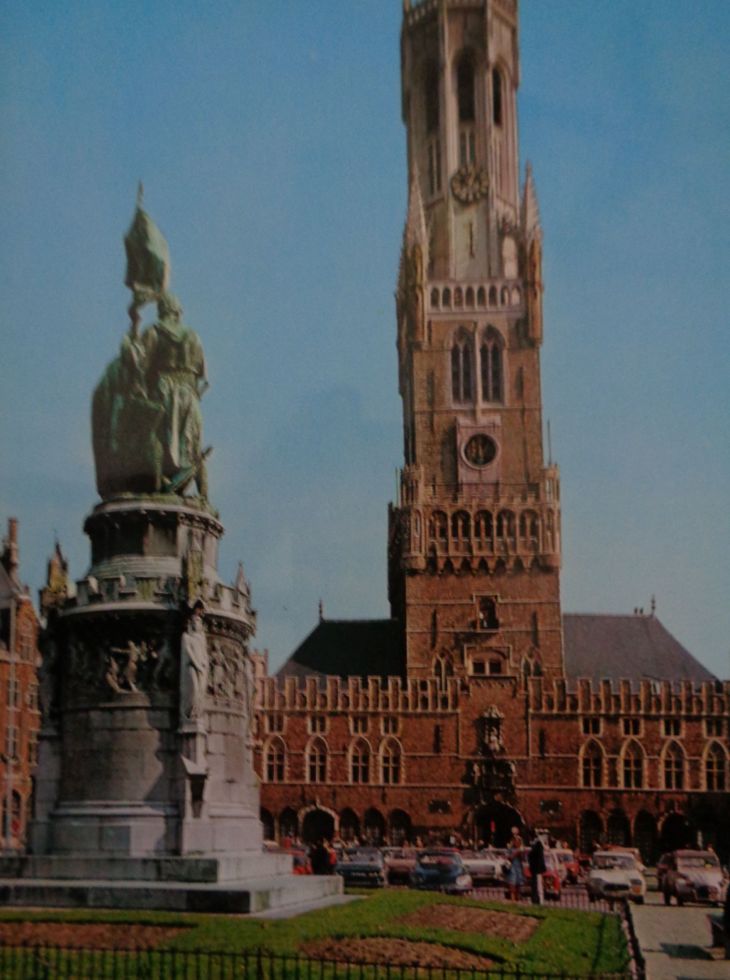
The 83-meters high Belfry of Bruges (Brugge) is a high medieval tower surmounting the Cloth Hall on the Grote Markt , It is a civil monument, built in several stages from the 13C to the 15C, which was the symbol of the municipal independence of Bruges, an important commercial city in the Middle Ages. A first construction surmounted by a wooden tower erected in 1240. The construction housed the wool and cloth halls and warehouses. The tower had a more administrative function and served at the time for the magistrates of the city. It included a room of safes as well as the archives of the city. The halls of the city extended during the 15C and in particular between 1482 and 1486 , A gallery was added to the rear of the halls during the 16C. The inner courtyard also received a few galleries on the first floor. In 1741 a fire again destroyed the spire of the tower. This was repaired in 1753, but without the spire. The tower received its present form with the addition of a new neo-Gothic openwork crown in 1822 at the top to replace the damaged old one, and by the absence of a new spire.
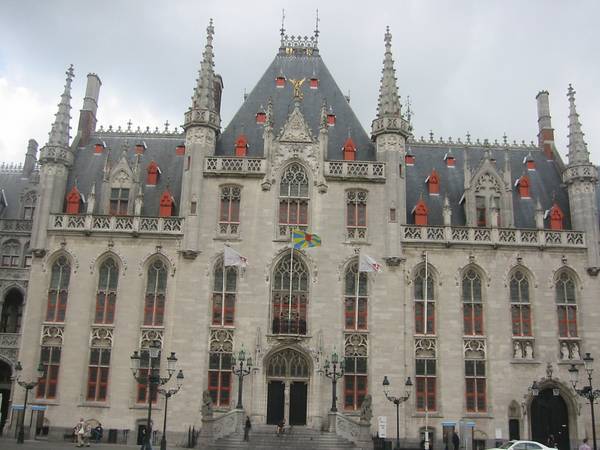
The City Hall (Stadhuisi) is a landmark building and the seat of that city. Built in a late-Gothic monumental style between 1376 and 1421, it is one of the oldest city halls in the former Burgundian Netherlands, It is located on Burg Square, the area of the former fortified castle in the centre of Bruges. The statues under the stone baldachin-canopies on the building’s facade have been renewed several times. At the time of the French Revolution, all the statues were destroyed. The Bourg Square is the historic center of the city of Bruges. Surrounded by various buildings that have marked the history of the city, this square square was the headquarters of the Count of Flanders.
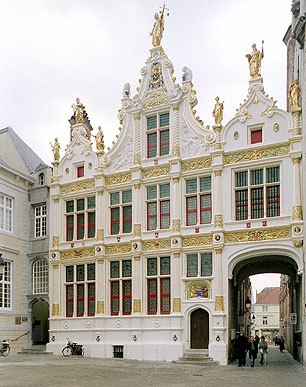
The Oude Griffie is the seat of the former administration of the economic “colonies” of the mighty medieval Bruges. The Old Civil Registry is a quite astonishing historical monument that stands out from the other buildings that line the Bourg Square. It is not the tallest or largest but the Old Civil Registry is richly decorated and its very light natural stone facade enhanced with gold and red windows inevitably catch the eye. Built between 1534 and 1537, the Old Civil Registry is one of the oldest Renaissance buildings in all of Flanders. Used as a court until 1983, it has since hosted the Franc of Bruges. The 7 bronze statues which overlook the building date from 1883 and represent the world of law as represented by the local painter and sculptor Henri Pickery ; such as the allegory of Prudence with snake and mirror; Moses and the Tablets of the Law; the allegory of Fidelity represented with a dog; In the center, the allegory of Justice with its essential attributes: scales, a sword and blindfolded eyes; the allegory of Temperance with bridle and bit; Aaron with the attributes of the priests; and the allegory of Force carrying a column.
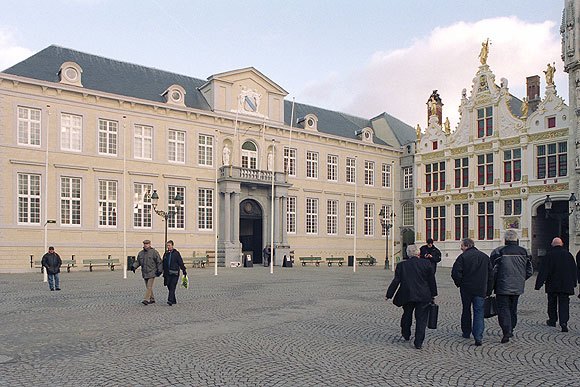
The former Justice courthouse, which dates from 1727, being in the Renaissance style. Today it is dedicated to the Museum Het Brugse Vrije The facade of the Brugse Vrije (Frank of Bruges), on the Burg near the Stadhuis (City/Town Hall), immediately catches the eye. The goddess of justice shines brightly on its roof. It recalls the function that the building had from 1795 to 1984: a court. Since the beginning of the 12C, the Frank of Bruges was the name of part of the county of Flanders which was administratively, financially and judicially independent , By the end of the 14C, the Franks became the ‘fourth member’ of Flanders, alongside the three major cities, Bruges, Ghent and Ypres. The Franc of Bruges was abolished in 1795. Today, the Franc of Bruges houses the city’s municipal archives. Only the alderman’s room is part of Musea Brugge. The municipal archives preserve the written memory of the city and are therefore a real treasure for historical study.
The Grand Place or named Grote Markt and for 3 years Place Napoléon in 1807 is one of the city’s must-see places. Located in the very center and covering 1 hectare, the paved square is surrounded by important monuments. On the north side, a typical set of houses with stepped gables closes the square. Behind this facade, the most curious will imagine the remains of the old St Christophe church on the left of the north face. On the east side, the provincial palace is the major element. To the south, the belfry of Bruges soars into the sky. The West side is home to several buildings of various styles with time markers that are now obsolete. On the ground, in front of the Bouchoute house, nails inserted into the ground show the exact location of the meridian. In the center of the Markt is a statue representing Pieter de Coninck and Jan Breydel, famous revolutionaries of the 14C who fought against blood privileges. The statue, erected in 1887 by the Belgian sculptor Paul de Vigne, shows the two figures with sword and flag in hand over the enemy. A medieval building, the Burghers’ Lodge was where wealthy merchants met and held their meetings. The bourgeois lodge is located at the end of the canal (between Piegelrei and Spinolarei streets) just after Jan van Eyck square. The place was not chosen by chance: it was one of the main places dedicated to trade in the Middle Ages. The building does not go unnoticed and it can be mistaken for a church because of its pointed tower which soars skyward and exceeds all the other multi-story buildings , It is done in Gothic style with the exterior richly decorated and can recall the buildings of the same function of other strongholds in Europe, In 2014, the city owns the premises and since 2016, the building has been used as a temporary exhibition space for contemporary art.(one pic both)
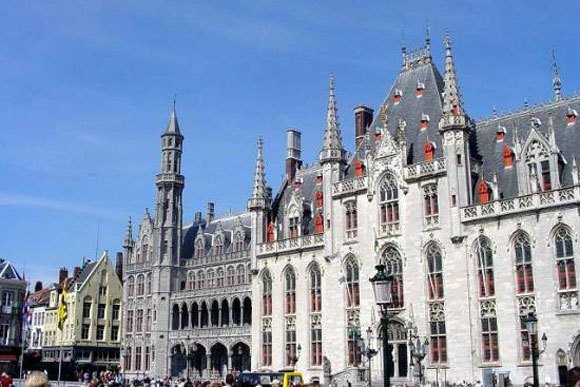
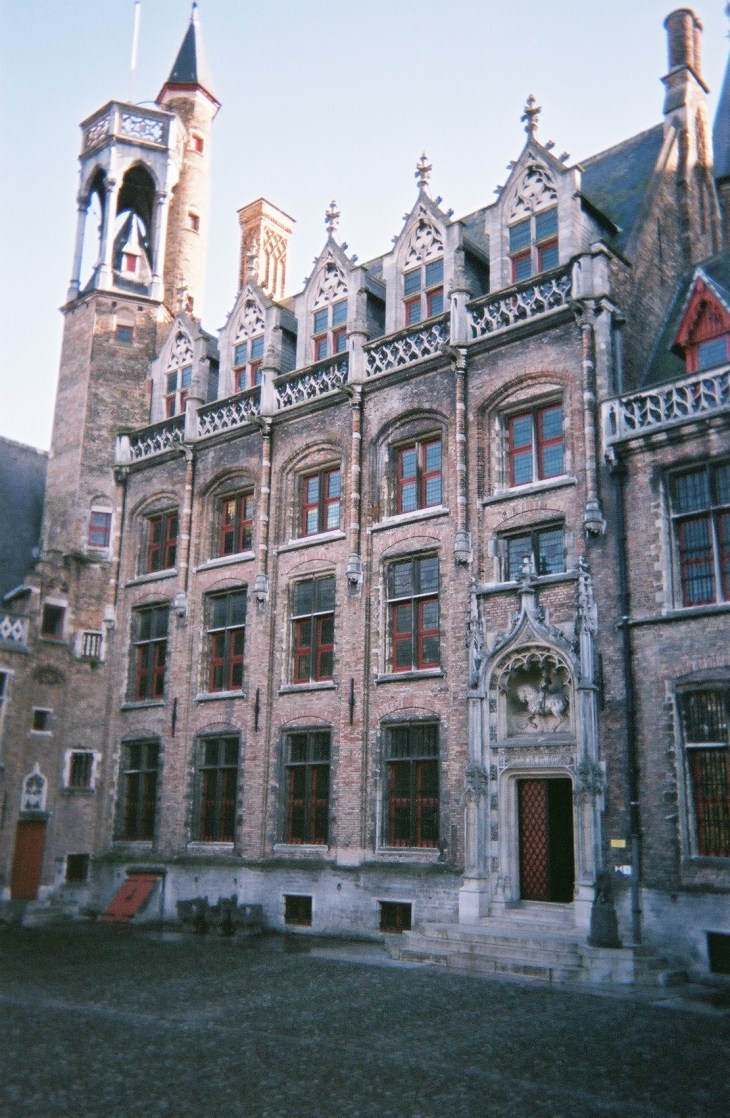
The Gruuthuse Museum is located in a former 15C mansion of the Lords of Gruuthuse, and has the most varied collection of applied or decorative arts in Brugge from the 13C to the 19C. In 1596, the house was purchased by Philip II of Spain and in 1623 given to Wenceslas Cobergher to house the pawnshop of Brugge. The city of Brugge purchased the house in 1875 and the architect Louis Delacenserie completely restored it between 1883 and 1895. The exterior is partly original, partly a reconstruction: the interior is mainly a neo-Gothic reconstruction of the end of the 19C of a medieval interior. The building was first used by the city of Bruges to display the archaeological collection of the Archaeological Society, and developed into a more general museum over the years, after the city acquired the collections for itself in 1955.
The Brugge tourist office on its heritage: https://www.visitbruges.be/en/things-to-do
The Flanders region tourist office on Brugge : https://www.visitflanders.com/en/flemish-destinations/bruges
There you go folks, the city of Brugge (Bruges in Fr) is awesome, a must to visit me think. A memorable family trip indeed and always looking forward to be back, eventually, Again, hope you enjoy my curiosities of Brugge as I. And remember, happy travels, good health, and many cheers to all !!!

 Paris1972-Versailles2003