
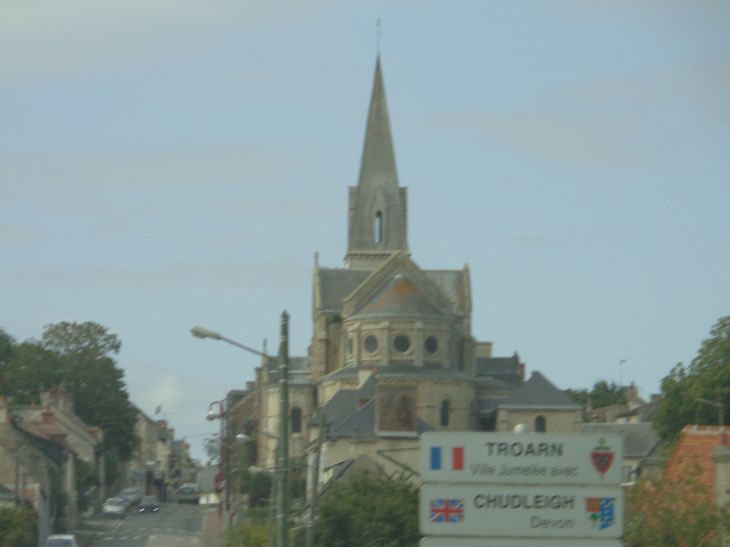
And my continuing road warrior trip back into our nostalgic Normandy, we visited two main towns and stayed between the two, perfect timing and location. We headed back after another wonderful visit and of course, we passed by wonderful monuments for a memorable picture, This was the last town we stopped on our way home and it was a nice find, to be back,eventually, Let me tell you about the Church Sainte Croix of Troarn ! Hope you enjoy the post as I.
The town of Troarn is located in department 14 of Calvados in the Normandie region of my belle France. It went thru some changes as between January 1, 2017 and December 31, 2019, it became a delegated town within the short-lived new town of Saline. On January 1, 2020, the new town of Saline is separated, and the old towns of Troarn and Sannerville regain their initial names. I took the route D 675 on our way home no tolls, this section is split by the A13 autoroute de Normandie, exit no. 30 at km 216 serving Troarn and Sannerville. This took me to the Caen rocade and home !
The Sainte-Croix Church is a neo-Romanesque church, rebuilt in 1890 and restored after WWII, containing the tomb of Knight Hugues, a sarcophagus found in 1909 in the remains of the Saint-Martin abbey church. The church is located at 16 Rue de Rouen (route D675) in Troarn, Sadly, it was closed as we were passing by but the pictures remain and will be back eventually,
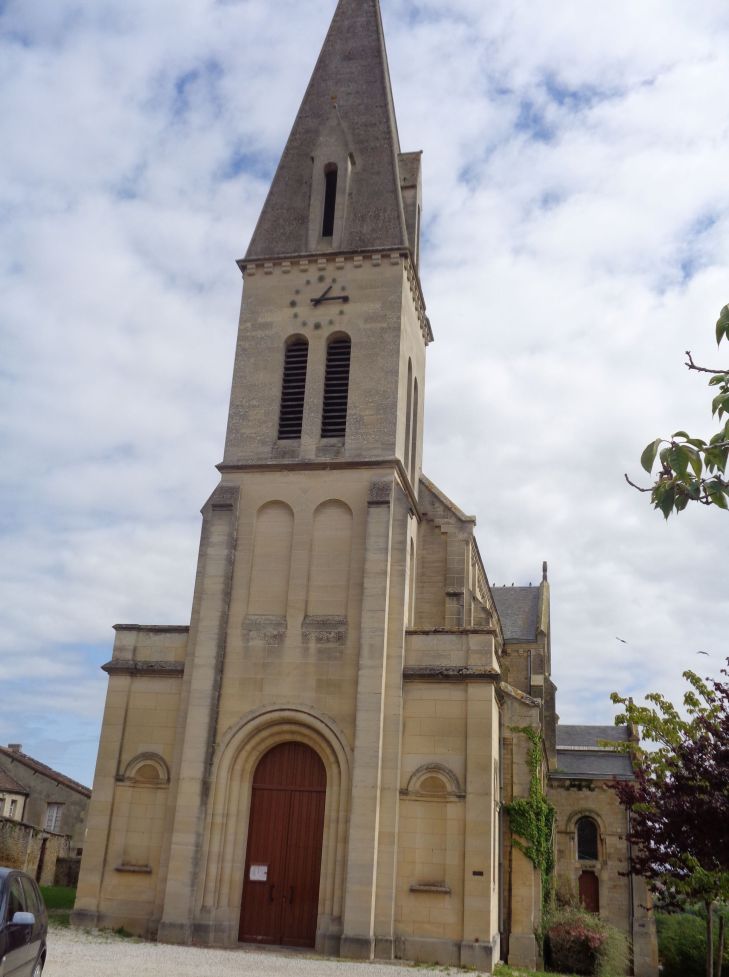


The town is located on the borders of the Caen plain and the Pays d’Auge, in the north-western part of the Dives marshes. Troarn developed on the top of the hill overlooking the ancient abbey built halfway up above the marshes, The history of Troarn dates back to 1022, with Roger I of Montgomeri built a collegiate church. Succeeding his father: Roger II de Montgomeri brought monks from the abbey of Conches (Eure 27) and founded the Benedictine abbey of St Martin in 1048 on the site of the previous one. This church was consecrated on May 13, 1059 by Odon de Conteville, bishop of Bayeux, half-brother of Guillaume known as “The Bastard”. The Tomb of Knight Hugues his sarcophagus, richly sculpted and provided with a long commemorative inscription, is one of the very rare examples of Norman Romanesque funerary sculpture that has survived to the present day. It was discovered in 1909 in a place corresponding to the transept of the Saint-Martin de Troarn Abbey Church. This knight could be Hugues de Montgomeri, brother of Roger II, founder of Saint-Martin Abbey. It would therefore predate the 1040s.
As a history buff, a nice story like to include here, In WWII, the Nazis occupying the sector belong to the 5th company of the Panzergrenadier-Regiment 125 of the 21. Panzer-Division, they have set up their command post led by Oberleutnant Brandenburg in Troarn. The 3rd Para Brigade of the 6th Airborne Division was tasked with the mission to take over the bridges in the early hours of June 6, 1944. The 3rd Parachute Squadron Royal Engineers commanded by Major Tim Roseveare received several destruction missions in the Dives marshes and one of its objectives is a bridge located in Troarn. Captain T. R. Juckes, leading No. 2 Troop of the 3rd Parachute Squadron Royal Engineers, crossed Troarn in an attempt to blow up the bridge. It detonates the charges which increase the extent of the damage then immediately withdraws. During the weeks that followed, Troarn remained in Nazis hands and it was not until the launch of Operation Goodwood, launched on July 18, 1944, that the situation evolved. The Allies launched a vast offensive aimed at seizing the city of Caen from the east and the 3rd British infantry division was tasked with carrying out a large circumvention movement towards Troarn. But the English stopped the advance on July 20, in the immediate vicinity of the village. It was not until Operation Paddle in August 1944 that the town fell into the hands of the Allies. This offensive directed towards the Seine river began on the night of August 16 to 17 and it was the N°41 Royal Marine Commando (4th Special Service Brigade) commanded by Lieutenant-Colonel T. M. Gray which captured Troarn on August 17, 1944 , without major fights. Thank you,
The town of Troarn on its heritage : https://troarn.fr/fr/rb/653122/patrimoine-historique-5
The Troarn Heritage site on the church : https://patrimoine-troarnais-et-burois.neopse-site.fr/fr/rb/1169339/eglise-sainte-croix-de-troarn
There you go folks, a dandy way to come back home ! A nice ride back and wonderful new monuments to see. This was a wonderful trip and again, hope you enjoy the post on the Church Sainte Croix de Troarn as I
And remember, happy travels, good health, and many cheers to all !!!
ps. I did not had time to see this but will put some here as my reminder to come back eventually and see, worth the trip back me think, The Saint-Martin Abbey founded by Roger II de Montgommeri and his wife Mabile de Bellême in 1059. This abbey dedicated to Saint Martin enjoyed great fame in the Middle Ages. Saint-Martin-de-Troarn was then the most important abbey in the diocese of Bayeux after the Saint-Étienne-de-Caen Abbey. Placed under the rule of Saint Benedict, in the 13C it housed around forty monks. For 700 years, the monks contributed to the development of the marshes of the Dives, the grasslands of the Auge valley and the vineyards of the Caen countryside. Charles IX and Catherine de Medici stayed there. It was burned in 1562 by Admiral de Coligny in the wars of Religion. Put up for sale by the French revolutionaries in 1792, the demolitionists destroyed the church and the cloister. Today, some vestiges remain, including a 13C building, Saint-Martin Abbey also housed the tomb of Knight Hugues, companion of William the Conqueror. This tomb, which includes interesting Romanesque sculptures, was transported to the parish Church of Saint-Martin-de-Marais 2 rue Square ,Troarn, The church in the shape of a Latin cross has a nave and two aisles, a transept with four chapels and a flat head choir. It measures 76 × 11 meters plus side aisles. The height of the two towers is 26 meters. It is one of the most beautiful churches in the region.

 Paris1972-Versailles2003