
And my continuing road warrior trip back into our nostalgic Normandy, we visited two main towns and stayed between the two, perfect timing and location. We headed back after another wonderful visit and of course, we had to stop on nice places coming back for a quick look, These are towns we have passed by but never entered, this time it was time, Let me tell you about the Church Notre Dame de l’Assomption in the new town of Rives en Seine (former Caudebec en Caux) !!! Hope you enjoy the post as I.
The new town of Rives-en-Seine is located in the Seine-Maritime department 76 of the Normandie region,and in my belle France, The town was formed on January 1, 2016, by the merger of Caudebec-en-Caux, Saint-Wandrille-Rançon and Villequier. The capital of the new community is located at the City/town hall of Caudebec-en-Caux.
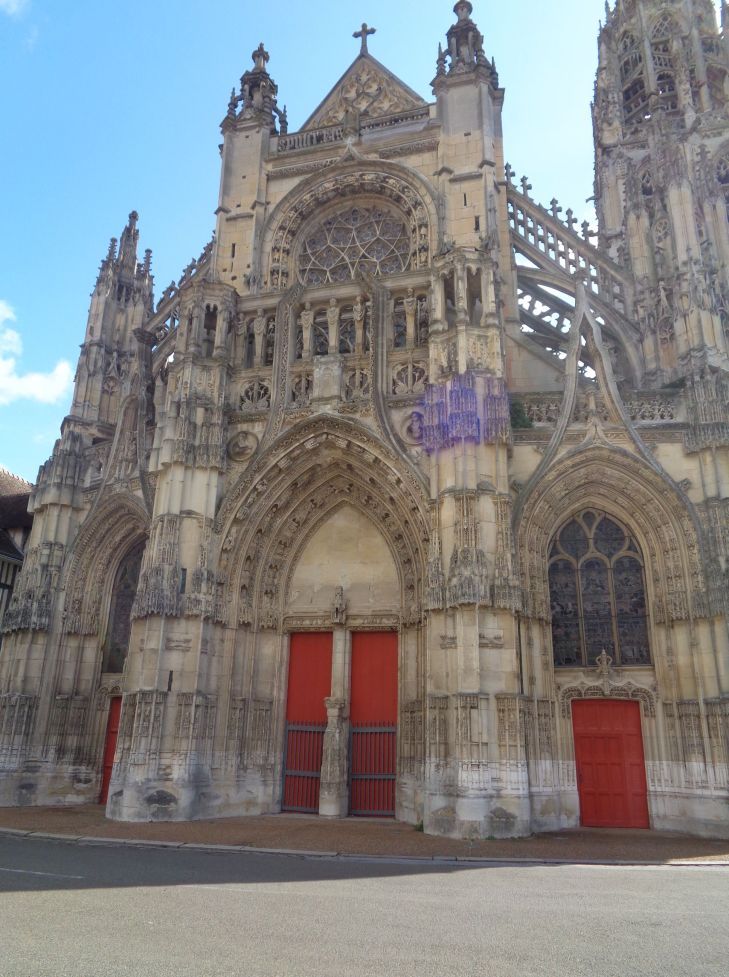
Cruising along we saw and stopped at the Church Notre Dame de l’Assomption, King Henry IV is said to have said that it was one of the most beautiful churches in France: “It is the most beautiful chapel in my kingdom.” Indeed, this manifesto of the flamboyant Gothic style and the beginnings of the Renaissance does not include a transept, and which perhaps justifies this royal term of “chapel”.

On the roof balustrade are inscribed in Gothic letters verses from the Song of Songs, or Song of Solomon. Passages from the Magnificat also appear on this balustrade, Its west portal is finely sculpted and decorated with a whole population of sculptures (originally 333) representing saints, but also characters from daily life of the time, including a loure player which constitutes one of the rare representations of this old musical instrument. However, the small figures on the south side of this west facade have been restored according to their original layout and appearance.


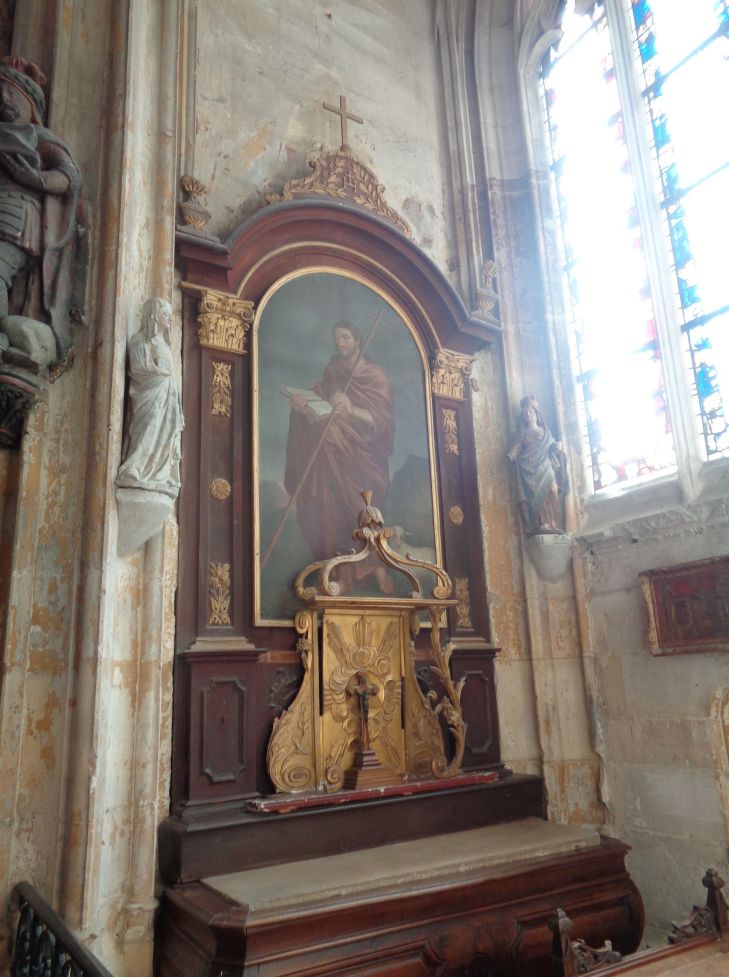
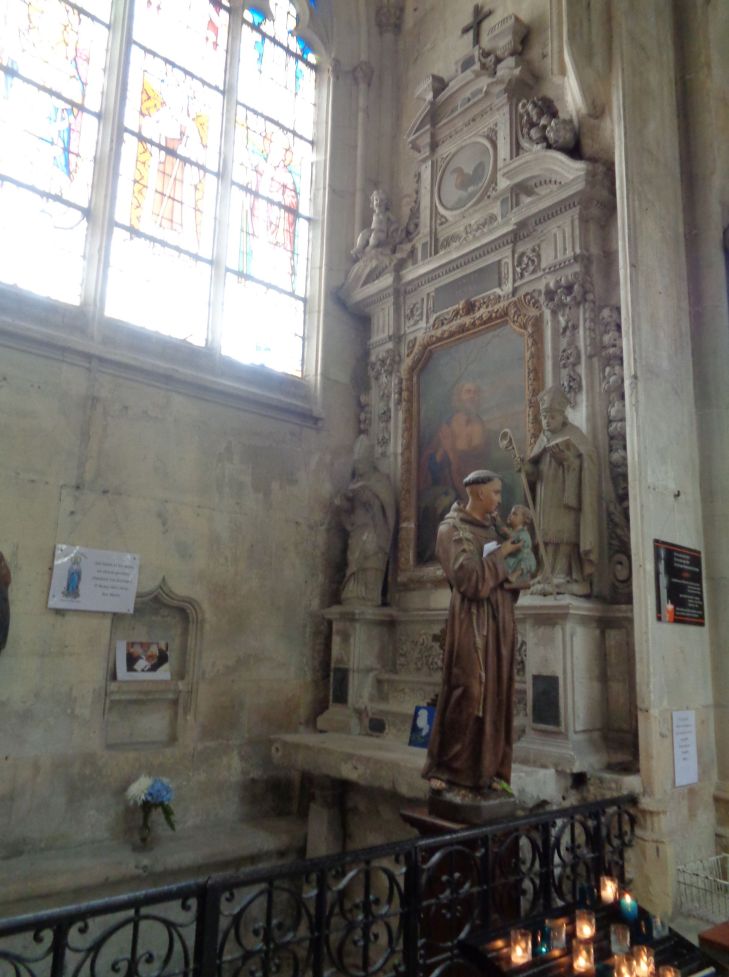
The beautiful 15C stained glass windows leave an impression on the visitor. The first of them represents Saint George, patron saint of England, slaying the dragon. It has its counterpart in the chapel which adjoins this portal on the right, in Saint Michael, patron saint of Normandy, then of the kingdom of France, who also defeated a dragon. The two other stained glass windows represent Saint Catherine and the Virgin Mary. Most of the stained glass windows from this period, especially in the chapels of the north aisle, represent full-length saints, patrons of the trades, offered by the numerous corporations in this very industrious city. The 16C stained glass windows are even more famous. They adorn four bays in the last two Gothic-Renaissance bays of the west facade. Two other Renaissance stained glass windows also adorn the lower windows of the west facade. They mainly represent scenes from the Old Testament or the life of Christ: Jesus and the Samaritan woman (1532) at Jacob’s well, Moses and the crossing of the Red Sea by the Hebrews, the Last Supper, the Wise Kings, the life of Saint John the Baptist and a Jesse tree. We see that the master glassmaker in the representation of the passage of the Red Sea depicted the sea and its waves in the color red,

The pendant key of the Chapel of the Virgin measures 4.5 meters and weighs 7 tons, The baptismal font in carved wood also makes the church famous, Gustave Flaubert found his inspiration for the creation of his tale Legend of Saint Julien the Hospitaller in front of the statuette of Saint Julien located in the chapel. In flamboyant Gothic style, it underwent three major periods of construction (11C, 1382,and 1426) during which it continued to expand. Its stained glass windows and facades decorated with sculptures are remarkable. The stone gallery and its balustrade were built in 1539. They were richly decorated: musicians, plant motifs, angels, soldiers, chimeras and the Virgin and Child. Statuettes at the very top are even articulated and four lanterns, surmounting the whole, give it a majestic appearance
In 1542, the organ was built. Over the centuries, various works were carried out to improve and augment the instrument. It was in 1738 that the instrument was most transformed, notably by placing a buffet, the positive, in its center, suspended in the nave. From one keyboard, the organ increases to four. The organ survived the French revolution without major damage. Two series of important restorations took place in 1931 then in 1972. Then in 2002, the organ was transported to a workshop in Italy where it was rebuilt, according to the 1738 model, all the mechanics, the windchests and the keyboards. Also restored all the old pipes and manufactures the missing ones. The organ today has an international reputation as much for its musical qualities as for its splendid organ case.


The local Entre Seine et Mer tourist office on the Notre Dame Church : https://www.entreseineetmer.com/a-voir-a-faire/patrimoine-culturel/eglise-notre-dame-de-lassomption/
The Rives en Seine on its heritage : https://www.rives-en-seine.fr/decouvrir/patrimoine-culturel/
There you go folks, a dandy way to come back home ! A nice ride back and wonderful new monuments to see. This was a wonderful trip and again, hope you enjoy the post on Rives en Seine as I
And remember, happy travels, good health, and many cheers to all !!!

 Paris1972-Versailles2003