
I had passed by this garden many many times and finally was in a while back, It was another nice experience in my Madrid as my dear late wife Martine love these gardens ,a die hard garden lover ! A pleasant surprise of a beautiful garden and interesting history I like. I had 3 post with repeated text so condense into one and update text/links in this single post. Therefore, let me tell you again of the Real Jardin Botànico of Madrid !!! Hope you enjoy the post as I
The current site of the botanical garden or the Real Jardin Botanico is not accidental and responds to the interest of the enlightened monarch, Carlos III, to create a complex dedicated to the natural sciences in Madrid. That is why it was located next to what today is the Prado Museum, which at the end of the 18C was the Museum of Natural Sciences. The scientific spirit is currently preserved as the space is managed by the Higher Council for Scientific Research, which organizes a multitude of activities of an informative nature, such as conferences and exhibitions. Its collections include a herbarium with more than a million spreads, the library and archive, with about 10,000 drawings, as well as the sample of 5,000 species of living plants. Located officially at Plaza de Murillo, 2,and best going there on Metro Atocha line 1, Atocha Renfe train station metro stop and line 2 Banco de Espana.
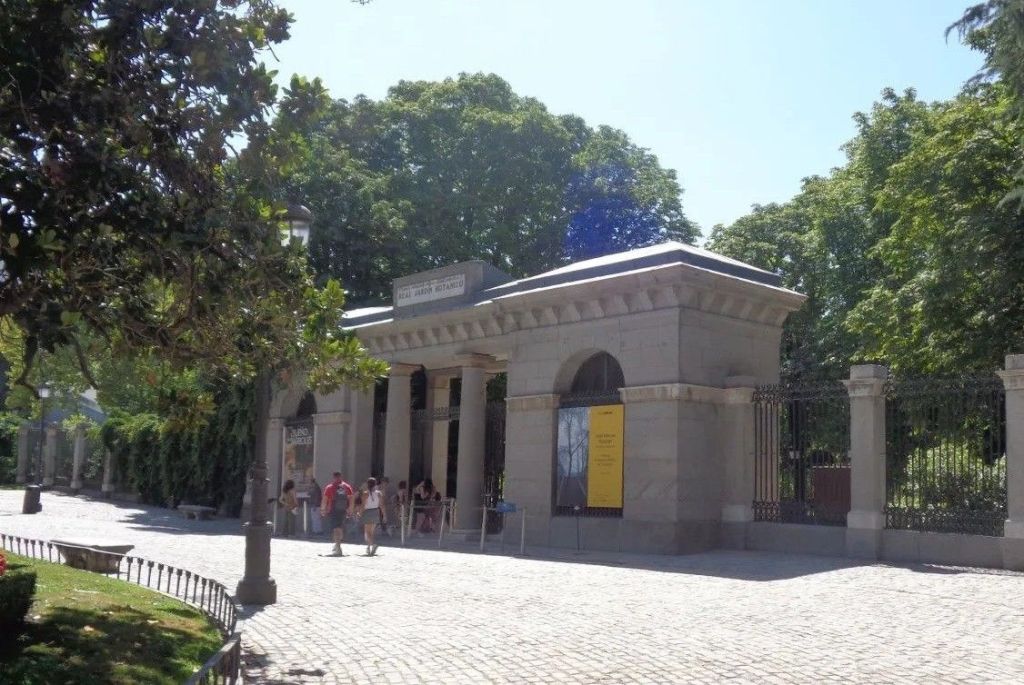
The Royal Botanical Garden of Madrid is a research center of the Higher Council of Scientific Research. Founded by royal decree on October 17, 1755 in Madrid by King Fernando VI, at Migas Calientes, it was then ordered by King Carlos III at its current location, This garden hosts, on three terraces, plants from Europe, but also from America and the Pacific. It is surrounded by walls and vegetation, the tranquility of this 8-hectare setting is appreciable in a heaven of peace. With more than 5,000 different species of plants spread over a 4-level terrace, the Royal Botanical Garden of Madrid is a pleasant green lung, located right next to the Prado Museum.
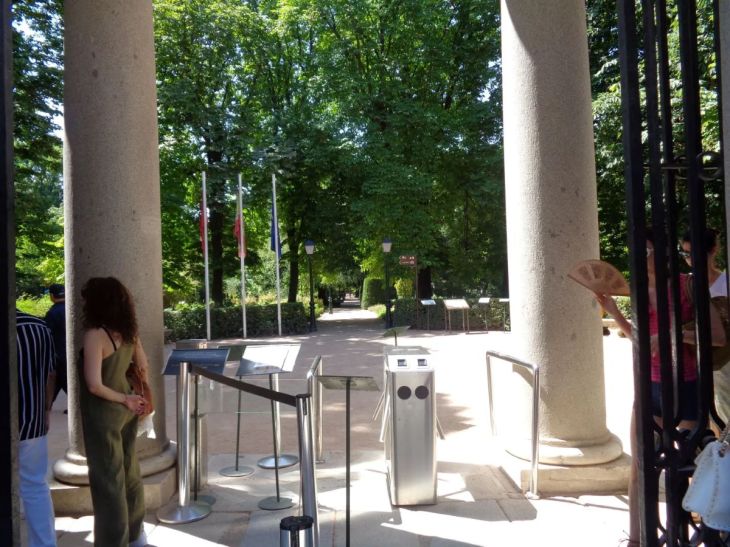
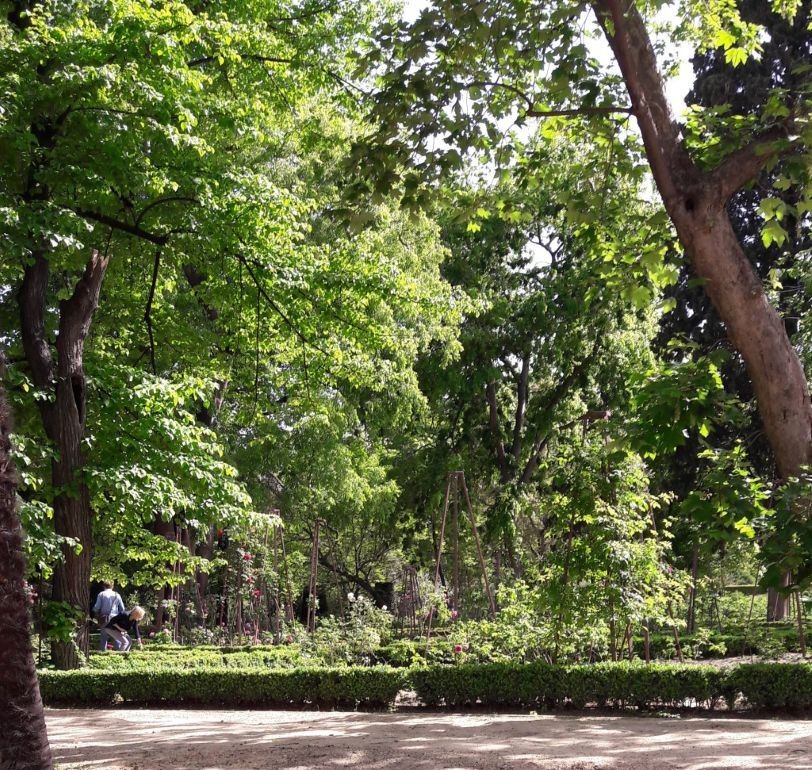
The garden has four staggered terraces on which the different species are distributed. In the upper area, located next to the pavilion hosting the temporary exhibitions, you will find special collections such as the bonsais donated by Felipe González. (former prime minister of Spain), The second terrace, in a romantic style, is made up of a pond and two greenhouses, while the next offers a collection of plants to trace the history and evolution of plants. At the very bottom, you will find the most alive and ornate plants, in addition to medicinal, aromatic and fruit plants. The before mentioned terraces are: Terraza de los Cuadros (or portraits) is the terrace located below and the most spacious of all. It includes the collections of ornamental plants, medicinal, antique rose, aromatic and orchard and fruit trees, within the geometric tables formed with hedges of boxwood that surround small sources (fontanels) in the central axis of the tables. At the end of the central promenade of this first terrace you will find the coral rock spot. Terraza de las Escuelas Botanicas ( botanical schools) ;this second terrace is a little smaller than the previous one. This terrace shows the taxonomic collection of plants. Ordered phylogenetically by families, around twelve sources are located. You can take a tour of the plant kingdom from the most primitive plants to the most evolved. Terraza del Plano de la Flor (map of the flower) this is the highest terrace and a little more reduced, with a romantic style. It is divided into twenty-five figures or bedding curvilinear, limited by hedges of Durillo, four roundabouts and a central roundabout with a pond and a bust of Carlos Linnaeus. On the north flank of this terrace are the greenhouse Graells, a structure of the 19C, where we find tropical plants, aquatic and bryophytes. Next to the former is the largest and most modern greenhouse, the Exhibicion or exhibition, which is divided into three environments with different requirements of temperature and humidity (tropical, temperate and desert), and the Terraza Alta o de los Laureles (High Terrace or laurels) , this terrace added as an extension of the garden in 2005, is of much smaller dimensions than the previous ones and is behind the Villanueva pavilion. Destined to host special collections, here is the Bonsai collection donated by the Spanish former President Felipe González.
You find as well the most important herbarium in Spain, bringing together nearly a million spreads, some from the 18C. It is composed of: the Fanerogamia Herbarium, the Cryptogamia herbarium and the historical collections. The latter gather the plants collected in the scientific expeditions carried out during the 18C and 19C.
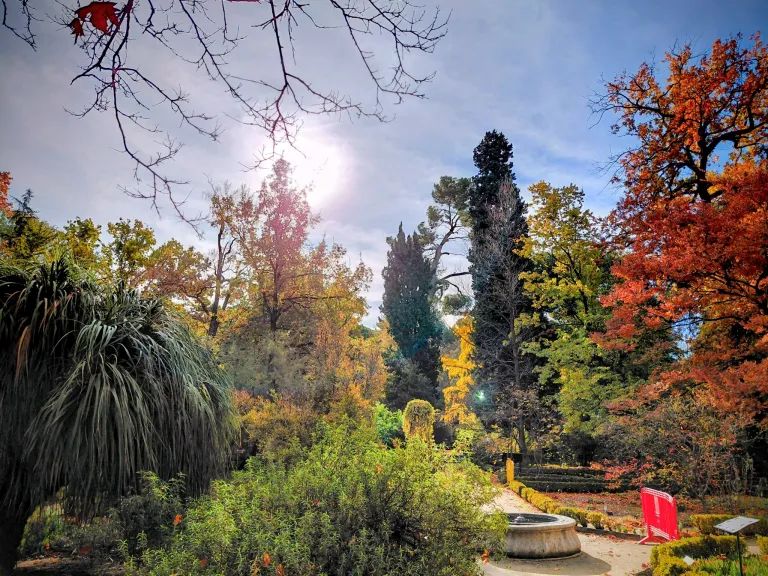
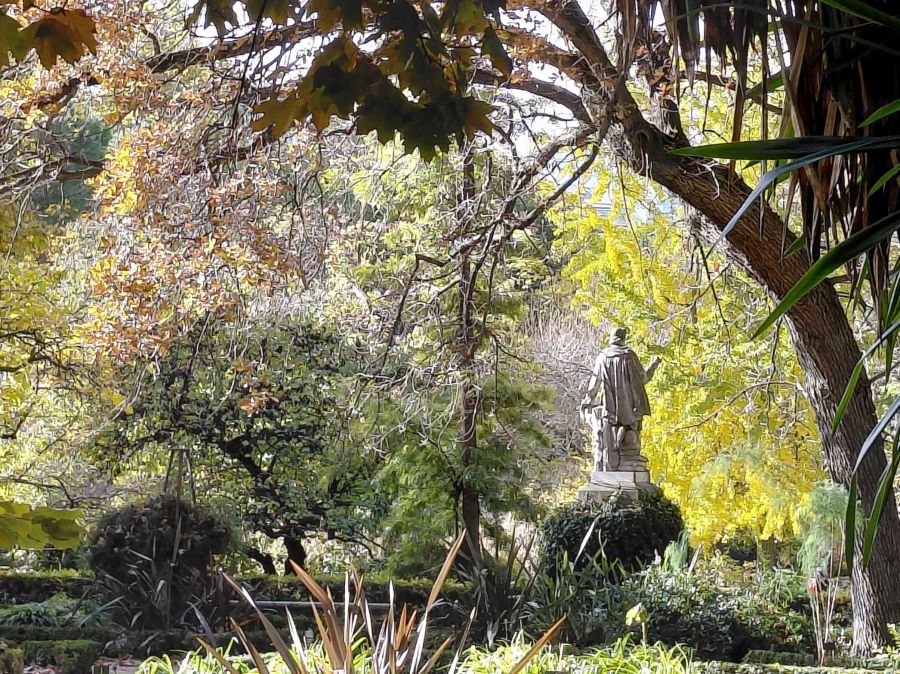
Specifically, to adorn the central plazas of each of the sections on the two lower terraces, these 29 identical small fountains were created, linked by intermediate walkways, which contribute to unifying the ensemble and emphasizing its geometric and rational structure. There is an interesting statue here of the scientist Antonio José Cavanilles y Palop stands on the Paseo Alto de Casimiro Gómez Ortega, within the Botanical Garden, established by Royal Order on July 25, 1774. The honoree was born in Valencia in 1745 and died in Madrid in 1804, having served as director of this institution for three years prior. It was in Paris that he discovered his passion for botany, while tutoring the children of the Duke of Infantado. This knowledge, combined with his experience managing the Botanical Garden, allowed him to make it a leading institution in Spain and Europe. His early death prevented him from completing his work, “Hortus Regius Matritensis,” which included the rich and varied botanical collection.
The Library of the Royal Botanical Garden was formed at the same time as the garden grew. In 1781 it had some 151 works of which 83 were of botany, 19 of Natural history and 49 of Chemistry. Currently at last count, the library consists of some 30 000 books of everything related to botany, 2075 titles of periodic publications, some 26 000 leaflets or separate chucks , 3000 titles in microfiche, 2500 maps. It has facilities and equipment suitable for Internet consultation, reading and reproduction, on paper, microfiche and microfilm, photocopying of books and magazines and scanning zenith.
The Germplasm Bank since its foundation, the Royal Botanical Garden maintains a seed exchange with other institutions around the world. The relationship of the seeds that can be exchanged is published annually in a publication called Index Seminum, which is distributed to more than 500 gardens and research centers. From 1987, with the construction of a refrigeration chamber where they can be stored at low temperature, dried and hermetically sealed, the conditions of conservation of the seeds were improved. This improvement allowed to extend the viability period of the seeds, so it was decided to carry out collection campaigns throughout the state.
During spring and summer nights, the Royal Botanical Garden opens its doors to offer a unique experience in Madrid. The Musical Walks of the Royal Botanical Garden combine the beauty of nature with classical music, creating a magical atmosphere thanks to a selection of musicians from the prestigious Reina Sofía School of Music. You will be able to enjoy different musical stops and listen to works inspired by nature from the 17-18-19C, which will take you on a magical journey through time.
A bit of history I like tell us that it was founded by Royal Order of 17 October 1755 by King Fernando VI in the spot of Soto de Migas Calientes, near the Manzanares River, king Carlos III ordered the transfer to his current situation in 1781,at Paseo del Prado, next to the Museum of Natural Sciences that was being built (current Prado Museum). King Felipe II created the botanical garden at the behest of the Doctor Andrés Laguna, next to the Royal Palace of Aranjuez. Later, king Fernando VI installed in 1755 by the orchard of Migas Calientes (currently Iron gate=Puerta del Hierro, on the banks of the Manzanares river) creating the Royal Botanical Garden. The continuous extension of the garden led king Carlos III to give instructions in 1774 to move it to its current location in the Paseo del Prado , within the program of management of the Prado and Atocha construction.
That between 1774 and 1781 year of the inauguration with a distribution in three levels, and part of the enclosure, which highlights the Royal gate (Paseo del Prado). On this basis, between 1785 and 1789 a second and definitive project was carried out, more rational and according to the scientific and educational function that the garden should have. It occupied an area of 10 hectares distributed in three terraced levels that adapted to the orography of the terrain, arranged in the form of Square barracks, following an octagonal layout and topped in the corners with circular fountains. The two lower ones Terraza de los Cuadros and Terraza de las Escuelas Botanicas remain today as they were built, while the superior one Terraza del Plano de la Flor was remodeled in the 19C with landscaped features. The enclosure was closed by an elegant iron gate, seated on granite stone and had two access doors: the aforementioned Real Puerta de Sabatini, Classic style with doric columns and pediment, and another secondary, In front of the Prado Museum, which currently accesses the enclosure ,current Plaza de Murillo.
The garden became the recipient of the recipient of the scientific expeditions that sponsored the Crown in this period. Between the 18C and 19C it participated in the development of at least five scientific expeditions, including the Royal Botanical Expedition of the New Kingdom of Granada (present-day Colombia), the botanical expedition to the Viceroyalty of Peru, the Royal Botanical Expedition to New Spain (present-day Mexico), the expedition around the world, and the Scientific commission of the Pacific now Philippines . It contains approximately 5,000 different species of trees and plants around the world. In 1857, important reforms were carried out that still persist, such as the cold stove that bears its name and the renovation of the upper terrace. Also at that time a zoo was installed, which twelve years later moved to the Retiro park (where it would be known as a zoo Casa de Fieras) in 1893, opens the calle de los libreros (street of booksellers and popularly known as Cuesta de Claudio Moyano) and cutting one end of the main body of the garden, so its surface is reduced to the current eight hectares.
The official Royal Botanical Garden of Madrid: https://rjb.csic.es/
The Madrid tourist office on the Royal Botanical Garden: https://www.esmadrid.com/en/tourist-information/royal-botanic-gardens
The Superior Council of Scientific Investigation on the Royal Botanical Garden of Madrid: https://www.csic.es/es/el-csic/organizacion/institutos-centros-y-unidades/real-jardin-botanico
The Digital Library of the Royal Botanical garden of Madrid: https://bibdigital.rjb.csic.es/en/
There you go folks, a space of tranquility in a chic area of the museums golden triangle. Family memories forever here. Again, hope you enjoy this post on the Real Jardin Botànico of Madrid !!! as I.
And remember, happy travels, good health, and many cheers to all !!!


