
A big task considering was a beautiful city now mostly in ruins unless Unesco has provided some funds, This is my native capital City, the city where I spent a great part of my very early life until 10 years old, For family or business was lucky to visit it in 1984, 1998, and 2012 , This City is Havana or La Habana or the full name San Cristobal de La Habana, the capital of the Republic of Cuba.
I left it in 1970, and hardly any sight pictures, the current pics in this post are from this last trip in 2012. It was the ultimate Caribbean destination, the “Paris of the Americas” (Hemingway ), the “key to the gulf (of Mexico) the bulkward of the West Indies” (Caribbean ; King Philip II of Spain), to the whole of Cuba. It was once the “Pearl of the Antilles”, the most chic city of Latin America until the revolution destroyed everything; streets names were changed, city names were change, province names were change, people left in hordes (over 2M), and more poverty than ever sets in all under the betraying revolution still there sadly. We had not much time to see the sights in 2012 ,so I took a ride by car on the Malecon, the wonderful spot in Havana where at one time or another we all meet. Lots old history ,and sad stories of my Cuba. The next day I asked my assigned driver to take me to my native town of Punta Brava, (see post) just in the city of La Habana, visiting family aunt and cousins (which by now all left Cuba ! ).
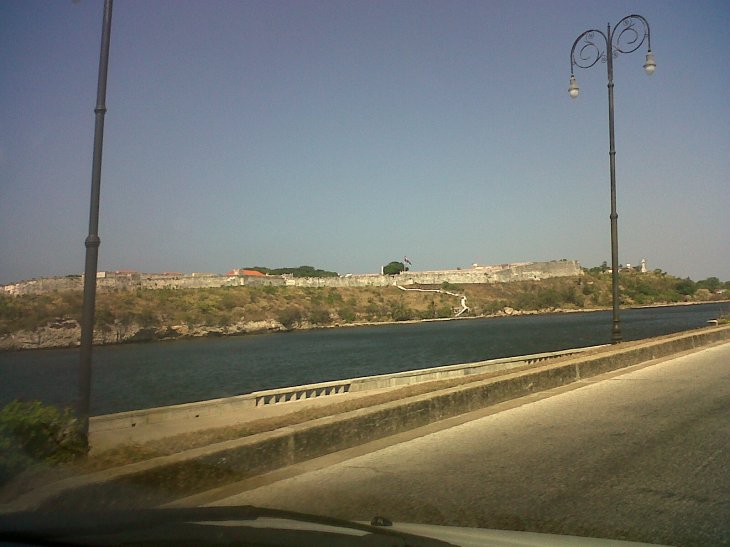
Well enough of my old rant, and let me tell you about the Malecon of my Havana!
The Malecón “the pier” is an 8 km long beachfront promenade located in Havana. Officially called Avenida Maceo, it is made up of a wide causeway and a dyke erected on the rocky barrier beach. This winding waterfront begins at the entrance to Havana Bay in Old Havana, runs along the north side of Centro Habana and ends at the mouth of the Almendares river in the Vedado district towards the west.
The first stretch of the Malecón was built from 1901 to 1902 under the temporary military government of the United States. With a length of only 500 meters, it then extended from the San Salvador de la Punta fortress in the east to Calle Crespo in the west. The American architect Mead and the Frenchman Jean Forestier developed a better plan to deal with the wind and the sea. In 1902 they finished the music place in front of the Prado. At the old Habana Vieja they built hotels and cafe’s, this all while the beach facilities had been concentrated at Miramar. In 1919 the Malecon already reached till Calle Belascoaín, and in 1921 till Calle 23. From 1902 to 1921, it was extended to the monument to the victims of the USS Maine across from Calle O and 19. Finally, from 1948 to 1952, the last section was built to the mouth of the Almendares River.
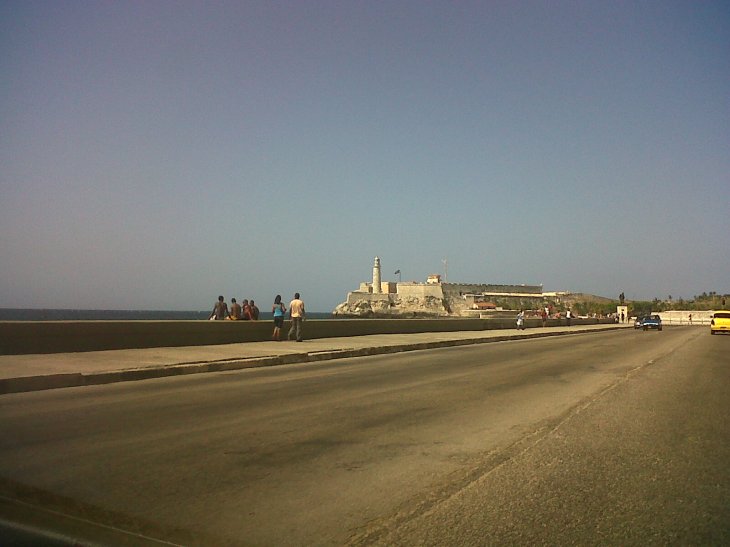
Originally, the Malecón was mainly intended to protect Havana against waves and winds from the North, the so called los Nortes (also cold weather). But it also served, and still serves, as a night walk for the locals and a place for recreational fishing. From east to west, we find on the Malecón. In addition to many private houses typical of the years 1930 to 1950, a succession of places and monuments, recent or old, worthy of interest such as the Castillo San Salvador de la Punta which faces at the Castillo de los Tres Reyes Magos del Morro (see posts). These two fortresses protected the port access bottleneck with their cannon batteries. The west end is at the Torreón de Santa Dorotea de la Luna de la Chorrera,(La Chorrera for short) a small fortress built in 1762 to defend the mouth of the Rio Almendares. Beyond the Castillo de San Salvador de la Punta and up to the Castillo de la Real Fuerza, that is to say on the side of Habana Vieja (Old Havana section), you can land along the shore in one of the parks. You, then pass on the side of the Canal de Entrada, with much less wind and a calmer sea. Just opposite, you can admire the Fort El Morro as well as the large statue of El Cristo de la Habana.
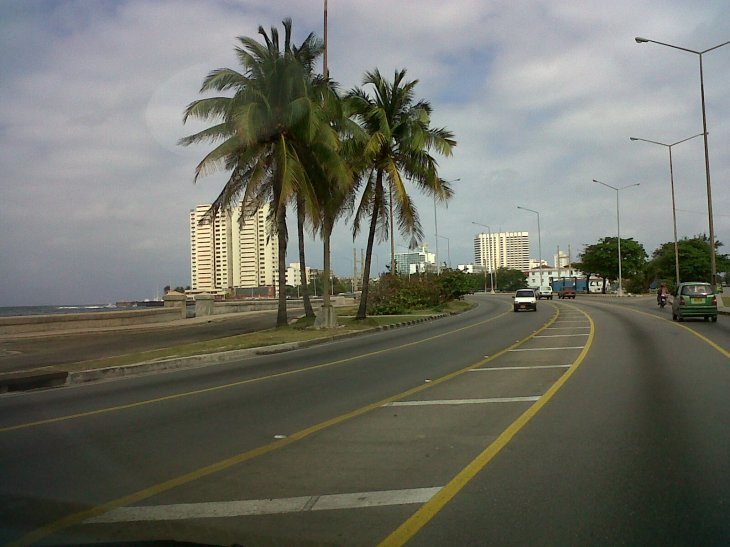
The park and the equestrian statue (made by the Italian Boni), of Major General Antonio Maceo, (José Antonio de la Caridad Maceo y Grajales), the “Bronze Titan”, hero of the independence of Cuba,see the Torreón de San Lázaro, a watchtower built by the Spaniards in the 18C, near the Hotel Nacional is the park and monument to the victims of the battleship USS Maine. A few hundred meters to the west is the equestrian statue of 1959 , which pays homage to one of Cuba’s great independence strategists General Calixto Garcia. Further still is the José Martí Sports Park among a succession of sports and leisure facilities spread out along the Malecón . The waterfront is then lined with stately 18C and 19C houses, followed by a row of 20C buildings, with their unusual combination of styles and profusion of portals, columns and pilasters that follow classical lines. On the final stretch of the Malecon , bold examples of 1950s modern architecture, such as the Riviera Hotel, emerge before the road disappears into a tunnel leading to the Miramar neighborhood. For example the Kariatide building; one of the most important buildings in the beginning of the Malecon, build in the 20C recently renewed and named by the women figures in Art-Deco Style under the veranda. The old buildings that line the Malecón today have been restored to their former glory after years of neglect.
Along this promenade, you’ll see tourists and locals grabbing lunch at the local cafes, cruising in classic cars, strolling along the waterfront, or catching fresh seafood for dinner. This bustling sidewalk is lined with some of the best places to eat in Havana. You can also find several family-owned restaurants, ice cream shops, and historical landmarks on the Malecon as above. Three major cocktails have been named after this promenade. One of the first printed documents detailing the Malecon cocktail was published in Bartender’s Manual by John Escalante in 1915. The ingredients included vermouth, cognac, Angostura bitters, sugar syrup, and a strawberry garnish. Another cocktail named after the Malecon was developed in the United States and featured in Crosby Gaige’s Cocktail Guide and Ladies’ Companion. For this version, the ingredients included white rum, dry gin, apricot brandy, and Swedish Punsch. In 2007, yet another Malecon cocktail was developed in London at the Connaught Bar. After bartender Eric Lorincz visited Havana, he was inspired to create this drink, which included port, sherry, rum, caster sugar, Peychaud Bitters, and lime juice. There you go a drink to you, Cheers!
There you go folks, a bit long but a real postcard on my Malecon of Havana, Many faded memories now, but the real Havana of old always in my heart. Again, hope you enjoy the post as I.
And remember, happy travels, good health, and many cheers to all !!!

 Paris1972-Versailles2003
I’ve been there too, and it’s such a shame to see these beautiful mansions on the Malecon facing the sea deteriorating without maintenance, to the point where the floors are collapsing.
LikeLiked by 1 person
Yes thanks to the darn revolution
LikeLiked by 1 person