
In my nostalgic saga of my family visits to wonderful places in my belle France, we found one sublime City, Take your time to visit Rouen, it is sublime to say the least and of course , a must to visit, The gorgeous city in the Seine-Maritime dept 76 of the region of Normandie. We have come here often many times, and glad to finally be back again, this time from the Morbihan breton ! . I have walked the beat this time with my sons and our dog Rex and found many treasures not seen before, as if never ending sights in the city of many wonderful memories with family; memories forever, I found me a new picture in my cd rom vault that rather than do another post will include here for you and me. Therefore, I like to tell you more of the other churches of Rouen, part I !!! Hope you enjoy the post as I.
Already at the beginning of the 6C, i.e. at the time of Clovis, king of the Franks, there was a small church here. It was dedicated to the Virgin Mary and was located outside the Gallo-Roman walls which were further south, the little rue des Fossés Louis VIII still retains the memory of it today. In 522 it was there that the Archbishop of Rouen Godard, Gilardus in Latin, was buried. Son of a noble franc, Godard was the first holder of the see of Rouen not to be of Gallo-Roman origin. If we know very little about his life, we do know that he took part in the Council of Orleans in 511. More than 30 bishops of now Frankish Gaul then met at the initiative of Clovis, who was described as “son of the Holy Church”.
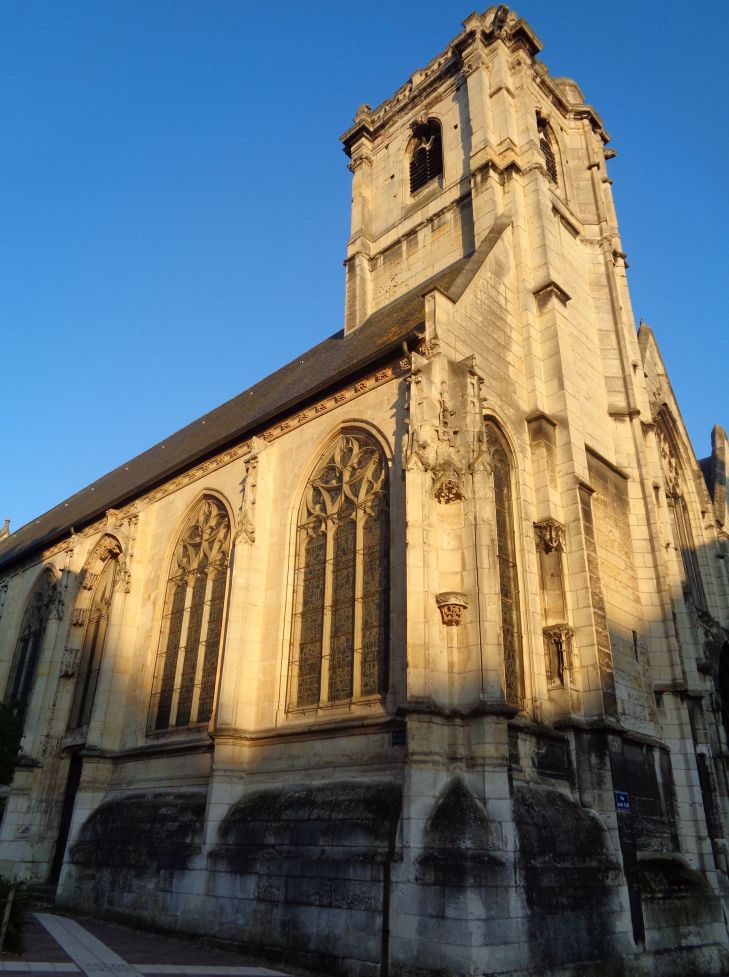
In the following century, in 644, another archbishop was buried here, Saint Roman, who in turn became the patron of the city. But about two centuries later, the Carolingian emperor Charles the Bald had the relics of Saint Godard transferred to Soissons and perhaps also some of those of Saint Romain. What remained in Rouen of the latter was at an uncertain date deposited at the cathedral and no longer at Saint-Godard Church. Of the churches which succeeded one another here, we know almost nothing before the end of the 15C. At most, we know that in 1122 the Duke of Normandy and King of England Henry II Plantagenet included this entire area within the perimeter of their new enclosure and that in 1248 a fire destroyed the church. But it was in the second half of the 15C, after the Hundred Years War, that a new reconstruction was undertaken which brought us the church we know today.
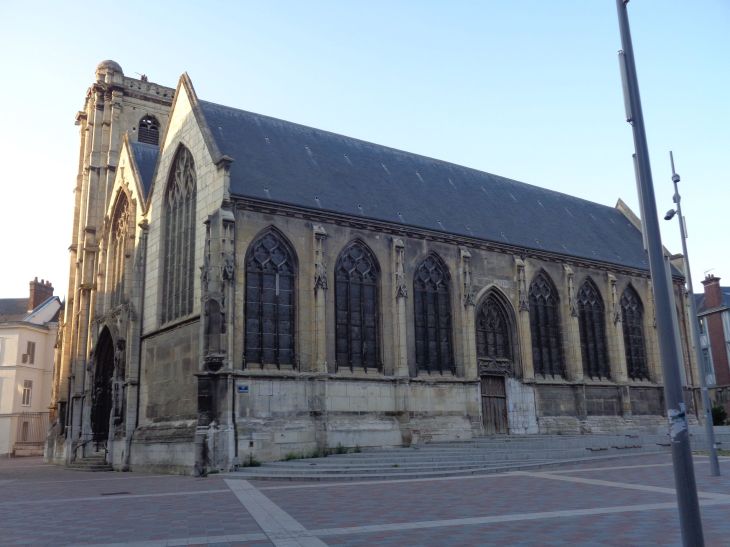
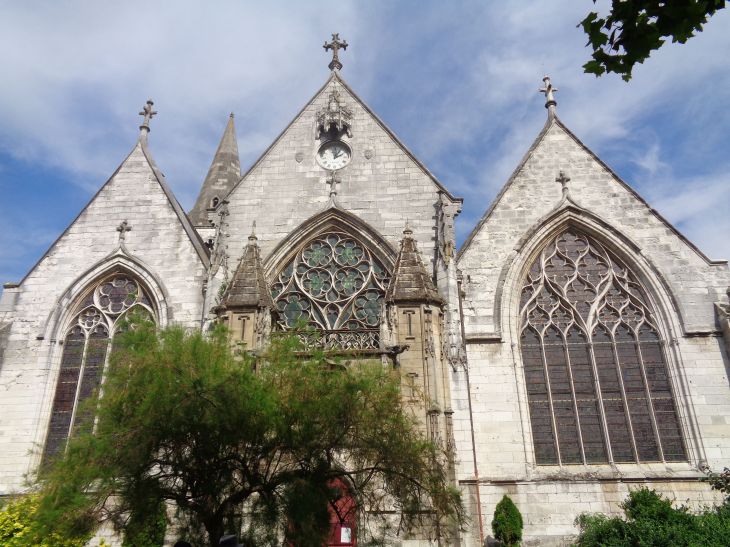
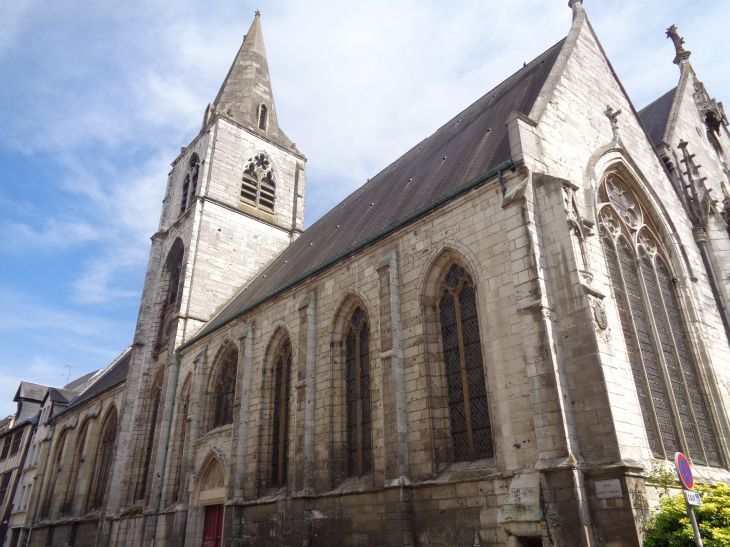
The facade with its three gables and its main portal was visible from the street from the outset, but the sides were completely cleared, no house leaning on them. To the north, Place Saint-Godard with a side door, to the south, another entrance which has preserved carved door leaves from the 15C with the coat of arms of the seneschal of Normandy and captain of the castle, Louis de Brézé, whose tomb is at the cathedral in the chapel of the Virgin. There was the parish cemetery, an open space between Saint-Godard and Saint-Laurent, the current Le Secq des Tournelles museum (see post). To the east, while the north and south naves end in a gable wall, the center one ends in a three-sided chevet, overlooking the street.
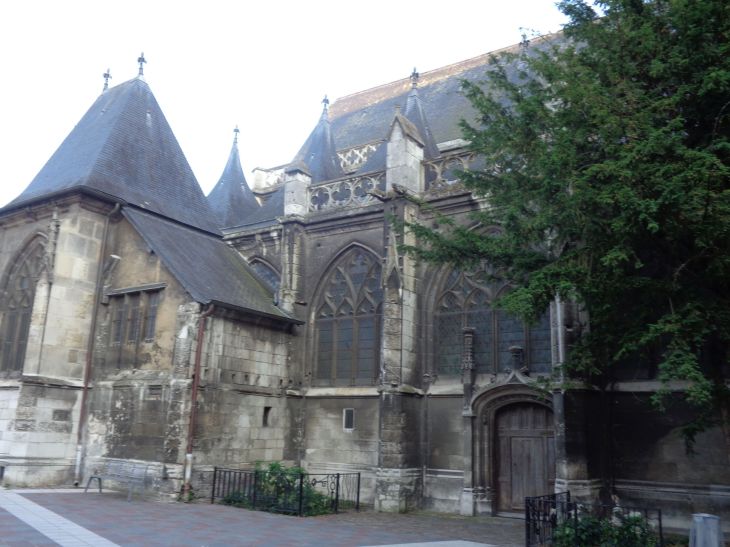
The archives do not allow us to date the beginning of the reconstruction, probably towards the end of the 15C, probably starting with the crypt. The French revolutionary persecution of Catholicism means the closure of all remaining churches. Saint-Godard Church is stripped of its furniture and also of part of its stained glass windows. When worship resumed there in 1806, it was with few resources, but the size of the building prompted it to be reused in preference to Saint-Laurent. It was not until 1829 that Saint-Godard Church became a parish again, which it remained until the regrouping at the end of the 20C. Soon after, the church, which no longer interested anyone except the organists, was deconsecrated and became an annex of the Museum of the Library,
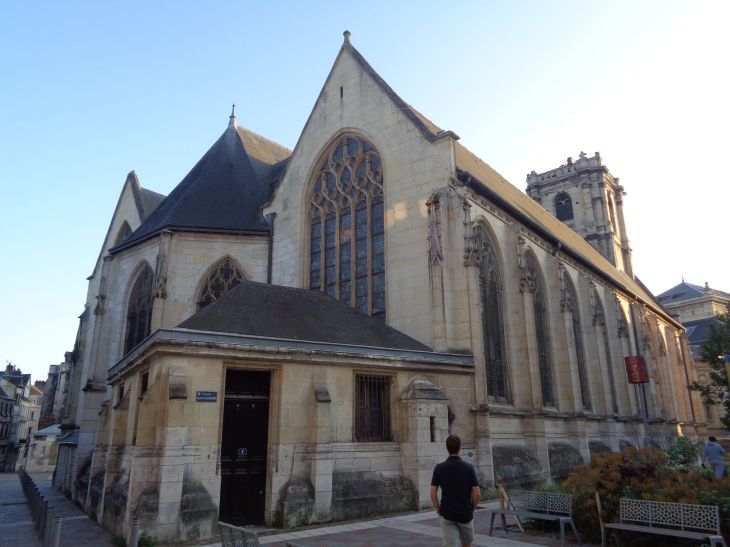
The Saint Vivien Church dates from the 14C. It is the only church in Normandy to bear the name of Saint Vivien, whose relics were brought to Rouen in 1459, The area was a flourishing cloth-making district, it expanded in the middle of the 15C, It is a church without transept, it has three naves which were built successively. It is cited in a text from the time of William the Conqueror. Later, it was rebuilt and consecrated in 1358. On the north facade, you can admire a clock, older than the “Gros Horloge”, whose motto is “the last hour is hidden”. Continue your way and you will find on the corner the trace of the old tower. In the 16C, the naves were extended and a new nave was built to the south. In 1636, the central nave was raised, following the construction of a tenement house along the walls of the church. It then takes on its current appearance. The extension of rue Armand-Carrel in 1880 destroyed the houses located around the church and cleared a square. Today, one can notice on the north wall of the church along rue Saint-Vivien, looking towards the Croix de Pierre district, the remains of the Saint-Vivien fountain as well as a tower, which allowed to collect abandoned babies. You now arrive on the square to admire the west facade and its porch decorated with pinnacles and gargoyles. On the south facade, on the side of the square, you can discover a beautiful alley which leads to the sacristy on which you can see a sundial.
The City of Rouen on its historical archives : https://rouen.fr/archives-municipales
The Rouen tourist office on its history/heritage: https://en.visiterouen.com/heritages/history/
The Seine Maritime dept 76 tourist office on Rouen: https://www.seine-maritime-tourisme.com/en/destination/city-break/rouen/
The Normandie region tourist office on Rouen: https://en.normandie-tourisme.fr/unmissable-sites/rouen/
There you go folks, a wonderful display of architecture and history on these wonderful monument of a great Rouen, worth the detour me think, the other places to see in wonderful Rouen. Again, hope you enjoy the post on the other churches of Rouen, part I !!! as I.
And remember, happy travels, good health, and many cheers to all !!!

 Paris1972-Versailles2003