
Once again, coming back at you with another off the beaten path gem of my belle France. These are again road warrior passing of me in my loving south , always with great architecture and history to boot. Therefore, here is my take on the curiosities of the Dordogne, part I !!! Hope you enjoy the post as I.
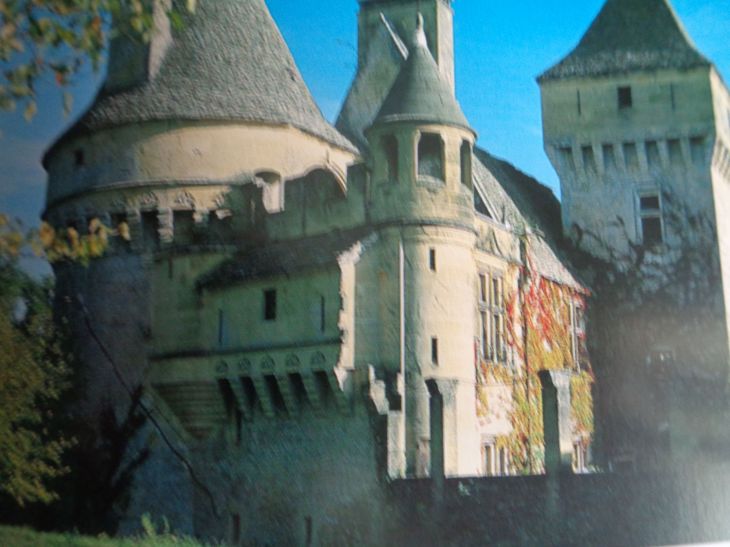
The Château Fayrac is from the 15-16C and 19C built on the banks of the Dordogne river, in the town of Castelnaud-la-Chapelle, In the 14C, the castle belonged to the lords of Castelnaud, the Caumont family. It was then called the “Fayrac towers”. During the Hundred Years War, the Fayrac towers served as a watchtower for the Château de Castelnaud which stood for the King of England, opposite the Château de Beynac which supported the King of France. An entrance gatehouse with a drawbridge giving access to the inner courtyard dates from the 15C. In 1789, the castle was owned by a collateral branch, some of whose members had emigrated. The castle was then seized as national property and sold. The castle was then the property of the composer Fernand Fouant de la Tombelle, one of the founders of the Schola Cantorum, who extensively restored it. André Malraux lived for a few weeks at the castle when he joined the Resistance following the arrest of his brothers, after March 1944. It is not accessible to the public, but you can nevertheless admire it from afar while walking around.

The town of Castelnaud la Chapelle on its heritage (not above as private) :http://castelnaudlachapelle.fr/tourisme/
The town of Jumilhac-le-Grand has a castle built from the 13C to the 17C now private property,but open to visitors, The castle, under permanent restoration by its owner, has belonged to the Chapelle de Jumilhac since the 16C and now to their direct descendants: the La Tour du Pin. Its park is laid out as a French garden. During the French revolution, the estate was placed under sequestration, following the emigration of Antoine Pierre Joseph Chapelle de Jumilhac. The castle was then occupied by the town. In 1862, the castle was sold by its heirs in 1917, The castle was then divided into several dwellings and its outbuildings into several shops. In 1927, it was bought by Raymond Odet Chapelle de Jumilhac and his wife, who undertook the restoration and in whose descent are still there.

The town of Jumilhac le Grand on the castle :https://jumilhac-le-grand.fr/fr/rb/828570/monuments-et-lieux-a-visiter
The town of Les Eyzies-de-Tayac-Sireuil is a former town which on January 1, 2019, it was integrated into the new town of Les Eyzies, The Château de Laussel, is a typical Périgord haunt, former residence of the Commarques, Renaissance style, has been extensively restored. Thus the history of Laussel merges with that of the Château de Commarque. The two castles were both abandoned at the same time, in the 18C. Laussel dates from the 15-16C,with machicolated towers, a square keep, a 17C chapel and a walkway placed on stone corbels with six steps, make it a whole, which a skilful restoration undertaken, Reported in ruins from 1738, the castle was completely restored at the beginning of the 20C. Private property of a family, it includes a troglodyte dovecote, hanging gardens, a chapel, a prehistoric shelter.
The town of Les Eyzies on its heritage :https://www.leseyzies.fr/decouvrir-les-eyzies/
The town of Loupiac gave its name to the AOC loupiac (sweet wine), One of the greatest “sweet wines of the Right Bank” in Bordeaux , History has it that it was while tasting a 1929 vintage of Château de Ricaud Loupiac in a great Parisian restaurant that Alain Thiénot fell under the spell of this wine: a gustatory thunderbolt that made him owner of the estate. Since 2007, it has relied on the expertise of the Dourthe teams, who manage this 66-hectare vineyard today mainly planted with red vines, The town of Loupiac is located in the Bordeaux attraction area on the right bank. from the Garonne river, 37 km from Bordeaux, 11 km from Langon, and 2.5 km from Cadillac, Out of sight, on a hillside in Haut Loupiac, nestles the magical château de Ricaud. This 15C castle passed through the hands of multiple families according to historical alliances. It is then a real reconstruction in a neo-Gothic style. The result is a fairy tale: strange gargoyles, slender turrets, crenellations offer a most suggestive atmosphere, in this park with 300-year-old trees. It was between 1882 and 1910 that a vineyard of nearly 20 hectares was built. Bought in 1980, Château Ricaud is part of a vast restructuring plan. The castle is not open to visitors.

The town of Loupiac on its heritage : http://www.commune-loupiac33.fr/Presentation
The Château de Roquetaillade is located on the territory of the town of Mazères, This castle which appears in history in the 12C is split in the 14C by the construction of a new castle restored between 1864 and 1878, Today, Roquetaillade is made up of two castles within the same enclosure: the “old castle” whose stone remains date back to the 10C; the “new castle” which dates from the beginning of the 14C. Built at the request of Gaillard de La Motte, nephew of Pope Clement, it was fitted out twice, notably in the 19C by Viollet-le-Duc, who undertook numerous decorations there. It is inhabited by the same family since 1306 !! While Roquetaillade has never been sold and has always been transmitted by inheritance, the family name has changed three times since its origins , In 1864, their son, the Marquis Lodoïs de Mauvesin and his wife Geneviève, born in Galard-Béarn, inherited Roquetaillade. They were the ones who carried out the major interior fittings carried out by Viollet-le-Duc. Having lost their only child, the Mauvesins passed on Roquetaillade to their cousin Hippolyte de Baritault, whose family still maintains the château today, At Roquetaillade Castle there has been the setting for several films, including Fantômas contre Scotland Yard with Jean Marais, Mylène Demongeot and Louis de Funès !!, The Pacte des loups or pact of the wolves with Vincent Cassel, Doctor Popaul with Jean-Paul Belmondo, The Seducers with Roger Moore. It is also seen in certain series such as La Poupée sanglante or the bloody doll by Marcel Cravenne (1976) after Gaston Leroux: it is the castle of the Marquis de Coutleray, which is in Vendée in the plot. The Highlander series also makes a detour to Roquetaillade. Indeed.

The official Château Roquetaillade: https://www.roquetaillade.eu/
There you go folks, again, another gem and an off the beaten path sites of my belle France ! This is in wonderful 3 departements (provinces/states) of the south which we love to go so much and so many old pictures that I am glad putting in my blog, Great architecture and history as always, Again, hope you enjoy the post on the Curiosities of the Dordogne, part I as I
And remember, happy travels, good health, and many cheers to all !!!

 Paris1972-Versailles2003