
I like to redo update these wonderful monuments in lovely Chinon, Let me tell you about the Saint Radegonde chapel of Chinon. The chapel is a marvel of architecture , history and know them is plenty for this road warrior traveler. Chinon is located in the Indre-et-Loire department, 37 in the Centre-Val de Loire region. 47 km from Tours, 30 km from Saumur, 80 km from Angers, 85 km from Poitiers, and 305 km from Paris, Also about 314 km (about 195 miles) from my house. We like to go on the D751 linked to Tours, which partly bypasses the city.
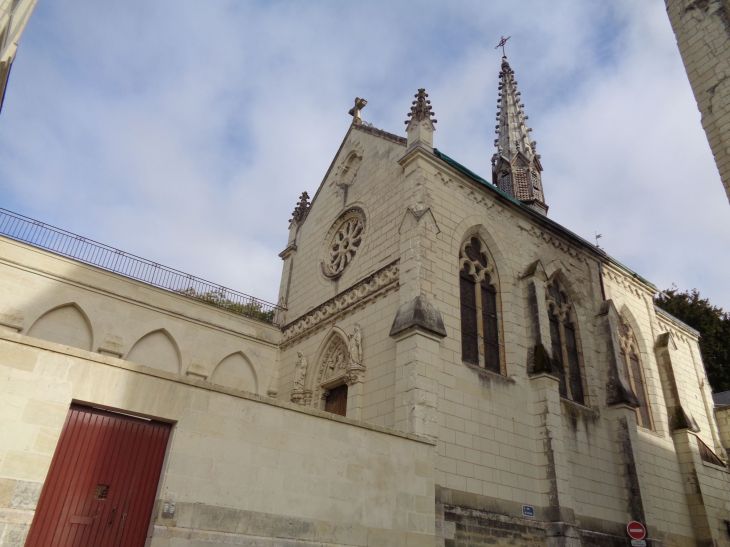
There are so many monuments in Chinon, and of course, plenty of churches; I will pick some as my historically incline favorites. Let me tell you a bit about them, and hope you enjoy the tour. We took a ride by car as hilly roads and my Dad Elio on wheelchair would have been difficult if impossible. We stop each time we reach a church !
The Sainte-Radegonde chapel is a former oratory converted into a chapel on the hillside of Sainte-Radegonde, east of the historic town center of Chinon, in the department of Indre-et-Loire no 37 in the Centre-Val de Loire region of my belle France. The chapel owes its name to Radegonde de Poitiers, who is said to have met the hermit Jean Reclus there on several occasions. The chapel, disused, was sold as national property during the French revolution.
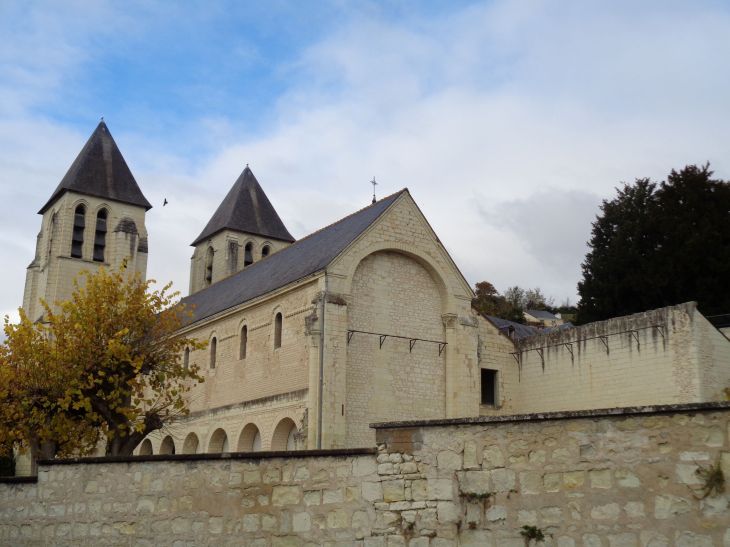
The Sainte Radegonde chapel is served by rue du Pitoche and rue du Coteau de Sainte-Radegonde, which rise gradually eastward up the hillside from the collegiate church of Saint-Mexme (see post) , just over 600 meters away from the chapel. According to the tradition reported by Gregory of Tours, the site was indeed Christianized in the 6C, perhaps around 530, when John the Recluse, a hermit from the British Isles also called the priest John, came to settle in a cave after having frequented the religious of Saint-Mexme for a time. The hermit John acquires, according to the chronicles, a great reputation for wisdom; he was even consulted by Saint Radegonde who stopped in Chinon to visit him on several occasions, notably when she went to Poitiers to found the abbey of Sainte-Croix de Poitiers (see post) which explains the dedication of the chapel. Tradition reports that the oratory became, upon John’s death, a place of burial for other hermits who followed his example and retired to the same place. Among the burials found in the floor of the southern nave, those which could be dated with certainty, however, date back to the end of the Middle Ages and are characterized by the presence of cephalic cells intended to hold the head of the deceased, an arrangement which was developing at that time.
Sainte-Radegonde chapel takes its modern configuration in the 11-12C. A nave is dug directly into the rock, and consolidated by two monolithic columns when its vault is raised ,perhaps at the end of the 12C or the beginning of the 13C, its vault partially collapses and the building is no longer able to accommodate the many faithful and pilgrims. A second nave was then built, covered with a frame and a single-pitched roof, which disappeared during the revolutionary period: this space has since been transformed into garden ; a medieval colonnade and a modern grille separate it from the troglodyte nave, The chapel was looted in 1563 during the religious wars, the graves were desecrated and the relics of Saint John destroyed; Twenty years later, it was used as accommodation for caregivers and families of patients with an epidemic of plague or typhoid fever which was then raging in Touraine. It was restored in the 17C: around 1643, during the time of Canon Louis Breton who lived in the presbytery, a troglodyte built near the chapel, a new altar was inaugurated in the southern apse and a new cycle of painting, telling the story of Sainte Radegonde and whose scenes are accompanied by a caption made on the walls and the vault ,
During the clearing, cleaning and repair work that was carried out from 1960, it was discovered in 1964 the painting of the chasse royale or royal hunt , hidden under several layers of whitewash in the 19C. After having been used as a dwelling in the same way as the adjoining caves and known to several successive owners, it has belonged to the town of Chinon since 1957. The museum of arts and popular traditions of Chinonais (see post) has been housed there since 1966. Today, the chapel is open to the public in summer and on the occasion of European Heritage Days.(see post).
The City of Chinon and its heritage : https://www.ville-chinon.com/loisirs/tourisme-et-patrimoine/decouvrir-ma-ville/patrimoine-a-decouvrir
The Touraine Loire Valley tourist office on the Chapel : https://www.touraineloirevalley.co.uk/cultural-heritage/sainte-radegonde-chapel-chinon/
There you go folks, the nice historical and architecture of the Sainte Radegonde chapel of Chinon. This is wonderful ,splendid Chinon, a must to visit me think. We will be back for more soon. Again, hope you enjoy the post as I. And remember, happy travels, good health, and many cheers to all !!!

 Paris1972-Versailles2003